Get Full Government Meeting Transcripts, Videos, & Alerts Forever!
Get email alerts on the Administrative Rules Regulatory Reduction topic
No spam. Unsubscribe anytime.
Senator questions Ohio Tuition Trust Authority over 'shall'‑to‑'will' edits, asks what was actually reduced
Summary
At a Joint Committee on Agency Rule Review hearing, Senator Brenner challenged the Ohio Tuition Trust Authority on whether changing language from "shall" to "will" met the statutory requirement to reduce regulations, and asked whether agencies used AI tools such as ChatGPT‑4 to rework rules.
Senator Brenner pressed the Ohio Tuition Trust Authority on Tuesday over whether edits that replace the word "shall" with "will" satisfy a state law intended to reduce administrative rules.
The question came during the Joint Committee on Agency Rule Review meeting when Senator Brenner asked representatives of the Ohio Tuition Trust Authority about item 25 on the agenda. "Changing the word from 'shall' to 'will' doesn't do anything to reduce anything," Brenner said. "What did you do to try to reduce the regulations inside your agency?"
The authority's legal counsel, Jeff Thogle, responded that the agency has reduced rules in other revisions and when creating new rules, but for the rules before the committee "we found that there wasn't anything to remove necessarily," and they replaced prohibitive words such as "shall" and "must" in the current set. Thogle identified himself as counsel for the Ohio Tuition Trust Authority.
Brenner continued, asking whether the agency had used generative AI tools during rule review. "Have you used ChatGPT‑4 or any kind of AI to go in and reduce it?" Brenner asked. A Trust Authority staff member said they had not used AI and offered to look into the suggestion.
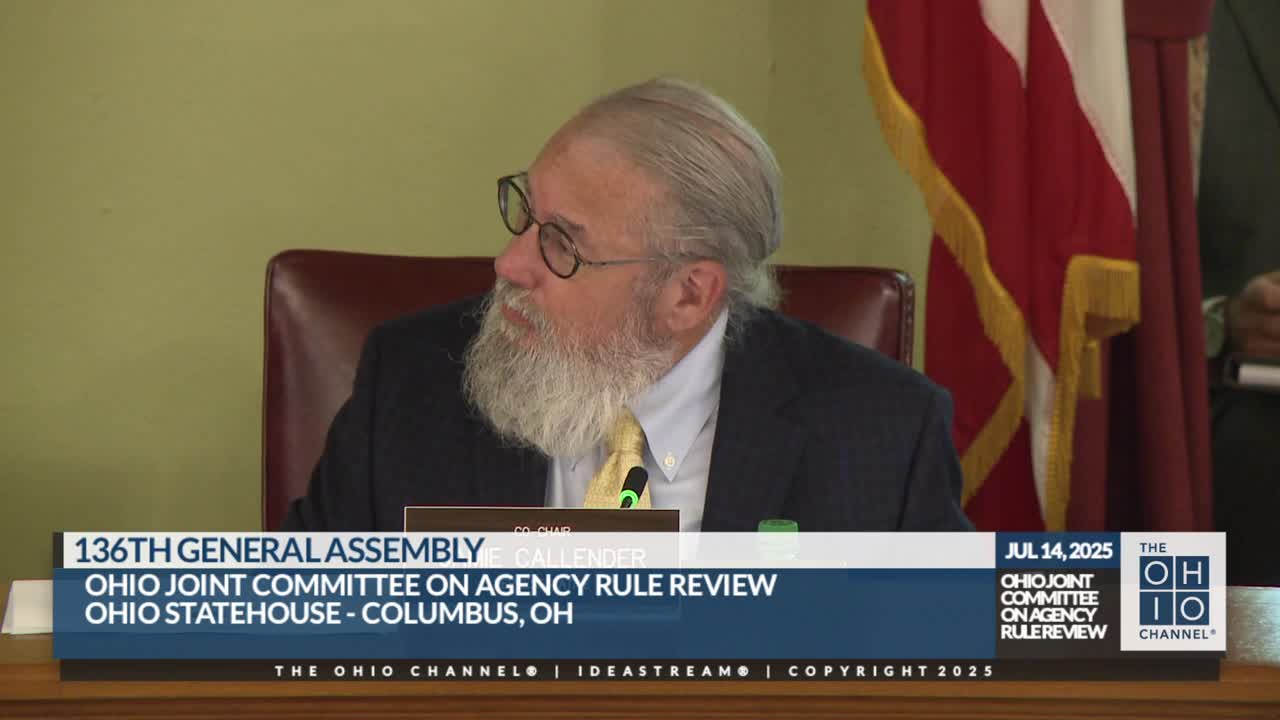
Brenner framed his critique as broader than one agency, saying many agencies have submitted similar word‑substitution edits and urged lawmakers to consider legislative clarification so that simple word changes would not be treated as regulatory reduction. "If you would like to draft some legislation to clarify that substituting words is not a reduction in words, we would certainly find cosponsorship on our side to carry that legislation concurrently," Representative Callender said during the same exchange.
No formal vote or rule adoption took place during the committee meeting on the item. The minutes from the June 25 meeting were accepted as written earlier in the session, and the committee proceeded through its regular and no‑change agendas without votes on the Ohio Tuition Trust Authority rules.
The discussion distinguished between several types of agency action: Senator Brenner labeled the agencies' edits as primarily wordsmithing; Thogle described prior, separate instances where the authority reduced rules; and staff offered to investigate additional methods, including the senator's AI suggestion.
The committee did not direct the Ohio Tuition Trust Authority to take a specific follow‑up action during the meeting. The chair noted the next meeting is tentatively scheduled for Aug. 14 at 1:30 p.m.
Background: Ohio law adopted in recent years requires agencies to reduce regulatory burden when creating new rules. Committee members said they remain concerned that simple wording substitutions do not meet the intent of that law and suggested legislative clarification may be necessary.