Get Full Government Meeting Transcripts, Videos, & Alerts Forever!
Get email alerts on the Prescription Drugs Exemption topic
No spam. Unsubscribe anytime.
Bill to exempt prescription drugs from Guam’s BPT wins broad pharmacy support, raises fiscal questions
Summary
Bill 101‑38, introduced by Senator Jesse A. Luhan, would expand the business privilege tax exemption list to include prescription drugs; pharmacy owners and clinicians urged passage while DRT and hospital officials raised implementation and fiscal concerns.
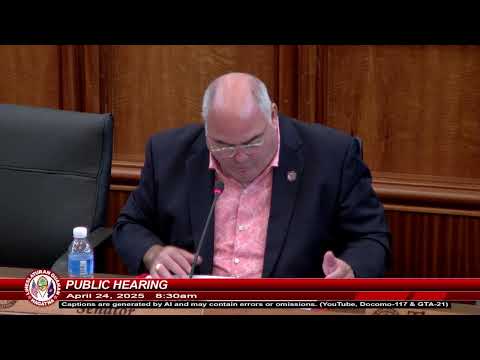
Bill 101‑38, introduced by Senator Jesse A. Luhan, would expand the business privilege tax exemption list to include prescription drugs. The committee heard extensive testimony from pharmacists, pharmacy owners, clinicians and agency officials April 24.
"This legislation is grounded in a shared belief that our people deserve better access to health care," said Senator Jesse A. Luhan in his opening remarks. Luhan framed the bill as a public‑health measure intended to lower out‑of‑pocket costs for patients and support local pharmacies.
Pharmacists and pharmacy owners testified in strong support. Arthur S. Mariano, a pharmacist, noted World Health Organization guidance recommending tax exemptions for medicines and said the United States mainland already exempts prescription drugs in 49 states (with Illinois the notable partial exception). "Taxes on medicines can significantly increase their price, hindering access to necessary treatments," Mariano said. Pharmacy operations leaders described thin margins on specialty drugs, high refrigerated shipping costs and situations in which reimbursement rates from insurers do not cover acquisition costs — a dynamic that can force local providers to decline stocking costly specialty medicines.
Several clinics and practitioners provided case examples. Attorney Roland Mantenonia read a written statement from Dr. David J. Parks, an ophthalmologist, that said Guam currently taxes physician‑administered drugs through GRT reporting and that in some cases reimbursements leave practices operating at a loss for those medications; Dr. Parks urged an exemption to sustain in‑office treatments that preserve vision.
DRT Director Marie Lizama told the committee that the agency does not currently track sales at the product level on its BPT/GRT forms and would need form and programming changes — and dedicated enforcement resources — to implement and monitor a prescription‑only exemption. DRT warned it is not able to produce a precise fiscal impact without a data cross‑walk and suggested the committee consider technical approaches, such as abatements or reconciliations, to preserve pledged revenues while targeting relief.
Guam Memorial Hospital Authority reiterated earlier concerns: GMHA told the committee it opposes a broad exemption without clear offsets because a portion of BPT receipts (statutory allocation to the GMHA pharmaceutical fund) supports hospital medicines and supplies. Representatives of multiple pharmacies and healthcare providers urged senators to act, arguing that exemptions would boost medication adherence and reduce downstream health costs.
No votes were taken. Committee members requested DRT and budget offices provide a fiscal estimate and suggested further hearings to examine implementation mechanics and possible offset mechanisms that protect bonded pledges and essential hospital funding.