Get Full Government Meeting Transcripts, Videos, & Alerts Forever!
Get email alerts on the Business Privilege Tax Transparency topic
No spam. Unsubscribe anytime.
Guam committee hears bill to require itemized business privilege tax on receipts
Summary
Legislators and Department of Revenue and Taxation officials discussed a bill that would require businesses to display the business privilege tax (BPT) as a separate line item on receipts, with penalties for noncompliance and a timetable for agency rules and implementation.
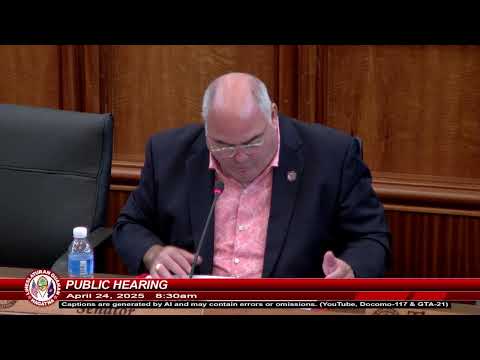
Lawmakers heard testimony April 24 on Bill 59‑38, the Business Privilege Transparency Act of 2025, which would require businesses to separately state the business privilege tax (BPT) on receipts, invoices and other customer documentation and set penalties for noncompliance.
The bill’s prime sponsor, Senator Christopher M. Duenas, opened the hearing by reading the measure and the legislative findings, saying the change is intended to make the island’s tax structure more transparent. "The business privilege tax, PBT, is a significant source of revenue for the government of Guam but is largely invisible to consumers at the point of sale," Duenas said in his opening remarks.
Department of Revenue and Taxation (DRT) Director Marie Lizama told the committee the agency provides factual analysis rather than policy recommendations but raised operational concerns about enforcing a visible‑BPT requirement. "It will add further strain on an already critically understaffed BPT branch," Lizama said, noting the branch currently relies on two dedicated full‑time staff and temporary help and that additional personnel and programming would be needed to monitor compliance and reconcile exemptions.
Jerome Uggen, administrator for DRT’s Taxpayer Services Division, echoed the implementation challenge and said some technical work would be required to modify online forms and programming. He told senators that the 90‑day rule‑making window in the bill is likely achievable but that reconciling printed, receipt‑level estimates with later adjustments and exemptions would complicate enforcement.
Senators on both sides of the aisle raised the policy tradeoffs. Senator Gumatalto said the bill is overdue and expressed support while asking DRT for data on cash transactions and verification capability. Senator Turlahi and others pointed to prior litigation and uneven business practices when a similar disclosure was tried before, warning that some businesses implemented the line item in ways that misled customers and that exemptions could cause receipts to overstate tax burdens.
Several senators, including Senator William Parkinson, questioned whether normalizing a visible tax line might serve as a step toward adopting a sales tax. Duenas and proponents countered by pointing to other U.S. jurisdictions that disclose excise or gross receipts taxes and argued rule‑making could address ambiguity and exemptions.
The bill would direct DRT to promulgate rules within 90 days of enactment and make the requirement effective six months after the rules are complete. The measure also sets a penalty of $500 per violation, capped at $10,000 per calendar year.
The committee did not take a vote; the hearing closed after DRT and senators discussed technical options and possible staffing and education programs to support a rollout.
The committee will accept written testimony for five calendar days following the hearing.