Get Full Government Meeting Transcripts, Videos, & Alerts Forever!
Get email alerts on the Sex Offender Residency Restrictions topic
No spam. Unsubscribe anytime.
Public defender office urges committee to reject broad residency restrictions for level‑3 registrants, citing constitutional and practical problems
Summary
A Committee for Public Counsel Services attorney told lawmakers that proposed 1,500‑foot residency limits for level‑3 registrants risk increasing homelessness, impairing supervision and likely violating Massachusetts Supreme Judicial Court precedent.
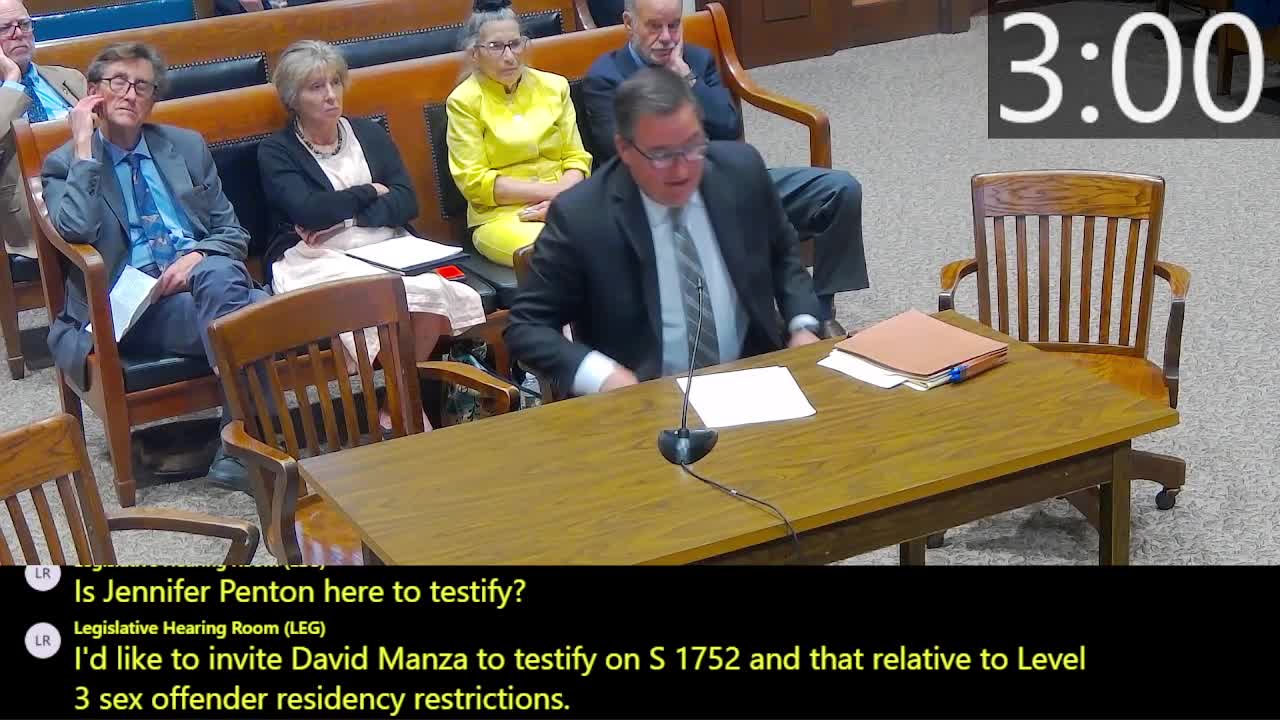
An attorney for the Committee for Public Counsel Services urged the Joint Committee on Public Safety and Homeland Security not to advance Senate Bill 1752, which would impose residency restrictions on level‑3 registered offenders. "These types of laws have been passed in many other jurisdictions and there have not been good results," said David Manzan of CPCS, who cited studies and court rulings in opposition to blanket restrictions. Manzan said California experienced a 24‑fold increase in homelessness among registrants after a similar law. He told the committee that homelessness among registrants increases the risk of reoffense and makes supervision and service delivery more difficult. "A stable home environment is something that lowers a person's risk to reoffend," he said, referencing the registry board's guidance. Nut graf: Manzan told the committee that recent Massachusetts Supreme Judicial Court decisions require individualized findings before imposing severe restrictions, and that the court has struck down broadly applied residency limits in prior cases. He cautioned that the bill's blanket 1,500‑foot buffers around schools, day cares, parks and other public facilities could effectively banish registrants from large areas and trigger constitutional concerns. He cited Doe v. City of Lynn, in which the SJC invalidated a residency ordinance and warned of "grave societal and constitutional implications" when an ordinance creates de facto segregation of registrants; he also cited decisions limiting automatic GPS monitoring and residency bans in congregate settings. Manzan urged the committee not to advance language likely to be found unconstitutional and to consider evidence that such restrictions hinder public safety by creating homelessness. Ending: The witness urged the committee to reject or substantially redraft the bill; no committee action was taken at the hearing.