Get Full Government Meeting Transcripts, Videos, & Alerts Forever!
Get email alerts on the Clean Slate Record Sealing topic
No spam. Unsubscribe anytime.
Mass. advocates push automated ‘clean slate’ to seal eligible criminal records
Summary
Lawmakers and advocates testified before the Joint Committee on the Judiciary in support of H.1811, a bill to automatically seal eligible criminal records after statutory waiting periods, arguing it would increase employment and reduce recidivism; supporters said implementation costs can be offset by long-term economic gains.
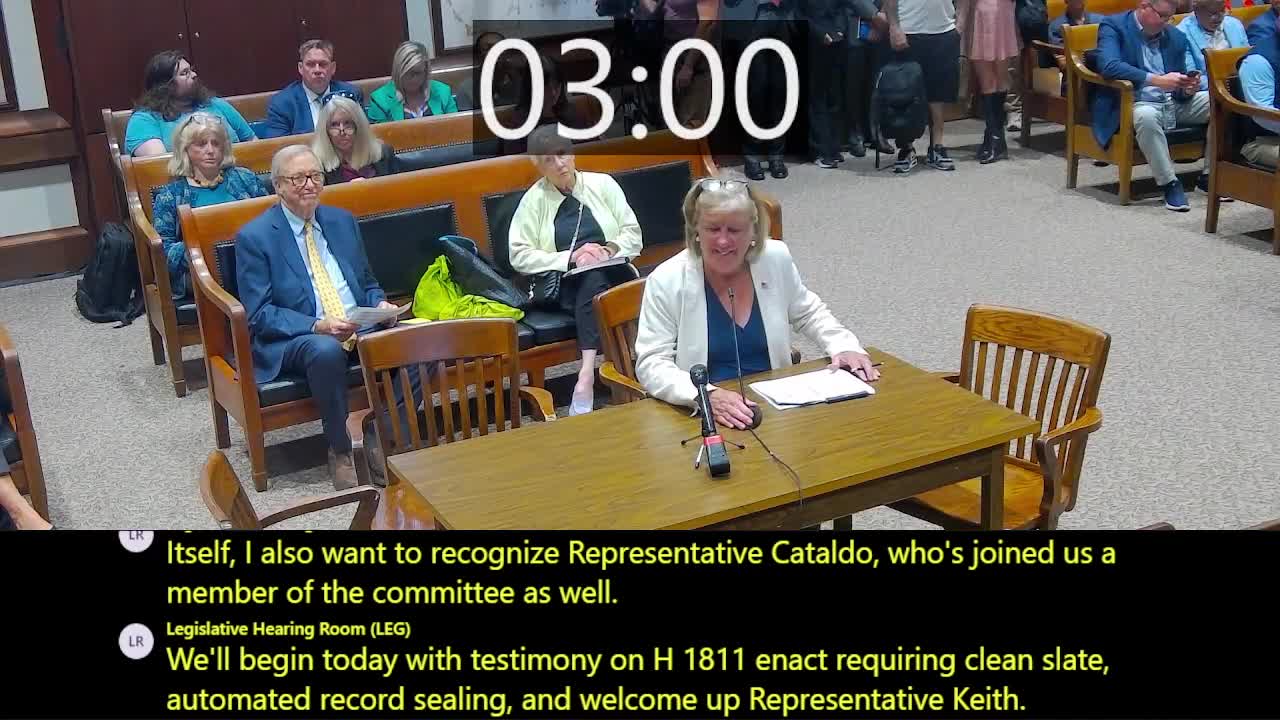
Representative Russell E. Keith told the Joint Committee on the Judiciary on Sept. 9 that H.1811 would create an automatic, government-initiated sealing process for eligible criminal records in Massachusetts. “H 1811, an act requiring clean slate, automated record sealing for Massachusetts,” Keith said in opening testimony, adding that “we have over a million people that are affected in this way. That's 1 out of 5 persons here in Massachusetts.”
Supporters from legal aid, advocacy groups and business organizations said the current petition-based process is underused and leaves eligible people locked out of jobs, housing and education. Pauline Kurian of Greater Boston Legal Services told the committee the state’s petition process is slow and inconsistent, creating real barriers: she cited backlogs and mail losses that can keep people waiting months to have records sealed.
Business and workforce advocates said automated sealing would expand the labor pool and boost wages. Maggie O’Donnell of the Responsible Business Initiative for Justice said employers across the state back the measure and that national research suggests sealing can materially increase earnings and reduce turnover. Katie Svoboda Kendall of the Clean Slate Initiative told the committee that 12 states and the District of Columbia have enacted similar automated programs and that automated sealing is technically feasible using existing state data systems.
Legal advocates stressed the bill does not change eligibility or waiting periods: it automates relief already authorized by law. Supporters repeatedly framed the bill as an implementation and equity fix, not a change to substantive sealing rules. Several speakers — including formerly incarcerated residents and community organizations from Western and Greater Boston — said they or members of their families faced repeated denials for housing and employment because records remained readily visible on background checks.
Implementation cost questions surfaced during committee questioning. Witnesses said start-up expenses vary by state; speakers cited figures from other states (for example, a reported $3 million implementation cost in Pennsylvania and $1.5 million in Utah) and argued such investments pay off by raising employment, reducing recidivism and cutting reliance on public support. Clean Slate Initiative witnesses offered technical assistance to the state on design and execution.
No formal committee action or vote was taken at the hearing. Committee members heard multiple requests to report the bill favorably; supporters asked legislators to prioritize automation as a practical follow-on to the 2018 criminal justice reforms that expanded eligibility for sealing.
Supporters asked the committee to balance the startup cost against long-term savings and workforce benefits. If enacted and properly implemented, advocates said, the policy would seal hundreds of thousands of eligible records and quickly expand employment pathways for those affected.
The committee accepted written testimony and said staff would continue follow-up on implementation details, funding estimates and technical options.
Ending: The committee will consider H.1811 as part of the full session’s review of judiciary bills; proponents asked lawmakers to act this legislative session to make sealing routine for people who meet existing eligibility rules.