Get Full Government Meeting Transcripts, Videos, & Alerts Forever!
Get email alerts on the Csc Act Coverage topic
No spam. Unsubscribe anytime.
Clinicians and families urge insurers to cover coordinated specialty care and assertive community treatment
Summary
Providers, family members and researchers urged the committee to require commercial insurers to cover Coordinated Specialty Care (CSC) for first-episode psychosis and Assertive Community Treatment (ACT), saying teams cannot sustain operations without insurer reimbursement despite CMS billing codes.
A coalition of clinicians, family advocates and hospital leaders urged the Joint Committee on Financial Services to require commercial insurers, the Group Insurance Commission and MassHealth to cover two evidence-based, team-based services for people with early psychosis and severe mental illness: Coordinated Specialty Care (CSC) and Assertive Community Treatment (ACT).
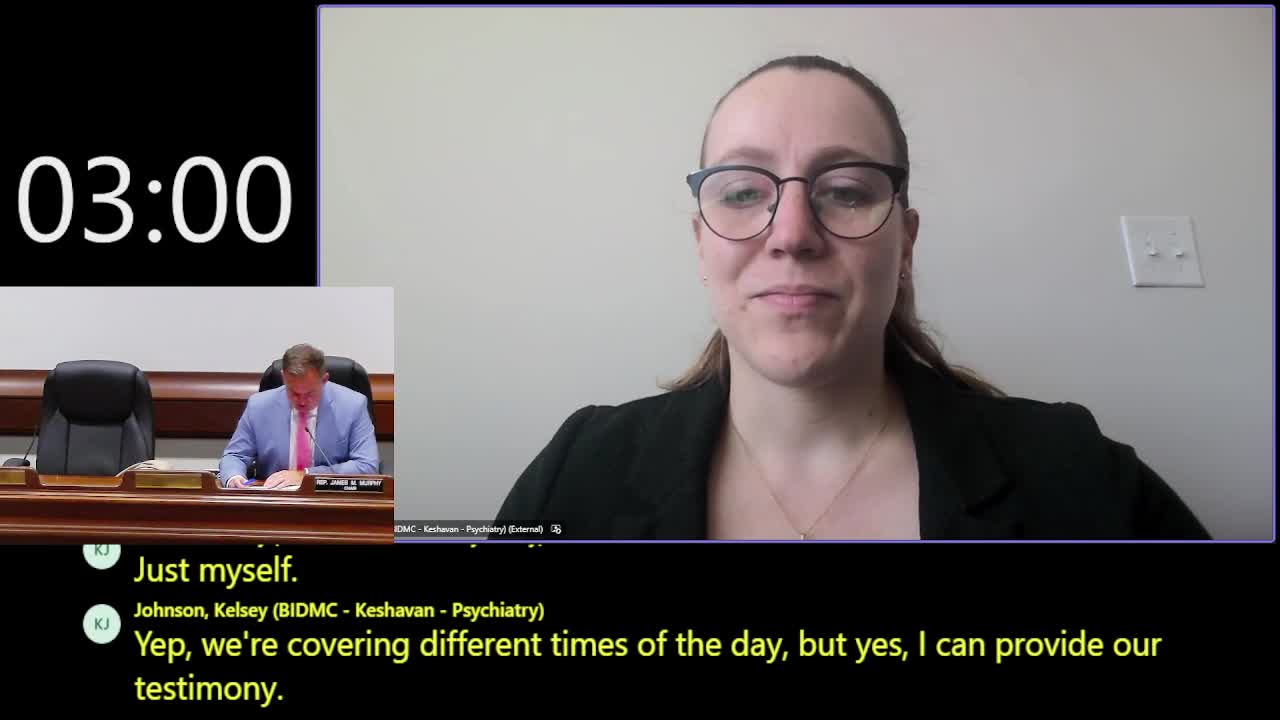
Kelsey Johnson, program manager for the Massachusetts Psychosis Network for Early Treatment (MAPNET), said CSC is the leading evidence-based intervention for first-episode psychosis and uses multidisciplinary teams. MAPNET estimates roughly 1,200 young people experience first-episode psychosis each year in Massachusetts and that 25–50 CSC programs would be needed to treat all cases; currently about ten programs operate and many are financially unsustainable because private insurers have not reimbursed CMS-developed CSC billing codes.
Several family members described life-changing benefits from team-based care. Ken Farbstein, a parent and advocate, said his son received coordinated care and is in recovery but the local program later closed due to funding gaps. Peter Bachman, a clinical psychologist at Boston Children's Hospital, described a 12-year-old patient with repeated hospitalizations and said CSC can reduce hospital stays and improve functional outcomes, but teams cannot be sustained without payer coverage.
Jessica LaRochelle of the Massachusetts Association for Mental Health summarized research showing CSC and ACT reduce hospitalizations, improve employment and education outcomes and can save public dollars long-term by avoiding costly inpatient care.
Why it matters: Witnesses said CMS issued billing codes for CSC and ACT in 2023 but private insurers have not routinely reimbursed claims; programs now operate on grants or operate at a loss, limiting statewide availability when early intervention is considered critical to recovery.
Next steps: Supporters requested the committee report H 11 35 / S 7 09 favorably and urged the Commonwealth to require commercial coverage of CSC and ACT with bundled payments to sustain high-fidelity teams.