Get Full Government Meeting Transcripts, Videos, & Alerts Forever!
Get email alerts on the State Police Education Incentive topic
No spam. Unsubscribe anytime.
State police witnesses urge restoration of Quinn-era education incentive to improve recruitment and pay equity
Summary
Troopers, association leaders and union officials told the Joint Committee on Public Safety and Homeland Security that restoring an education incentive for Massachusetts State Police hires after a 2009 cutoff would reduce a two-tier pay structure that weakens recruitment, retention and morale.
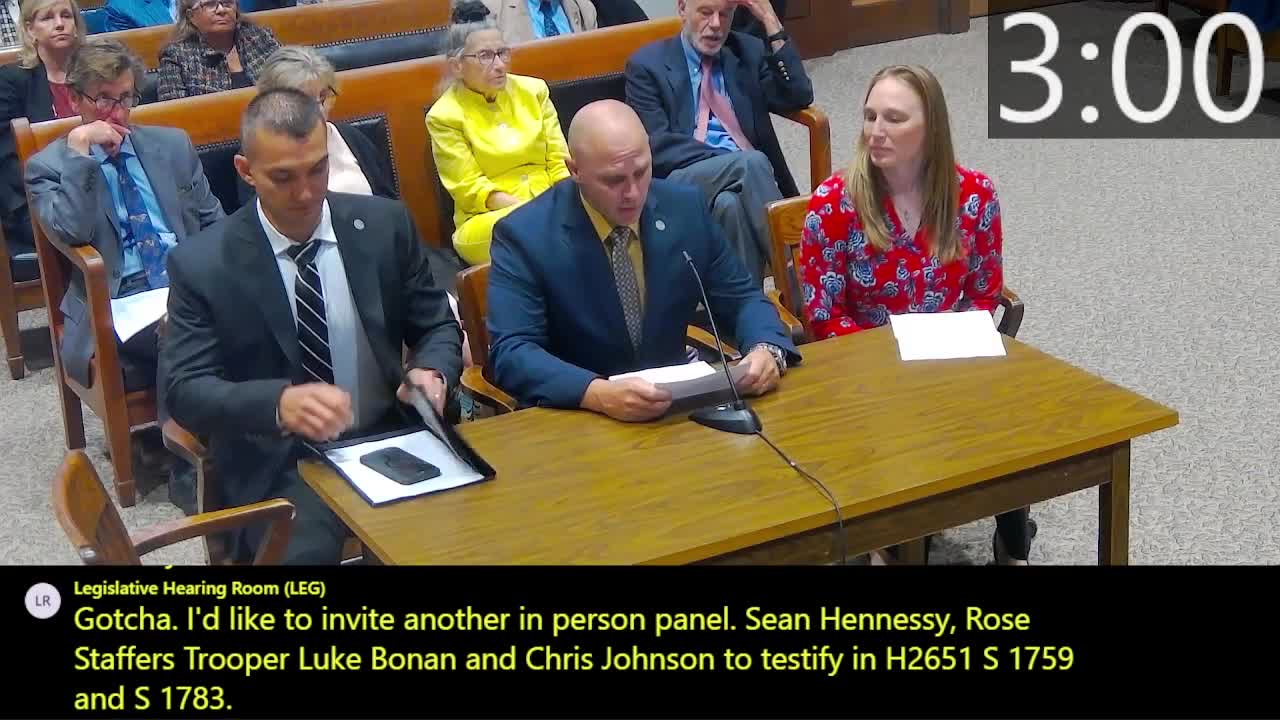
Members of the Massachusetts State Police Association and several troopers told the Joint Committee on Public Safety and Homeland Security on Wednesday that legislation to restore an education incentive for troopers hired after February 2009 would address a widening pay disparity and help recruit and retain more qualified, diverse applicants. "Please support our goal of recruiting and retaining a well educated, well qualified, diverse force by reporting these bills favorably," said Luke Bonin, vice president of the State Police Association of Massachusetts. The bills under consideration — House Bill 2651 and Senate Bills 1759 and 1783 — would create an education incentive comparable to the Quinn Bill that existed before a 2009 budget change removed the benefit for newly hired state troopers, witnesses said. Advocates called the current arrangement a two‑tier system that gives troopers hired before the cutoff higher base pay tied to degrees, while later hires performing the same duties receive no educational pay. "A trooper hired post 2009 must reach the rank of lieutenant ... just to earn the same salary as a pre 2009 trooper with a master's degree," Bonin told the committee. Nut graf: Supporters said reinstating an education incentive would raise professional standards and make Massachusetts State Police competitive with municipal departments that still offer education pay, reversing declines in applicants and the share of veteran recruits. They urged the committee to report the bills favorably to begin restoring parity. In testimony, troopers and officers described recruitment drops and workforce impacts. Bonin said applicants for state police exams declined from more than 14,000 in 2013 to fewer than 5,000 in 2023, with fewer than 3,500 passing the exam in the most recent year. He said the share of veterans among applicants fell by about 50 percent. Trooper Sean Hennessy and Lieutenant Jennifer Penton recounted how the education incentive previously encouraged officers to pursue higher studies that improved investigative, communication and leadership skills. Hennessy said the current pay structure undermines morale because supervisors hired before 2009 may earn more than the troopers they oversee. "It is morally wrong to perpetuate a system that treats identical qualifications differently," Hennessy said. The State Police Association, represented at the hearing by President Brian Williams and Legislative Director Christopher Johnson, presented survey and polling material claiming strong public support for an education incentive. Johnson cited a 2023 MassINC poll paid for by the association showing roughly 77–84 percent public support when respondents were informed about the policy and its stated benefits. Testifiers contrasted the state police with municipal departments: witnesses said roughly 308 full‑time municipal police departments exist in Massachusetts, and about 209 of those provide a formal education incentive. They argued the state police, which provide specialized services such as homicide and crime scene work to many municipalities, should match that standard. Supporters also said the incentive would help reach diversity goals, including a department pledge to raise the share of female officers. Lieutenant Penton told the committee that pay inequities run counter to the state's equality initiatives and said, "Supporting these bills would correct this injustice and guarantee that all members are paid fairly for equal work." The panel asked for cost estimates and legislative language; witnesses urged consultation with the committee to craft a sustainable implementation plan. No committee action was recorded at the hearing. Ending note: Supporters requested favorable reports on the bills to move them toward debate and potential enactment; the committee did not take a vote during the public testimony session.