
Hillel: Jewish students report vandalism, exclusion and online harassment across Massachusetts campuses; calls for stronger enforcement and training
Get AI-powered insights, summaries, and transcripts
Subscribe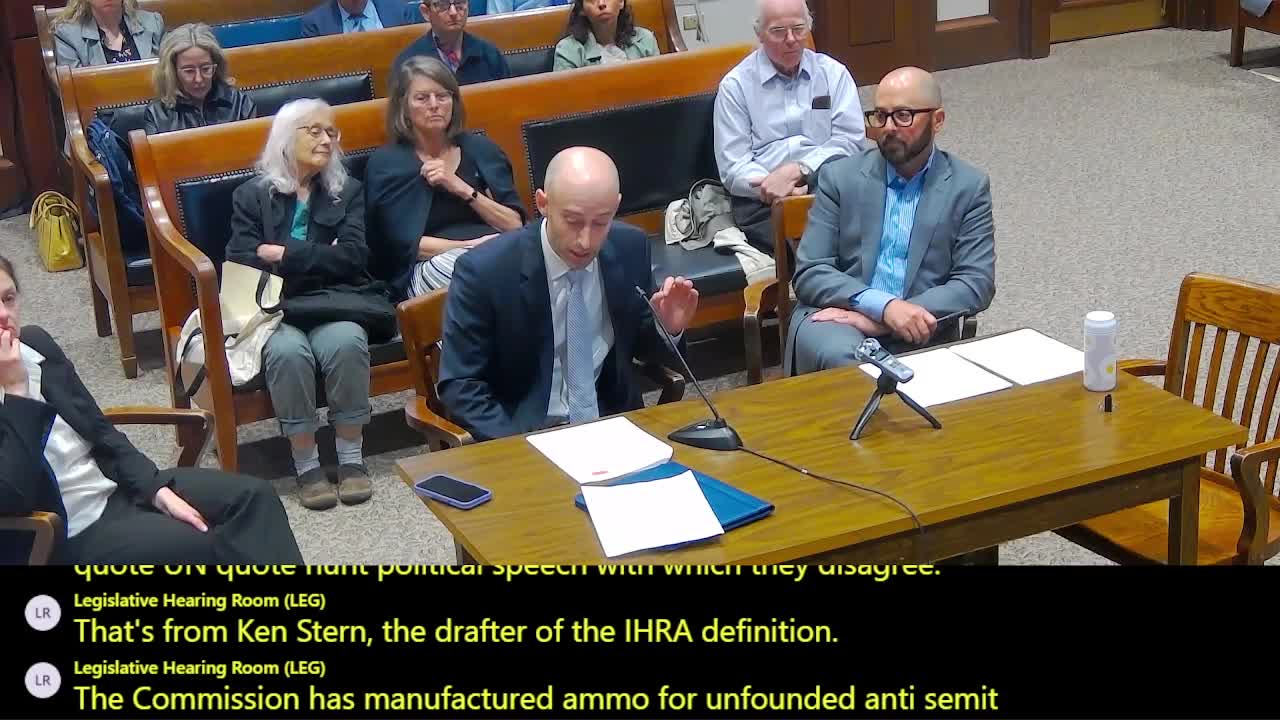
Summary
Miriam Bluhm, executive director of the Hillel Council of New England, told the commission Jewish students across public and private Massachusetts campuses continue to face harassment, vandalism and exclusion; she urged Title VI enforcement, mandatory trainings, and convening university leadership to share best practices.
Miriam Bluhm, executive director of the Hillel Council of New England, told the Special Commission on Antisemitism that Jewish students at Massachusetts colleges—public and private—are facing harassment, exclusion, vandalism and peer‑driven intimidation that often leaves students feeling they must hide their identity.
Bluhm said Hillel supports and serves 12 Massachusetts colleges and universities and that the lived experience of Jewish students "remains fraught with harassment and bullying" despite fewer high‑profile encampments this past academic year. "Behind the numbers are real students," she told the commission, describing incidents such as vandalism of a Sukkah at Simmons University, repeated desecration of religious objects and graffiti at Emerson College, and a campaign at Boston College that she said discouraged a Jewish Hillel‑affiliated student from student‑government leadership.
Survey and numbers cited: Bluhm referenced a joint Hillel/ADL survey that found "over 8 in 10 Jewish college students have experienced or witnessed antisemitism since 10/07/2023," that "more than 1 in 4 Jewish students said they had observed antisemitic activity by faculty," and that "nearly half of all Jewish students feel the need to hide their Jewish identity." Hillel International also tracked 2,334 antisemitic incidents on campuses in the 2024–25 academic year, she said.
Policy requests: Bluhm urged the commission and state government to (1) enforce Title VI compliance at both public and private institutions receiving state funds, (2) require antisemitism awareness training for administrators, faculty and students, and (3) convene university presidents and senior leadership to identify and share best practices. She recommended using the IHRA definition to inform trainings.
Operational concerns: Bluhm described social‑media amplification of campus rhetoric and said some institutions have taken concrete steps—such as removing encampments or restricting the use of a university name by outside groups—that reduced some public protest activity. She also said masking and the use of anonymous tactics at protests hindered accountability and, where possible, suggested stronger enforcement of campus policies regarding demonstrations and use of campus names.
Discussion vs. decision: Commissioners asked for examples of effective practices; Bluhm highlighted administrative enforcement, clear denouncements from presidents and securing Jewish events. No formal commission action was taken at the hearing.
What’s next: Bluhm offered to share further documentation and urged rapid state action on training and Title VI enforcement for institutions that receive state support.