Get Full Government Meeting Transcripts, Videos, & Alerts Forever!
Get email alerts on the Guam Memorial Hospital P3 topic
No spam. Unsubscribe anytime.
Guam lawmakers hold hearing on proposed public‑private partnership to manage Guam Memorial Hospital
Summary
A legislative hearing on Bill 13 examined a proposal to form a public‑private partnership (P3) to stabilize operations at Guam Memorial Hospital. Supporters said the model could bring management expertise; hospital leaders warned the bill as written conflicts with the Organic Act and lacks guaranteed funding and detail on scope.
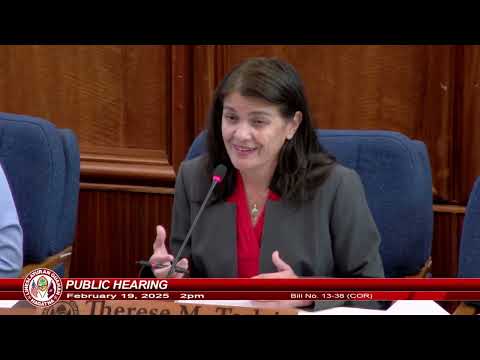
Senators and health officials gathered Feb. 19 for a public hearing on Bill 13, introduced by Senator Therese Terlahi, which would create a P3 committee to draft a request for proposals (RFP) for a public‑private partnership to manage Guam Memorial Hospital (GMH). The measure would require the committee to publish an RFP, hold hearings and submit the RFP to the Legislature for review before any appropriation or solicitation.
Why it matters: GMH faces chronic budget shortfalls, a large share of low‑reimbursing payers and aging facilities. Lawmakers framed the bill as a tool to lock in plans for operations and funding as Guam moves toward building a new medical campus; hospital leaders cautioned that the bill, as written, could conflict with statutory authority and lacks identified funding to procure a contract.
Senator Therese Terlahi, the bill author, told the committee the bill aims to create “a plan and we are going to follow that plan,” describing a committee that would develop an RFP and return it to the Legislature for public hearings and appropriation decisions. Terlahi said a prior 2016 GMH task force recommended considering long‑term options and that prior attempts to pursue a P3 stalled over procurement concerns and funding breaks for capital projects.
Lillian Perez Posadas, Guam Memorial Hospital administrator, said GMH is not opposed to P3s in principle but opposed the bill “as it is written.” She cited the Organic Act language that places authority for public health services with the governor and warned the bill could conflict with procurement rules and statutory responsibilities. Posadas also outlined GMH’s longstanding operating deficits and argued the hospital currently lacks sufficient funds to certify and pay for a procurement.
Clinicians and hospital leaders told senators that P3s are typically used for construction and infrastructure and that outsourcing medical management raises complex operational risks. A GMH physician who is also a neurosurgeon warned that private partners expect returns on investment and that Guam’s payer mix — large Medicare/Medicaid/MIP share and a high self‑pay rate — makes turnkey profitability unlikely without continued public subsidy.
Melanie Mendiola, CEO of the Guam Economic Development Authority (GEDA), said GEDA issued RFP 24‑0006 to study operational structure and that the RFP was awarded in January after ARP funding deadlines were missed. Mendiola described the RFP’s scope as analyzing revenue streams, regulatory requirements, and potential organizational models and recommended allowing the study’s findings to proceed before imposing additional committees by law.
Public testimony included private citizens and clinicians. Raymond Salas, a private citizen with public‑health experience, supported exploring a P3 and urged including aviation authorities if a helipad is contemplated for the new campus. Several speakers emphasized that Medicaid and Medicare reimbursement rates are below local cost of care: GMH’s reported Medicare cost of services for beneficiaries was cited as about $31 million while eligible Medicare reimbursement was described as roughly $14–$16 million.
No formal vote was taken at the hearing. Senators debated whether the Legislature should review the RFP before solicitation, how to protect employees’ benefits, and how any contract would interact with the governor’s authority to operate public health services.
Looking ahead: Terlahi and other senators said the bill is intended to produce a transparent, funded plan the entire government will follow as the island builds a new hospital. GEDA urged deferral pending the RFP study’s findings; GMH urged clearer drafting to avoid conflicts with procurement rules and the Organic Act.
Provenance: The committee opened the hearing introducing Bill 13 and the roster of invited stakeholders (transcript starting at 53.614998). Testimony and discussion on Bill 13 continued through the committee’s questions and the recess at roughly 7,368–7,380 seconds in the transcript.