Get Full Government Meeting Transcripts, Videos, & Alerts Forever!
Get email alerts on the Military License Reciprocity topic
No spam. Unsubscribe anytime.
Bill 75‑38 would let active duty nonresident service members and dependents use out‑of‑jurisdiction licenses; DRT seeks safeguards for commercial endorsements
Summary
Bill 75‑38 would permit active‑duty nonresident service members and their dependents to rely on a valid U.S. jurisdiction operator’s license instead of obtaining a Guam driver’s license; supporters cited administrative savings and reduced burdens on rotational military families.
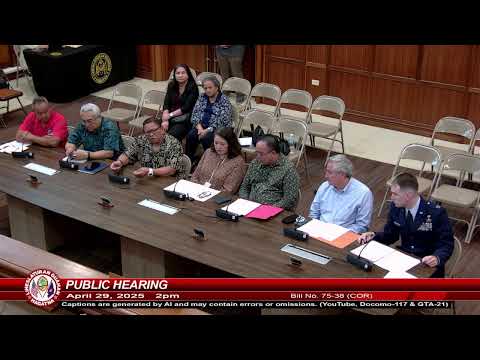
The committee considered Bill 75‑38 on April 29, a measure to exempt nonresident active‑duty service members and their dependents from Guam's driver‑licensing requirement when they hold a valid operator’s license from another U.S. state or territory.
Speaker Frank Blas, the bill’s sponsor, said the change would align Guam with other U.S. jurisdictions, reduce administrative burdens at the Department of Revenue and Taxation (DRT), and avoid forcing short‑term rotational personnel and their families to surrender home‑state licenses they must renew again at future duty stations.
Captain Matthew Vandrossik, representing the U.S. Air Force (and speaking for Navy interests present), told the committee the exemption benefits service members, saves DRT manpower, and preserves legal ties to home jurisdictions that affect voting, taxes and estate matters. He said the Defense Department and its families already contribute to local road funding through vehicle registrations and development programs.
Juan Carlos Benitez (military liaison) and the Guam Office of Veterans Affairs supported the measure. Director Matthew (Joe) San Agustin of the Guam Office of Veterans Affairs urged that local commanders and gate authorities continue to ensure that service members and dependents maintain valid licenses and that DRT and the services coordinate to validate credentials.
DRT Director Maria Lazama said the bill would likely reduce DRT workload because DRT already waives certain fees and in 2023 suspended fee collection to comply with the Servicemembers Civil Relief Act (SCRA). DRT cautioned the committee the draft bill must explicitly preserve Guam requirements where appropriate — notably commercial or chauffeur endorsements. The draft, as written, could be read to allow an out‑of‑jurisdiction operator’s license to substitute for a Guam chauffeur’s license (required to operate taxis, buses, limousines and other commercial vehicles). DRT recommended language clarifying that commercial endorsements must be equivalent to Guam’s chauffeur requirements.
Committee members questioned how graduates and minors (graduated licensing schemes) would be handled; DRT staff explained minors with only a graduated (restricted) out‑of‑jurisdiction license would still have to complete Guam’s graduated requirements. The hearing concluded with sponsors and military witnesses asking staff to prepare clarifying amendments on chauffeur endorsements, graduated licenses and data‑sharing arrangements for validation. No final vote was taken at the hearing.