
Guam committee hears Foster Care Bill of Rights; advocates urge codification to access federal supports
Get AI-powered insights, summaries, and transcripts
Subscribe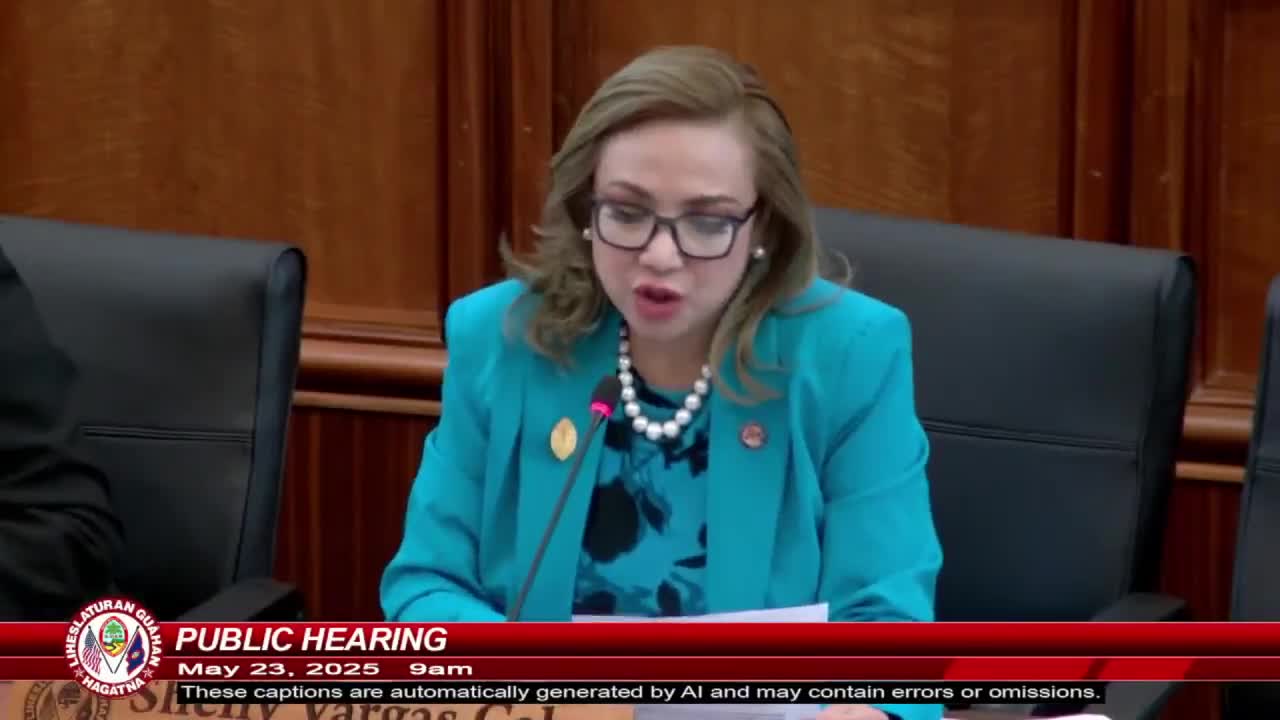
Summary
The Guam Legislature committee held a May 23 hearing on bill 139‑38 COR, the Foster Care Bill of Rights Act of 2025, which would add statutory rights for children in foster care and for resource parents; witnesses urged passage and asked for implementation funding and clearer statutory language.
The Committee on Child Welfare, Youth Affairs, Senior Citizens, Women's Affairs, Disability Services, Arts, Culture, Historic Preservation, and Hagatna Restoration held a public hearing May 23 on bill number 139‑38 COR, the Foster Care Bill of Rights Act of 2025, which would add new sections to Article 3, Chapter 13, Title 19, Guam Code Annotated to codify rights for children in foster care and for their caregivers.
Senator Shelley v. Calvo, the bill’s prime author, said the measure would enshrine protections intended to ensure ‘‘a secure and supportive environment’’ for foster youth and to help Guam access federal supports such as the John H. Chafee Education and Training Voucher (ETV) program. National and local witnesses described evidence‑based supports the committee should consider alongside statutory rights.
Rebecca Louv Yao, chief executive officer of the National Foster Youth Institute (participating by Zoom from Washington, D.C.), testified the bill ‘‘centers the voices and rights of children and youth in foster care’’ and urged Guam to pair codified rights with investments in mentorship, extended care, youth advisory boards and workforce programs. She cited national research on poor outcomes for youth who age out of care and recommended enforceable complaint mechanisms and services to support education and housing.
Local witnesses and agencies generally supported the bill’s intent while requesting edits and implementation resources. Director Therese Areola of the Department of Public Health and Social Services (DPHSS) and Bureau of Social Services Administration (BOSA) told the committee Guam has 697 children in foster care, partners with 96 licensed foster parents and 216 kin placements, and that the bill’s language contains terms that ‘‘require more precise definition’’ to avoid conflicts with existing practice. DPHSS provided an 8‑page set of suggested edits and said additional staff and funding would be needed for training and compliance work should the law pass.
Attorney Carol Henkel Sanchez from the Civil Law Center (Elder Justice Center) said the office supports the bill and proposed minor amendments to preserve confidentiality consistent with Guam’s Child Protective Act and juvenile procedures. Sherrell Mickens, acting deputy attorney general in the Family Division of the Office of the Attorney General, submitted written testimony supporting the bill as strengthening accountability and consistent standards of care.
Committee members asked technical and policy questions. Senators sought examples of states with similar statutes; witnesses cited California, Texas, New York and Colorado as jurisdictions with enacted foster‑care bills of rights. Members pressed for recommendations to reduce homelessness and improve educational outcomes for youth leaving care. Witnesses recommended culturally responsive mental health services, early career and college pathways, independent‑living practice and stronger transition supports such as extended foster care to age 21.
Senator Calvo emphasized a practical goal behind codification: making Guam eligible for federal programs and grants, including the John H. Chafee program and its Education and Training Voucher component. Committee members noted the Chafee program receives federal appropriations nationwide (testimony referenced approximately $143 million annually for related programs and roughly $43 million for Chafee ETV in aggregate) and said codification was part of a broader effort that also includes Title IV eligibility and CCDF‑supported initiatives referenced by DPHSS.
No committee vote was taken. Chairwoman Calvo said the panel will accept additional written testimony for 10 business days; she also said staff will continue drafting revisions and coordinate with agencies for a markup. Advocates and agency representatives urged the committee to include enforceable complaint procedures, youth advisory participation and funding language to ensure rights are backed by services.
The hearing record includes national expertise, local agency implementation questions and calls for specific program investments; the committee left the measure open for further refinement and outreach to ensure statutory language aligns with existing confidentiality rules and operational capacity.