Get Full Government Meeting Transcripts, Videos, & Alerts Forever!
Get email alerts on the Vehicle Title Taxation topic
No spam. Unsubscribe anytime.
Sponsor seeks bill‑of‑sale taxation for vehicle transfers to reduce overvaluation; DRT warns of fraud risk
Summary
Bill 88‑38 would base vehicle transfer tax on the notarized bill of sale instead of Kelley Blue Book (KBB) values; sponsors say the change is fairer for Guam’s high‑mileage, salt‑exposed fleet while DRT warns buyer‑declared prices can enable fraud without verification safeguards.
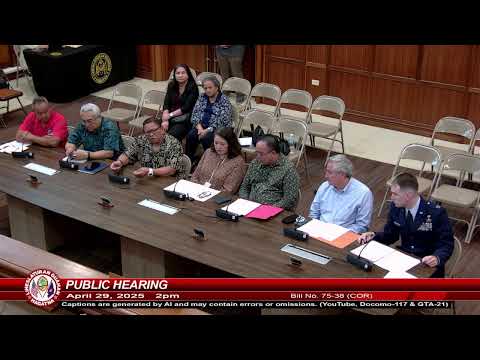
At a public hearing April 29, legislators considered Bill 88‑38, introduced to change how the government of Guam values used vehicles for transfer tax purposes. The bill would assess tax on the notarized bill of sale — the price actually agreed by buyer and seller — rather than using third‑party guides such as Kelley Blue Book (KBB). Sponsors said KBB values overstate market prices on Guam because of local wear, salt air and high mileage, which can produce inflated taxes for low‑income residents.
Senator Tello Titegwe, the bill’s sponsor, framed the proposal as an equity and administrative reform aimed at preventing overtaxation and improving title‑transfer compliance that in turn would help identify owners of abandoned vehicles. She cited task‑force figures saying thousands of abandoned or junk vehicles were removed in recent years and noted government disposal costs (she cited roughly $780,700 in FY2024 contractor removals for junk vehicles).
Maria Lazama, director of the Department of Revenue and Taxation (DRT), told the committee that DRT uses KBB, Black Book or NADA as industry standards and that the American Association of Motor Vehicle Administrators (AAMVA) warned DRT that relying on buyer‑declared sale prices “causes significant fraud to occur in the titling process.” Lazama also outlined revenue figures: over the past three fiscal years the agency collected approximately $2,557,000 annually from roughly 15,000 used‑vehicle transactions; changing valuation methodology could materially affect that revenue stream but the magnitude is uncertain.
Committee members and witnesses debated fraud risk vs. fairness. DRT and AAMVA recommended safeguards — spot audits, notarization, verification procedures and penalties — if the legislature moved toward bill‑of‑sale taxation. Sponsors emphasized existing criminal penalties for falsifying bills of sale and proposed administrative checks (notarization, random audits) to deter underreported prices. Mayor and mayors’‑office testimony in other meetings and task‑force discussions were cited as support for streamlining title transfers to improve ownership records and accelerate removal of abandoned vehicles.
DRT said it was finalizing implementation details for an existing statutory $1,000 fine that can be assessed to the last registered owner of an abandoned vehicle; staff said they have not yet reported significant collections under that provision and that operational coordination (e.g., tow firms, auction procedures) remains a work in progress.
Legislators asked DRT to provide more detailed revenue modeling and to propose anti‑fraud verification language for any bill that moves forward. The committee accepted additional written testimony and technical edits for markup.