Get Full Government Meeting Transcripts, Videos, & Alerts Forever!
Get email alerts on the Climate Vulnerability topic
No spam. Unsubscribe anytime.
Texas State study finds wildfire and heat heighten climate risks for Travis County operations
Summary
Texas State University's Institute for Government Innovation presented a climate vulnerability assessment to Travis County Commissioners Court, finding wildfire to be the dominant differentiator of facility risk in the county and recommending internal communication, continuity planning, and facility-prioritization tools.
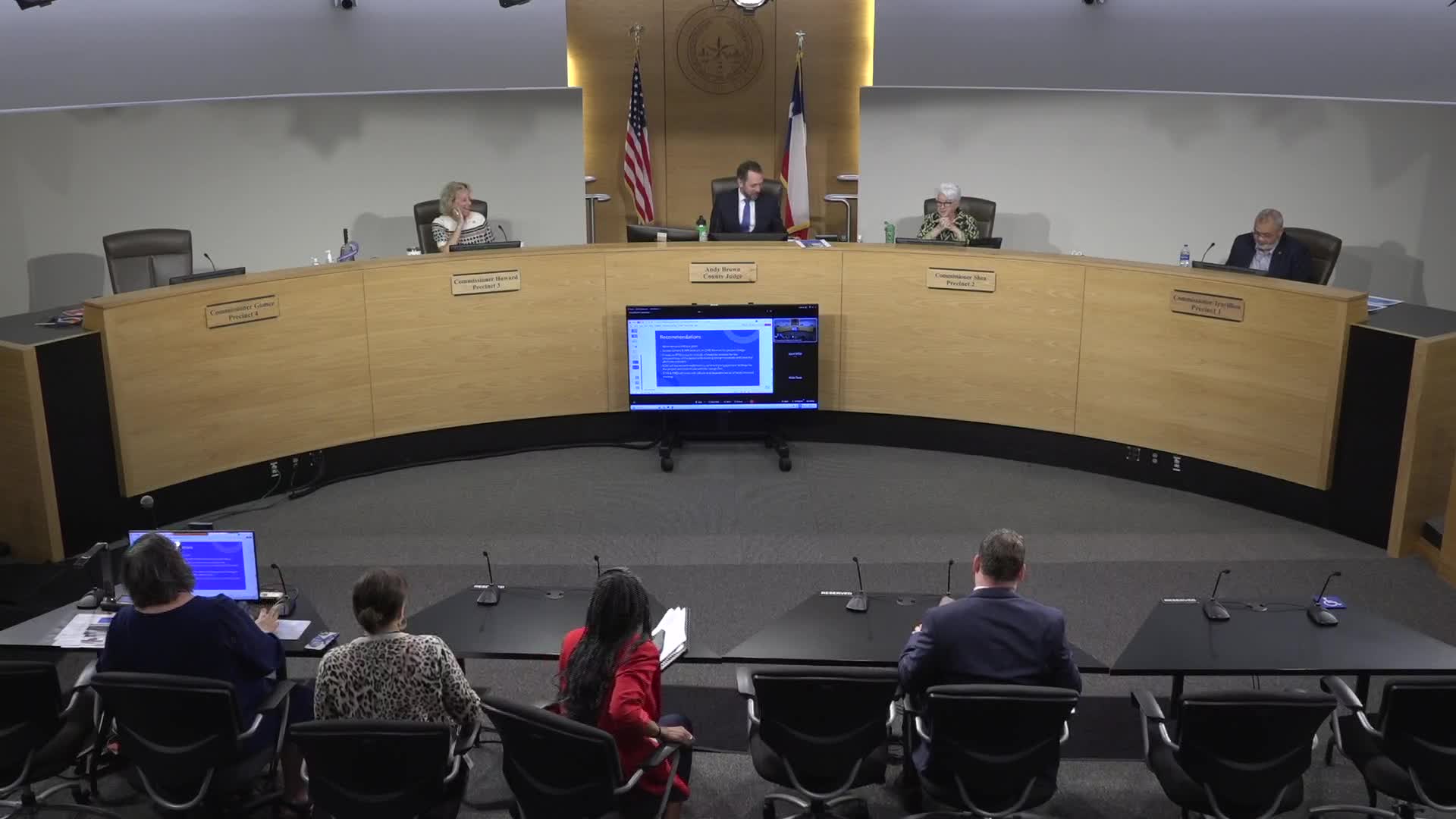
Travis County officials heard a cross‑departmental climate vulnerability assessment May 6 from Texas State University's Institute for Government Innovation and county staff, who urged new tracking tools and coordinated planning to protect county operations.
The study, led by Dr. Rebecca Davio and a Texas State team working with Transportation and Natural Resources and Office of Emergency Management staff, analyzed more than 40 documents, held roughly 20 meetings representing about 15 work groups and nearly 70 county staff and partners, and surveyed local nonprofits. The team said the county’s exposure to multiple hazards requires integrated planning across facilities, infrastructure and services.
Why it matters: county facilities and personnel provide critical services—public safety, emergency support, records and other functions—and those functions depend on facilities that can be damaged or isolated by wildfire, flood, extreme heat or severe storms. The report produced practical tools designed to help the county prioritize resilience investments and to make hazard‑mitigation planning easier to use in budgeting and grants.
Key findings and tools
- Hazard mapping: using FEMA’s National Risk Index weighted with historic building-loss data, the team found wildfire risk is a primary driver of relative facility vulnerability across the county and is concentrated in western portions of Travis County. For flooding, the team used FEMA floodplain layers and reported two county facilities in the 100‑year floodplain and three in the 500‑year floodplain.
- Interdependence: the report emphasized that services (county programs), infrastructure (roads, communication nodes) and facilities (community centers, jails, storage sites) are interdependent—damage to facilities can cascade to service interruptions.
- Actionable tools: the team delivered three planning tools for county use: a Climate Impacts and Solutions Viewer (links hazards to response strategies), a digitized Hazard Mitigation Action Plan tracking spreadsheet, and a Facility Investment Planning tool that combines tenant, service, hazard and resilience data to prioritize investments.
Recommendations and next steps
The report’s recommendations are organized under three goals—"Be informed, make a plan, build a kit." Priority actions include improving internal and external emergency communications, prioritizing continuity planning for county services, developing a countywide master list of facilities, digitizing and using the hazard mitigation tracking tool for budgeting and grant work, and creating a centralized repository (for example, on Microsoft Teams) for cross‑departmental documents and situational reports.
Johanna Arendt, environmental resilience project manager with Transportation and Natural Resources, described the assessment as a step in a standard progression of climate planning: inventory, action plan, vulnerability assessment and then mitigation/preparedness. Dr. Rebecca Davio told the court, “We are very grateful to Travis County for allowing us to work on this project,” and the team outlined how the tools could be used during budgeting and for grant applications.
County direction
Office of Emergency Management and Transportation and Natural Resources staff told the court they will explore implementation of the recommendation to create a centralized repository and indicated the Planning and Budget Office will begin using the Facility Investment Planning tool to help prioritize resilience investments. Commissioner Margaret Trevillian requested that the Emergency Services Committee track status and progress on the report’s recommendations.
Ending
Commissioners praised the team’s work and asked staff to integrate the new tools into ongoing planning and budget cycles. The court did not take formal action beyond directing staff to coordinate implementation steps and to brief the Emergency Services Committee on progress.