Get Full Government Meeting Transcripts, Videos, & Alerts Forever!
Get email alerts on the Public Lands Fuel Management topic
No spam. Unsubscribe anytime.
City and county outline shaded fuel breaks, monitoring and research for public preserves
Summary
Austin Water and Travis County staff described multi-agency work on the Balcones Canyonlands Preserve and other public lands, including shaded fuel breaks, monitoring partnerships with universities and prioritization by proximity to homes.
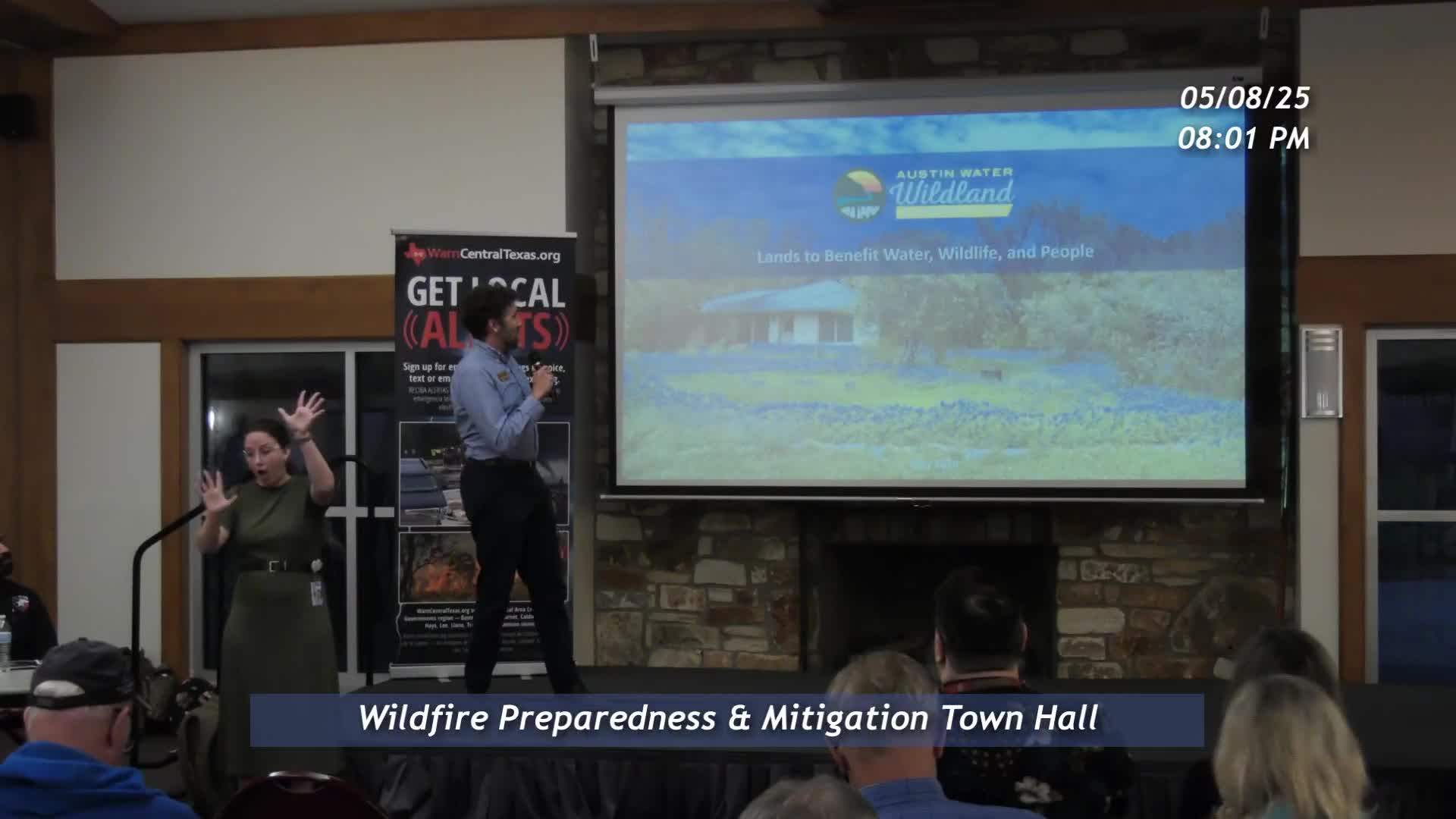
Justin Bates, division manager for the Wildland Conservation Division at Austin Water, and Jeremy Hall, Travis County assistant director of natural resources, described how public-land management fits into the county’s broader wildfire strategy.
Bates said Austin Water manages roughly 49,000 acres of protected land and works with the Balcones Canyonlands Preserve (BCP) framework that helped secure endangered-species mitigation for development. He said city and county land managers prioritize shaded fuel breaks — treatments that reduce understory and ladder fuels while retaining a shaded canopy — especially where public boundaries abut homes.
“We are so lucky here in Austin… This is not California,” Bates said during his remarks, adding that regional ecosystems and weather make local fire behavior different from Southern California’s chaparral, though stresses from drought and winter storms are increasing fuel vulnerability in places.
Bates noted ongoing research partnerships: a Baylor study comparing historic fuel conditions and a current project with the U.S. Forest Service and UT Austin to install sensors that measure moisture in juniper trees and otherwise quantify changing fuel conditions. County officials described a shared data layer and closer coordination with utilities (Austin Energy, LCRA, PEC) to map and respond to vegetation hazards near power lines.
Bates and Hall said the city and county have constructed and maintain shaded fuel breaks (the speakers reported roughly 30 miles of shaded fuel treatments between city and county programs in recent years) and emphasized that maintenance and monitoring are critical because treatments can make trees more vulnerable immediately after some operations.
Officials encouraged residents to volunteer on stewardship days, attend guided hikes, and engage with land managers, while stressing that private-land home hardening and neighborhood mitigation remain essential complements to public-land work.
Audience questions covered utility line vegetation clearing, coordination with LCRA and Austin Energy, and use of conservation corps crews and youth workforce programs for mitigation. Austin Water and county staff said they coordinate on vegetation management, seasonal constraints for endangered-species protections, and permitting for work on preserve lands.