Get Full Government Meeting Transcripts, Videos, & Alerts Forever!
Get email alerts on the Counsel At First Appearance topic
No spam. Unsubscribe anytime.
Residents, public defender staff urge Travis County to speed up ‘counsel at first appearance’ rollout
Summary
Multiple residents and public defender staff told the Travis County Commissioners Court during public comment that the county must accelerate implementation of a program to provide counsel at first appearance (CAFA), citing constitutional protections, ACLU observations and a $15.5 million budget ask to fully staff the effort.
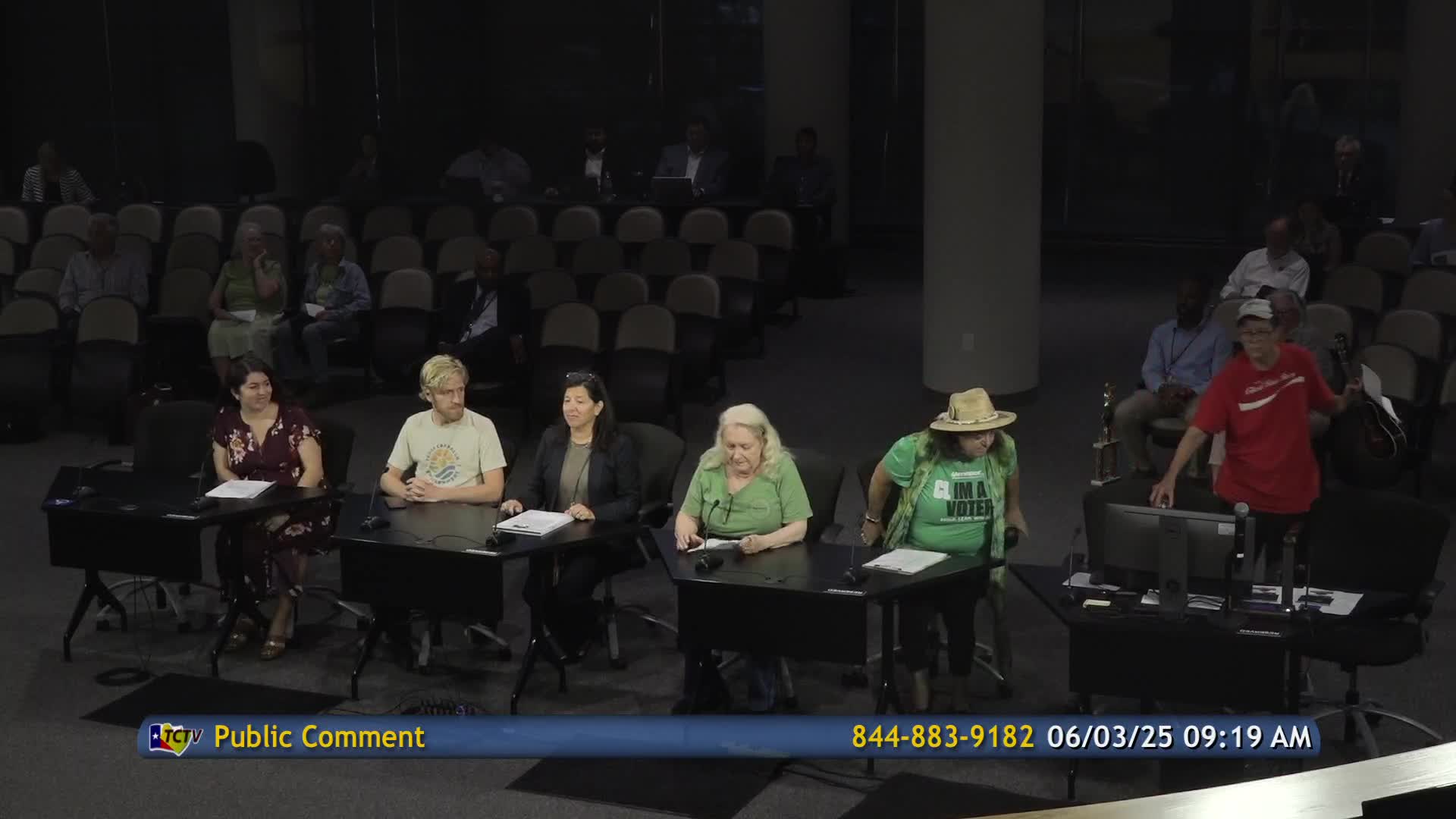
A group of Austin residents and public defender office staff urged the Travis County Commissioners Court on June 3 to move faster to implement Counsel at First Appearance, a county effort to give people access to an attorney at magistrate hearings.
Speakers said delays deny defendants a constitutional right and cause avoidable harms. “Navigating the legal system without representation, as you all know, can have devastating consequences,” Andrea Marquez said during the public-comment period.
The demonstrators — organized in part by the Austin Sanctuary Network — told the court they want full staffing on every shift and a clear timeline. Several cited a July implementation target and urged the court to accelerate it. Carol Jean Lewis Zavala said the county should “provide due process for all of its community members as the constitution mandates.”
Matthew Kennedy cited findings he said the ACLU reported from courtroom observations and asked the court to “staff every shift in this initiative so that no one else in our community has to endure this legal system without counsel, without an advocate.” Kennedy said, “The ACLU observed that magistrate judges have set bond without rationale in 73% of the hearings that they observed,” and described communication problems and other issues the ACLU documented.
Bridal Luis Savala, who identified herself as an investigation supervisor at the Public Defender’s Office but spoke primarily as a constituent, described volunteer observers who have “been going on the evenings and weekends to sit and bear witness” to magistrations and asked commissioners to join them. Lisa Rogers appealed to both constitutional and humanitarian reasons to fully fund CAFA, saying it would help people at risk of immigration detention avoid “fall[ing] in ICE’s hands.”
Several speakers referenced a county funding figure. “I know that the $15,500,000 allocated to fully staff and stand up this initiative,” Andrea Marquez said, “. . .” — language she used to characterize the budget request as part of her call for immediate implementation.
What the court said and did: the Commissioners Court listened to the public comment segment but did not take formal action on CAFA during the June 3 meeting. Commissioners and staff later discussed related pretrial budget items (see related article on electronic monitoring device funding) and said that county offices and community advocates are meeting about implementation details. Public commenters requested the court hold those charged with implementing CAFA accountable and to publicly confirm a full rollout for every shift.
Why it matters: Speakers tied CAFA to Sixth and Fourteenth Amendment protections and to local public-safety and fairness goals. They argued that counsel at the first magistrate hearing can reduce unnecessary detention, help avoid collateral harms (job loss, family separation, immigration consequences) and save taxpayer dollars by lowering jail days.
Courtroom context and next steps: The public comment block drew multiple speakers from the Austin Sanctuary Network and allies; several asked the Commissioners Court to respond to constituent emails, attend evening magistrations with volunteer observers, and to prioritize the public defender’s funding requests. The court did not announce any immediate policy change or vote on CAFA during the session; speakers asked staff and elected officials to report back and to confirm a firm implementation timetable.