Get email alerts on the County Executives Work Plans topic
No spam. Unsubscribe anytime.
Travis County executives outline FY25 priorities, emphasize diversion center, childcare and data-driven programs
Summary
County executives for Travis County presented their fiscal 2025 work plans to Commissioners Court on May 13, 2025, describing near‑term projects and longer‑term priorities including diversion‑center services, operationalizing voter‑approved childcare funding, expansion of Counsel at First Appearance and planning for replacement Star Flight aircraft.
County executives for Travis County presented their fiscal 2025 work plans to Commissioners Court on May 13, 2025, describing near-term projects and longer-term priorities including diversion-center services, operational plans for newly approved childcare funding, expansion of Counsel at First Appearance and planning for replacement Star Flight aircraft.
The presentations were a high-level review of departmental goals linked to the seven strategic goals the court adopted in March 2023, the Planning and Budget Office said. The county executive team asked the court for feedback on what “moving the needle” looks like and suggested reformatting future work plans so each department’s activities map directly to the seven strategic goals.
The briefing covered nine departments. Pilar Sanchez, Travis County executive for Health and Human Services (HHS), said HHS is “designing the HHS services in the [diversion] center” and working on juvenile justice deflection, a children’s crisis respite, and operationalizing the voter‑approved childcare funds, which she described as a substantial new initiative requiring contracting, evaluation and community engagement. Sanchez said HHS is preparing for potential state changes to foster care and possible reductions in federal funding.
Jeff Burkhart, county executive for Community Legal Services, highlighted progress on Counsel at First Appearance (CAFA), reporting that the Office of First Defense has one vacancy remaining and that CAFA will operate seven days a week, adding that the department is studying longer‑term plans for criminal, juvenile and family representation and exploring an appellate defender program.
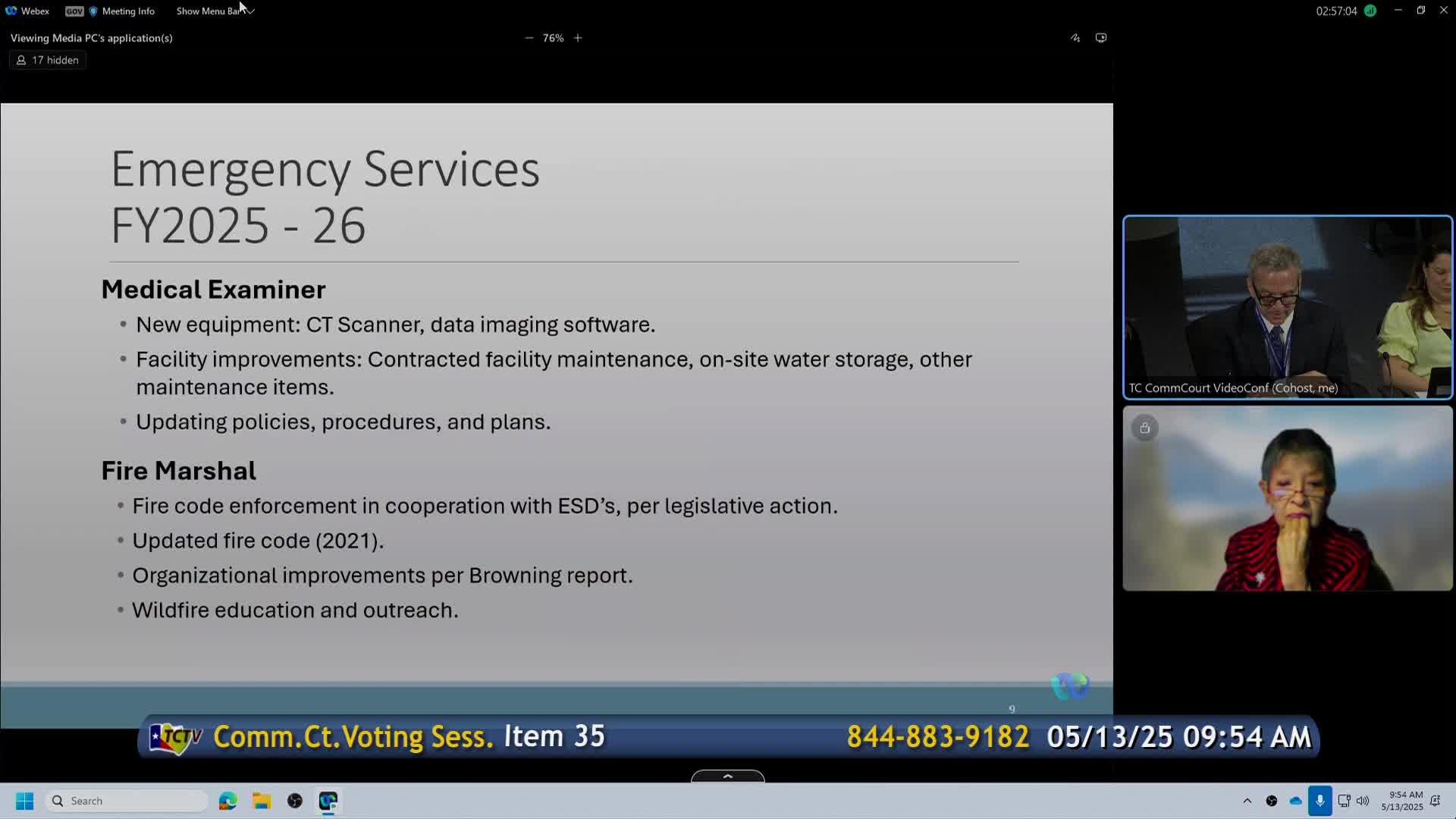
Chuck Brotherton, county executive for Emergency Services, summarized work on the medical examiner’s equipment replacement and recent facility repairs, the fire marshal office’s operational changes, restart of CERT teams and grant pursuit for hazard mitigation. He flagged planning for Star Flight aircraft replacements and a second Combined Transportation Emergency and Communications Center (CTEC‑2) to add resiliency for 911/dispatch functions.
Jackie Van Warmer, county executive for Innovative Justice and Program Analysis (IJPA), described counseling and education services, reentry programs and data research and planning that support CAFA and the mental‑health diversion effort. She said IJPA had conducted over 5,000 assessments this fiscal year and is building outcome measures to demonstrate cost‑benefit for diversion and reentry services.
Cynthia McDonald, county executive for Transportation and Natural Resources (TNR), described parks, water testing and land‑management work, wildfire fuel reduction, long‑range transportation and project delivery tied to the 2017 and 2023 bond programs, and a water‑availability study in progress. Paul Oppengardner (Technology & Operations) and Hector Nieto (Public Information Office) described efforts to modernize the county website, improve IT service delivery, expand communications capacity and prepare for data governance and artificial intelligence needs.
Julie Wheeler, intergovernmental relations officer, said staff are focused on passing the court’s legislative agenda and implementing grant management software and a grant risk assessment amid uncertain federal funding. Several commissioners asked for improved, routine communication with other elected officials and recommended department‑level briefings for the court or a recurring one‑department presentation during regular court sessions.
Court action: this was a briefing. Commissioners directed staff to refine work‑plan formatting to align deliverables to the court’s seven strategic goals and to return with more-detailed follow-up, including the Planning and Budget Office after the budget season. No formal budget or contract approvals were made during the item.
Going forward, executives said they will provide targeted follow‑ups on items the court requests, and several commissioners suggested bringing departments back individually to dig into details.
AI generated
The text on this page is AI generated. Summaries, highlights, analysis, and video transcripts are all produced from the original source material.
AI can make mistakes, so if you spot one, and we will fix it for everyone.
Note: the source content is unaltered by us. Any content source we link to, be it a video, an audio recording, or a document, is presented exactly as its publisher released it. That publisher is usually a government body, sometimes an individual official or another organisation.