
Travis County leaders say Austin State Hospital jail diversion bill failed; county staff to regroup on mental‑health strategy
Get AI-powered insights, summaries, and transcripts
Subscribe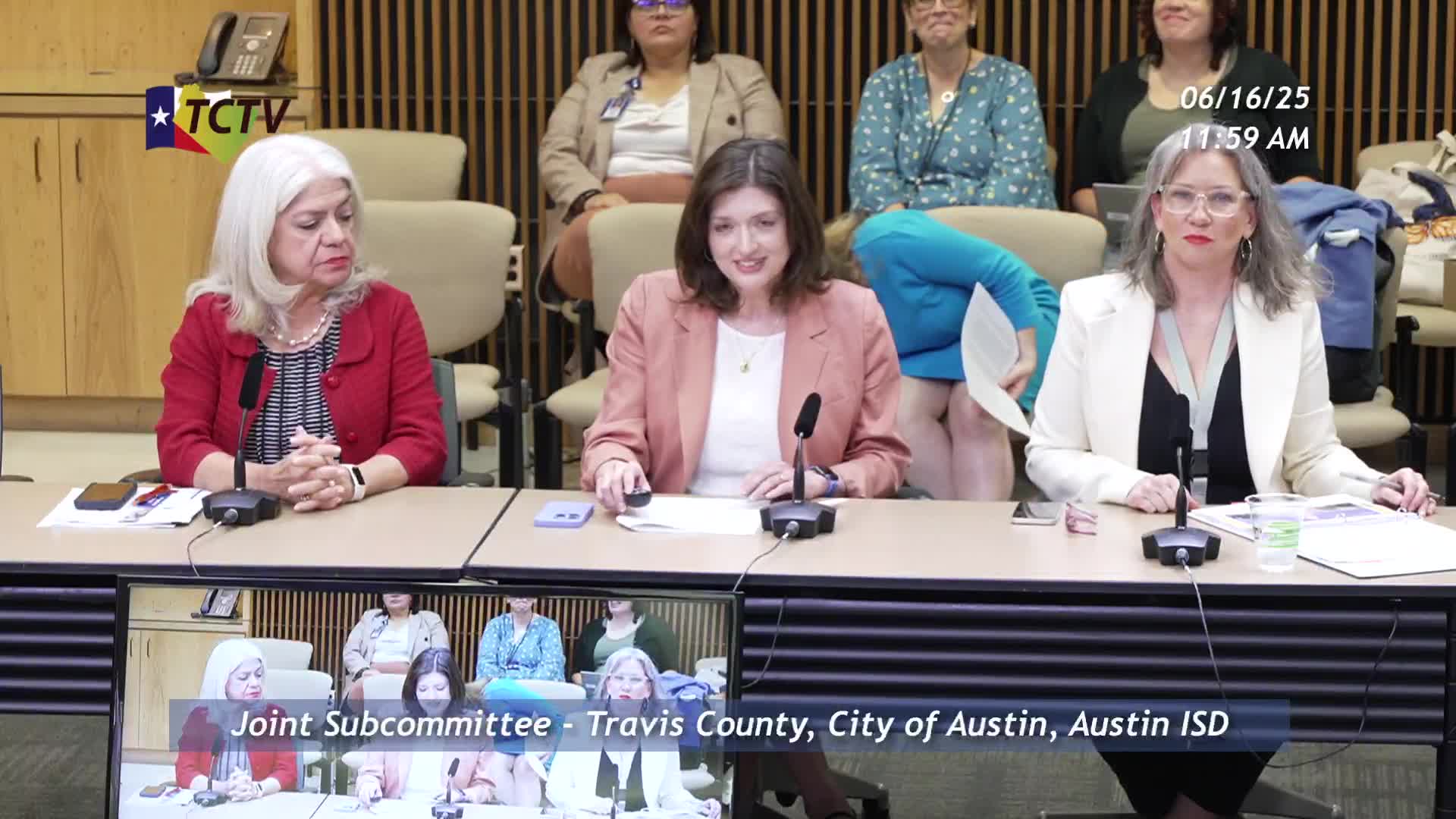
Summary
Travis County legislative staff told the joint subcommittee that a bill to use decommissioned Austin State Hospital sites for a jail‑diversion mental health center did not pass; staff also summarized other session outcomes including bills on 287(g) agreements, bail changes and land‑use preemption that will affect county operations.
Julie Wheeler, intergovernmental relations officer for Travis County, told the joint subcommittee that a county priority to establish a jail‑diversion mental‑health center using decommissioned Austin State Hospital sites passed one chamber but did not reach final enactment this session.
Wheeler said the Austin State Hospital initiative "did get past the house, did not pass over to the final chamber." She said the county will explore next steps and that passing the proposal will require broad community effort.
Wheeler reviewed a range of other legislative outcomes affecting the county. She said bills that did pass include measures affecting early‑voting timing and voter-registration rules (Senate Bill 2753) and changes tied to immigration enforcement that authorize 287(g)-type agreements with local sheriffs and ICE (SB 8). On that topic Wheeler said the final language allows local flexibility: the county "will be able to gauge our level of engagement within that one."
On criminal-justice changes she said Senate Bill 9, which limits judicial discretion on bail for certain charges, passed and that a related constitutional amendment (SJR 5) will go to the November ballot. Wheeler flagged that several preemption and land-use proposals that would have constrained local authority did not pass after intense lobbying; she singled out HB 23 and similar measures as threats to local land-use control.
Why it matters: Several enacted or proposed measures have operational implications for county public safety, courts, elections and land-use administration. Wheeler identified SB 8 as a high-impact item because it creates options for immigration enforcement agreements that previously were not available in the same form.
Wheeler also reported on smaller but notable outcomes that passed, including a medical‑examiner privacy change allowing shielding certain next‑of‑kin information from third‑party requests. She noted property-tax and debt proposals that did not move forward and said the session was notable for the number of high‑impact bills that failed as well as the ones that passed.
What—s next: The county will review options to revive the mental‑health diversion center proposal in future sessions and coordinate with city and school partners where county operations intersect with incarceration, public health and land use. Wheeler asked for input and community support if the county reintroduces the Austin State Hospital initiative.
Ending: Wheeler closed by saying, "we came through maybe bruised and battered, but not bleeding," and encouraged continued intergovernmental cooperation as the county translates enacted laws into local policy and operations.