
Austin ISD projects $93 million deficit, plans central-office reductions as new state school funding and mandates arrive
Get AI-powered insights, summaries, and transcripts
Subscribe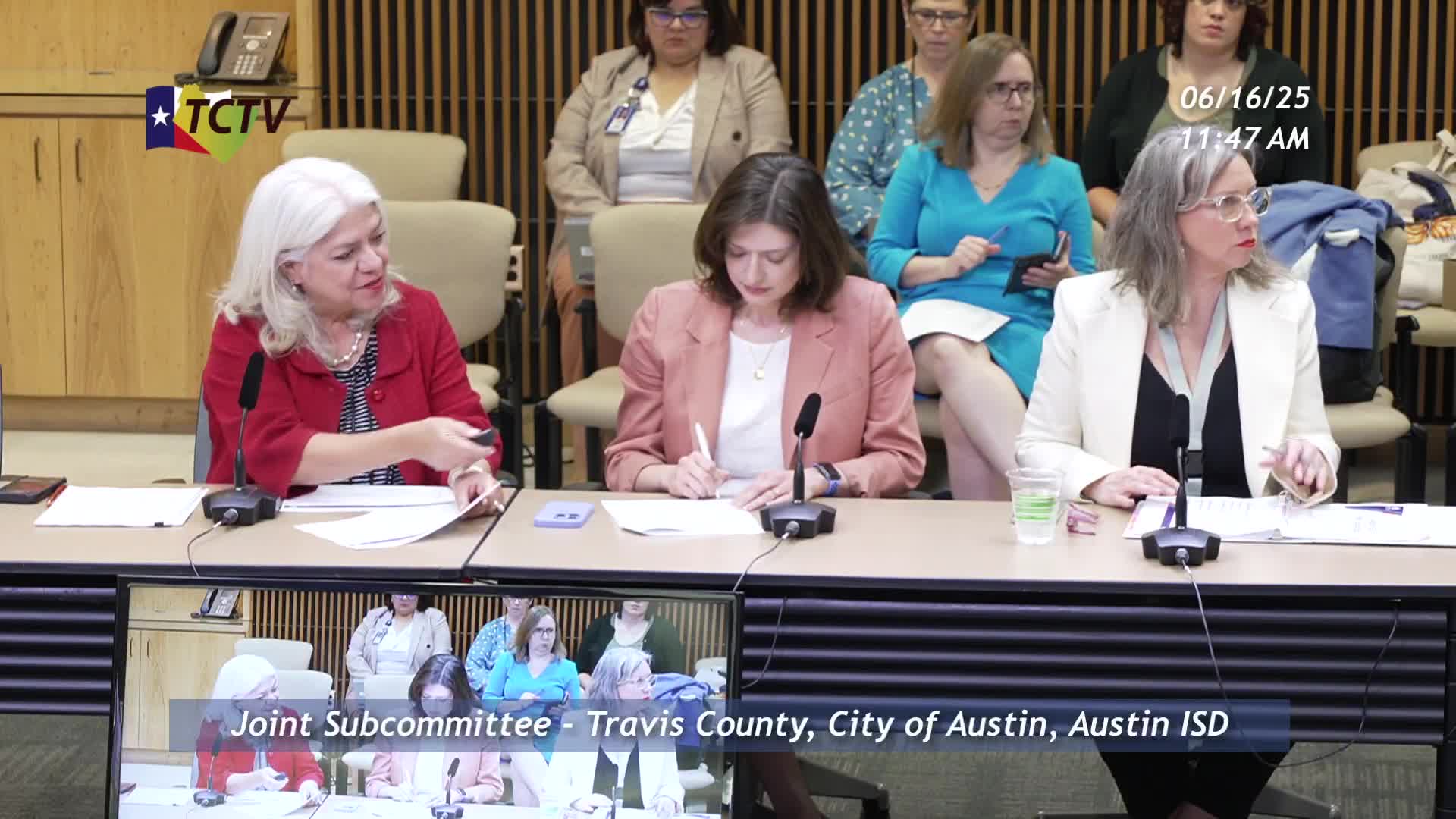
Summary
Austin ISD officials told a joint city-county-school subcommittee that the district expects about a $93 million deficit for the current fiscal year and is pursuing central-office restructuring and other cuts while implementing new state funding and mandates in House Bill 2 and related legislation.
Austin Independent School District officials told a joint meeting of the Austin City Council, Travis County Commissioners Court and the AISD Board on June 11 that the district is closing the current fiscal year with a projected $93 million operating deficit and plans central-office reductions and other force reductions to protect classroom services.
The district—s interim chief financial officer, Katrina Montgomery, said, "As of the May, it's showing that we have a projected $93,000,000 deficit." She outlined steps taken this year including a hiring freeze (excluding special education), spending controls on procurement cards and other reductions that reduced the projected shortfall from a January high of about $110 million.
Why it matters: The shortfall shapes classroom and district-level services for the coming year and comes as the Legislature passed multiple school-finance and policy changes that districts must operationalize. Edna Butts, presenting AISD—s legislative summary, noted the scale of state action: "the legislature appropriated $8,500,000,000" in the school funding bill commonly cited as House Bill 2, while also creating new allotments and mandates districts must implement.
AISD described the budget mechanics and planned actions in inverted-pyramid order. Montgomery said the district will present a recommended FY 2025-26 budget to the board for adoption on June 26; the proposed general-fund deficit for that budget is about $19.7 million while preserving a 15.21% fund balance through temporary changes to the district—s fund-balance policy. The district expects to draw on debt-service and other reserves where available and pursue revenue and expense strategies including sale of two excess properties (estimated $45 million in potential proceeds), tighter state funding reconciliation and operational efficiencies such as master-schedule optimization.
Superintendent Segura and staff stressed the constraints the district faces from both revenue and new state mandates. Segura said of HB 2 safety funding and local staffing choices, "For our model, 1 that aligns with our values, it does not meet or come close to even meeting the cost associated with it." Edna Butts explained that state changes include increases to the basic allotment, a new "allotment for basic costs," a teacher-retention allotment, a $45-per-ADA support-staff allotment and a larger school-safety allotment that doubled from $10 to $20 per student and increased per-campus funding; she noted districts still worry those amounts will not cover actual local costs.
District leaders emphasized implementation work remains. Montgomery described a central-office realignment aimed at $10 million in savings with a timeline that includes staff notifications in mid-June and employment changes effective Aug. 1. She said the district has used vacancy savings historically and cannot rely on those savings going forward because staffing rates have improved.
Board and committee members pressed for more transparent tracking. Commissioner Trevillion asked for a delta report showing adopted budget assumptions and subsequent changes; trustees and commissioners requested documentation tying specific cuts to impacts on Title I and other high-need campuses. Montgomery and other AISD leaders said they have a Support and Resource Index (SRI) and other analytic tools to target supports and to apply reductions in a differentiated way.
What—s next: AISD will bring the FY 2025-26 budget to its board on June 26. The district will continue operational work to enact the central-office realignment and other cost-saving strategies while seeking clarity on how new state allotments will affect recapture calculations and net revenue.
Ending: District officials asked for continued engagement from city and county partners as they finalize the budget and implement staffing and program changes in the coming months.