Get Full Government Meeting Transcripts, Videos, & Alerts Forever!
Get email alerts on the Environment Species Conservation topic
No spam. Unsubscribe anytime.
Travis County adopts resolution to conserve at‑risk species, staff to pursue Balcones Canyonlands plan expansion
Summary
Travis County Commissioners voted unanimously June 10 to adopt a resolution directing county departments to coordinate conservation of at‑risk species and to pursue habitat‑scale permitting options; staff recommended expanding the Balcones Canyonlands Conservation Plan as the most efficient permitting path.
Travis County Commissioners on Tuesday unanimously approved a resolution directing county staff to coordinate across departments to conserve and recover at‑risk plant and animal species and to explore permitting options under the federal Endangered Species Act.
The resolution, moved by Commissioner Shea and seconded by Commissioner Trevillian, formalizes earlier staff briefings and directs the Transportation and Natural Resources (TNR) department to identify operational adjustments and cross‑departmental opportunities to protect habitat and species while preserving public‑safety and other essential services.
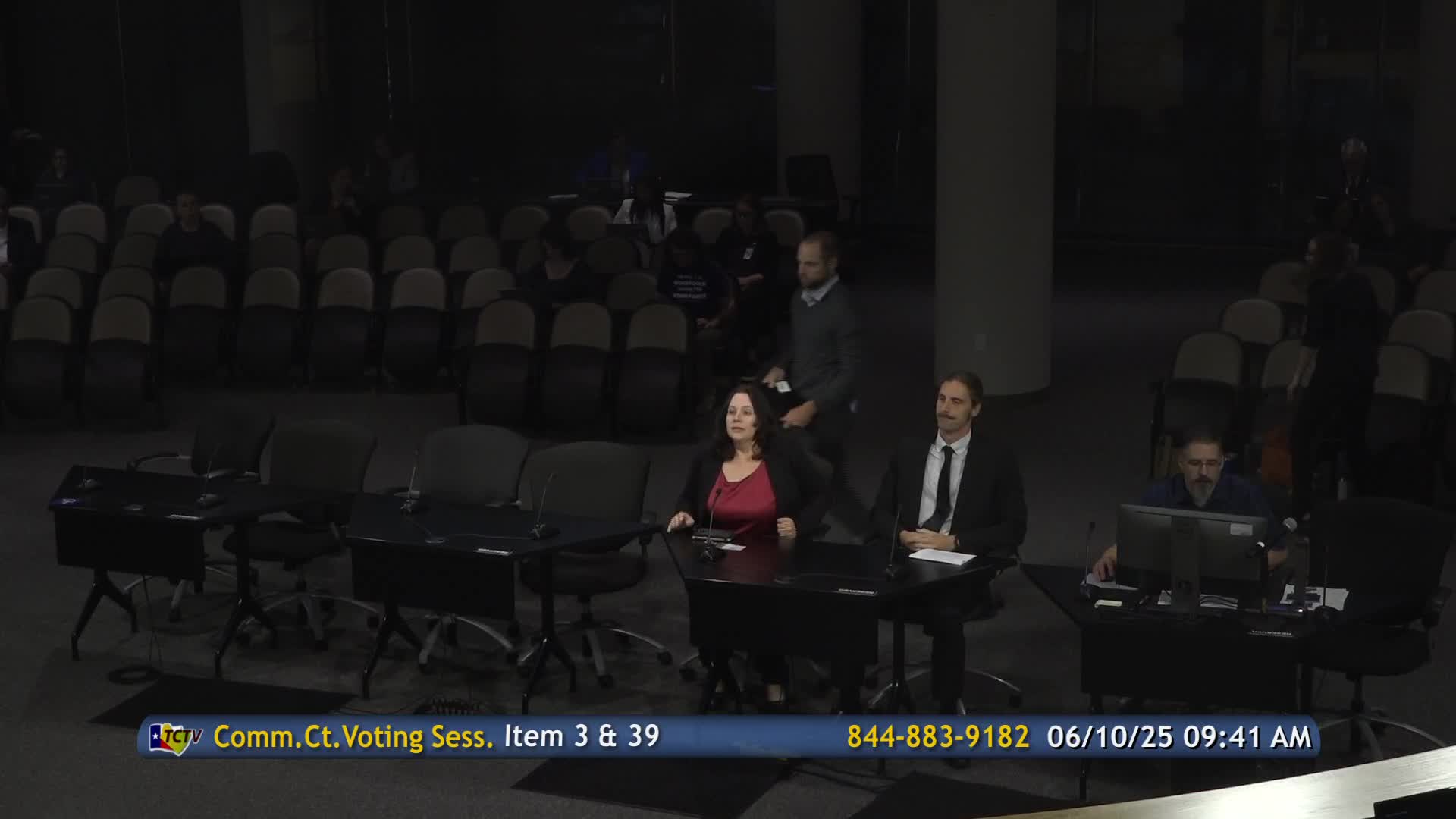
The vote follows a briefing by TNR Environmental Project Manager Deborah Scott and a technical presentation by Jared Haney, senior biologist with consultant ICF. Scott told the court staff had identified 11 species of concern in Travis County and hired ICF to evaluate options for incidental‑take coverage if those species become listed. Haney said the analysis compared six compliance approaches — short‑term measures such as avoidance and project‑by‑project permits, and landscape‑scale Habitat Conservation Plan (HCP) options. "The highest scoring option was expanding the Balcones Canyonlands Conservation Plan (BCCP)," Haney said, because it builds on an existing, 30‑year program and existing preserve system, he said.
ICF estimated a BCCP expansion could cost in the ballpark of $1 million to $2 million shared among partners and take roughly three to five years; a Travis County–only regional HCP would likely cost more and take a similar or longer time to complete. County staff emphasized no immediate action was required by the court today; the vote directs staff to continue the renewal and expansion work and to return with any necessary action items and contract requests.
Commissioners and staff discussed next steps including public participation, biological advisory teams, NEPA review, and potential Section 6 grant applications to the U.S. Fish and Wildlife Service. Commissioner Trevillian asked whether costs being discussed were additional to work already underway; staff said some renewal work is required by Fish and Wildlife regardless of expansion and that the county was in the early phase of renewal. Haney said the renewal phases — planning, technical analysis, drafting, federal review/NEPA and implementation — are expected to take about 36 to 64 months in total.
The resolution instructs TNR to work with other county departments on operational adjustments such as seasonal restrictions on vegetation management, native plantings for pollinators, incorporation of at‑risk species considerations into master plans, public outreach, and water‑conservation practices while ensuring essential public‑safety activities are not impeded. The court approved the resolution unanimously.
County staff said they will return with more detailed proposals, including estimates of what work will be covered by the renewal process and what would require new funding requests.