County commissioners hear pitch for paid renewable-energy advisory services as local projects grow
Loading...
Summary
A consultant told Pratt County commissioners his firm can help counties negotiate payments, ordinances and road-use terms for wind, solar and storage projects and recommended a $35,000 up-front engagement; commissioners discussed statutory exemptions, pilot payments and road use but took no formal action.
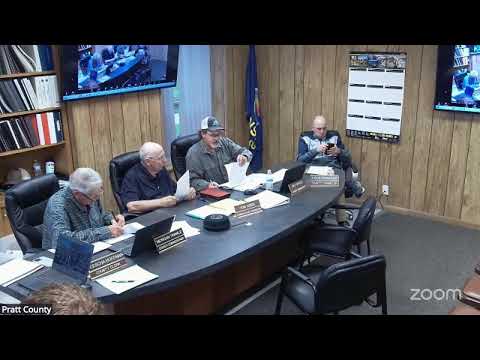
Pratt County commissioners on the dais heard a presentation from a consultant about hiring an advisory firm to help counties negotiate financial terms, ordinances and road-use agreements for renewable-energy projects that are expanding in the region. Tom Jones, who introduced himself as a representative of a consultant and advisory firm that works with counties, said his firm analyzes project cash flows and negotiates pilot payments or other compensation on behalf of local governments.
Jones said the firm charges an up-front fee and stays on for a year to support ordinance drafting and subsequent negotiations. "We take a fee. It's 35,000 up front. We revamp all your ordinances. We remain on board for that full year," he said. He also told commissioners his team can develop financial estimates when developers decline to provide full project data: "We're saying, you know, the range is gonna be between here and here for a project of this size. And then, also, we can back that up."
The presentation came as commissioners and staff described existing local projects, repowering of two wind farms and an expected battery-storage proposal. During the discussion, a county commissioner asked whether the consultant's office employed lawyers; Jones replied his firm provides commercial-term advice and that the county attorney would review legal language. A different commissioner referenced a ten-year exemption for some projects and the limits that creates for county leverage, saying, "There's a 10 year exemption," and noting that statutory exemptions constrain bargaining positions.
Jones described typical modeling inputs — panel, inverter and racking costs, project size and a net capacity factor — and said his firm aims to produce a revenue/cost view commissioners can use to assess whether a county should press for higher payments or additional protections. He said the firm plans to open an office in Wichita in January and that it is in conversations with other counties.
Commissioners repeatedly cautioned that statutory exemptions limit bargaining power and that counties may be unable to withhold project approvals solely to demand higher payments. No motion or formal action to hire the consultant was made during the meeting. The commission instead discussed whether the information would be valuable enough to justify engagement and suggested the presenter seek opportunities to brief county associations.
The commission later entered an attorney‑client executive session that included discussion of a solar project; the session ended with no formal action.
The consultant presentation adds to ongoing local discussions as Pratt County considers how to handle repowering, new projects and related infrastructure impacts such as road use and long‑term land impacts.