
Health & Human Services asks for dedicated substance‑use planner, training staff for senior programs and temporary funds after AARP site suspensions
Get AI-powered insights, summaries, and transcripts
Subscribe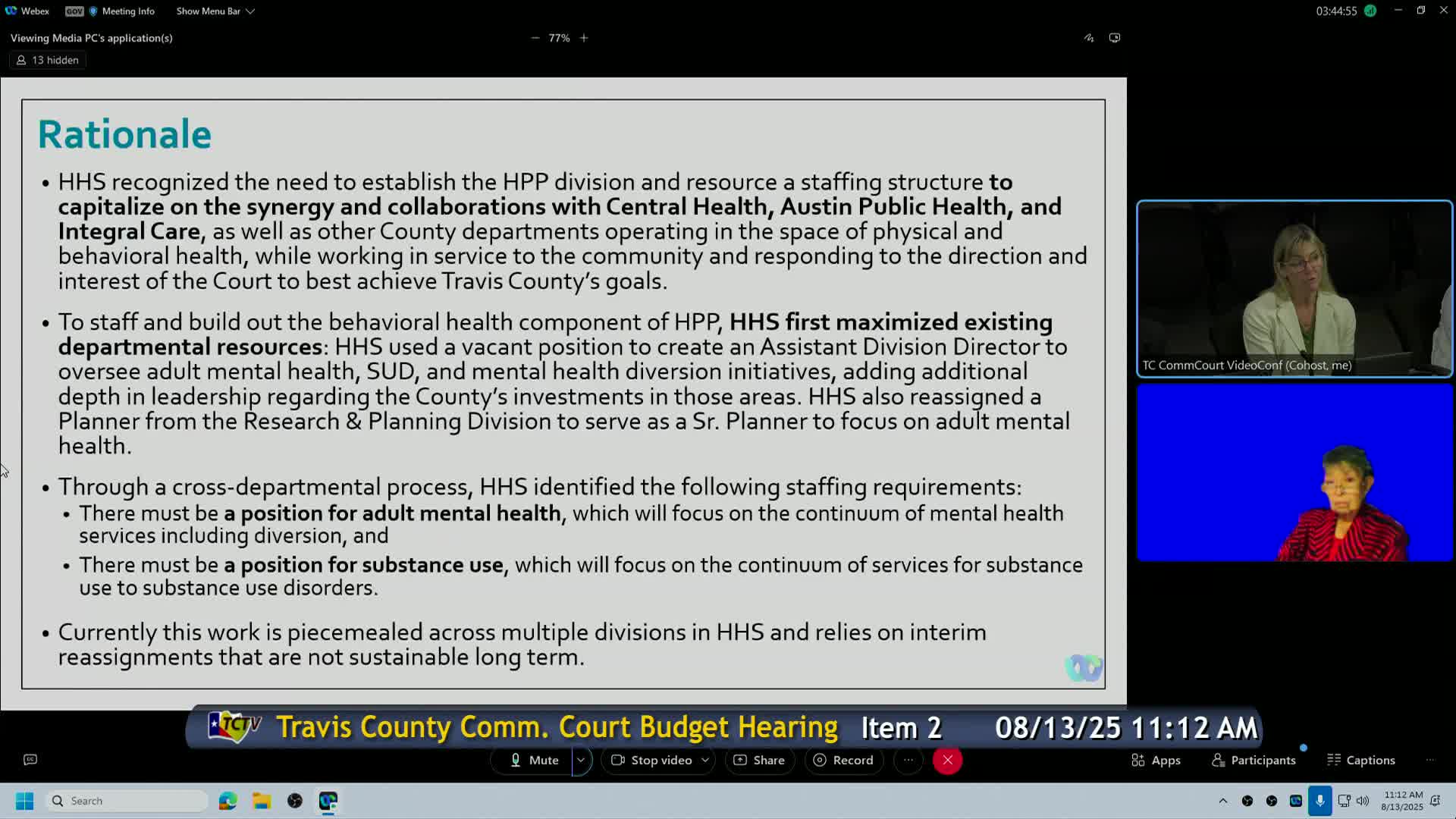
Summary
HHS requested a senior planner focused on substance use disorder (SUD) planning, two part‑time education/training coordinators for the Engage program, and $180,000 to replace AARP Foundation Community Service Employment Program participants who were suspended, shifting temporary staffing costs to the county.
Travis County Health & Human Services presented three items at the preliminary budget hearing on Aug. 13: a dedicated senior planner for substance use disorder planning within the newly formed Health Planning & Partnerships division; two part‑time education/training coordinators for the Engage aging and disability program; and funding to replace AARP Foundation Community Service Employment Program participants who were suspended, a change that is producing an immediate budget shortfall for family support services.
HHS explained the SUD senior planner request ($133,453 total) would create a permanent county position to coordinate substance use disorder planning across interlocal contracts, manage opioid abatement and other settlement funds, supervise a county‑wide SUD consortium convener contract, and work with partners (Integral Care, Central Health, Austin Public Health) on systemwide SUD strategy and procurement. HHS noted opioid settlement funds have come in three disbursements totaling about $3.1 million so far and are expected annually for up to 15 years, but staff cautioned those disbursements and amounts vary and cannot be relied on to fund a permanent payroll obligation without explicit direction; staff asked the court whether a one‑time opioid settlement special‑project worker option should be included as a worksheet option in case commissioners prefer that approach.
HHS also requested two part‑time trainers for the Engage program (cost $96,000) to support evidence‑based health and wellness classes for older adults and persons with disabilities and help recruit and coordinate volunteers. Commissioners and HHS discussed tying those coordinator duties to volunteer recruitment and local partners such as CAPCOG.
Finally, Family Support Services presented an urgent request to cover an unplanned $180,000 annual cost after the AARP CSEP participants were suspended on July 1; 12 AARP participants worked at six community centers doing food pantry and front‑desk duties and their suspension created immediate staffing gaps that the department has filled temporarily with OpenWork agency staff at municipal rates. HHS said the county could pursue recruiting the formerly placed seniors into county temporary jobs or coordinate with Engage volunteers, but asked for short‑term funds to avoid reduced services (food pantry hours, front‑desk coverage) while longer‑term options are explored.
Commissioners asked whether opioid settlement funds could be used for the SUD planner; HHS and PBO said opioid funds are one‑time and variable and recommended offering a one‑time special‑project option in the budget worksheet while exploring whether recurring general fund or other long‑term funding is appropriate. Planning & Budget agreed to include an opioid‑funded one‑time alternative on the budget worksheet for the court’s markup consideration.