Get Full Government Meeting Transcripts, Videos, & Alerts Forever!
Get email alerts on the Capital Budget topic
No spam. Unsubscribe anytime.
Travis County preliminary budget sets $299.2M for capital, $152M CAR reserve including $86M for jail diversion
Summary
County staff presented a preliminary FY26 capital plan that recommends $299.2 million in capital funding, split among department projects, a $152 million capital acquisition resources (CAR) reserve with large earmarks and a planned $66.8 million certificates-of-obligation sale. Commissioners asked for more detail on earmarks and timing.
Travis County staff presented a preliminary FY26 capital budget on Aug. 15 that recommends $299.2 million in capital allocations, including $80.4 million for department projects, $152.0 million held in a capital acquisition resources (CAR) reserve and a proposed certificates-of-obligation (CO) issuance of $66.8 million. County Executive Jessica Rio, Planning and Budget, said the CAR reserve "includes earmarks totaling approximately $145,000,000" and that major earmarks include $86.2 million for the jail diversion and central booking facility and $13.0 million for additional deferred maintenance.
The CAR reserve and CO plan are part of the preliminary budget packet the court will consider during fiscal-year deliberations. "This issuance will be primarily for road projects and TNR as well as two projects identified as CO eligible in FMD," Rio said of the $66.8 million planned spring 2026 CO sale, which staff estimated would include roughly $464,000 of issuance costs.
Why it matters: the CAR reserve is the county's pool of one‑time capital cash the court can allocate during budget markups; earmarks in the reserve do not automatically flow to departments without further court action. That creates a pool of uncommitted but identified cash that commissioners can direct later.
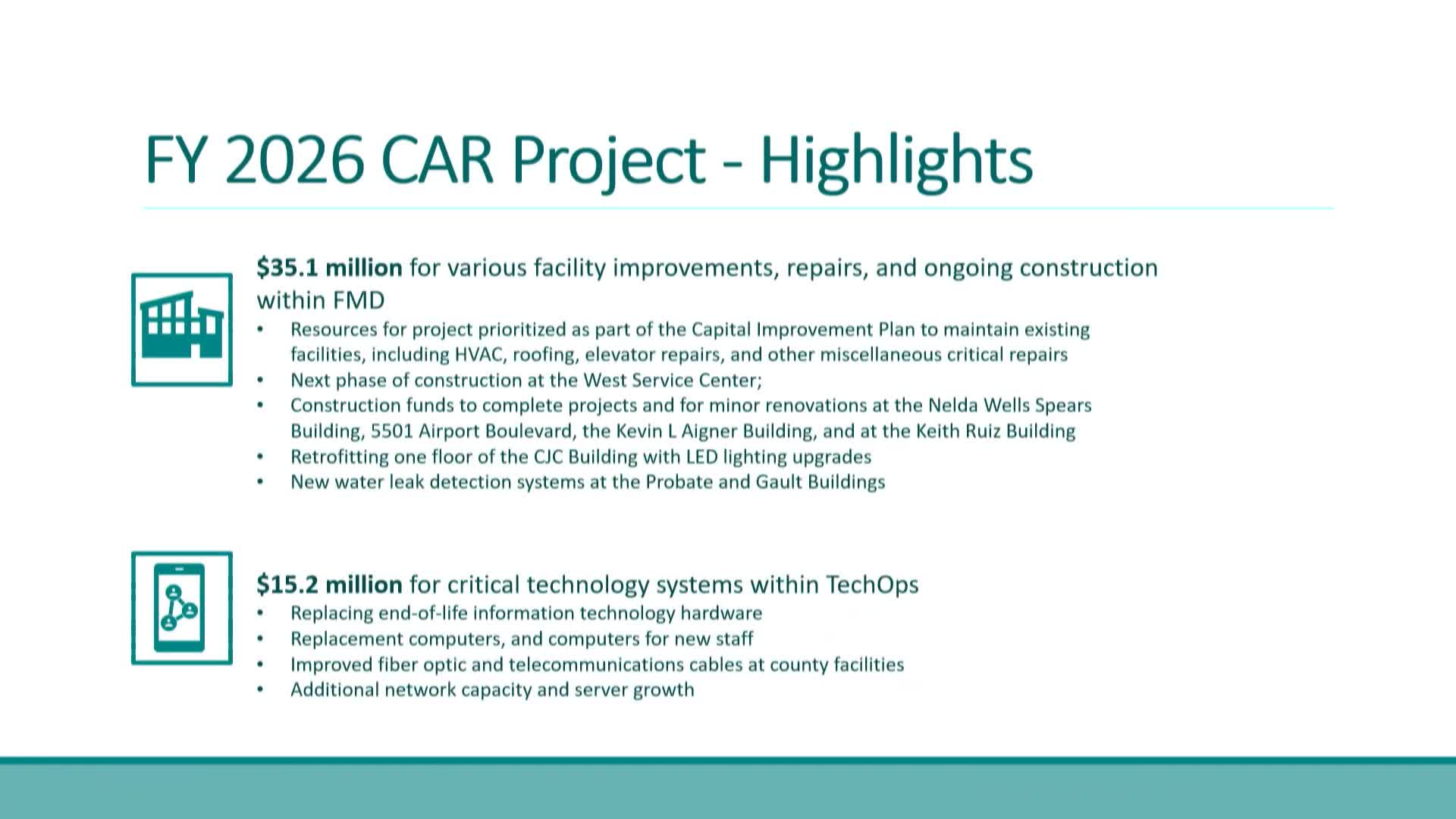
Most important details: staff told the court the FY26 preliminary recommendations include $35.0 million for facilities management (FMD) projects and repairs, of which about $27.0 million is allocated directly to projects FMD can execute and $13.0 million is an earmark for additional deferred maintenance. Tech Ops would receive $15.2 million for critical technology systems, including hardware replacement, fiber/telecom work and expanded network capacity. The budget also includes $2.7 million for Starflight helicopter service and warranties and $14.6 million for sheriff's office and juvenile facility maintenance and IT upgrades, including funding for an ADA bathroom remodel at Gardner Bets mentioned in the presentation.
Staff emphasized that earmarks are placeholders that require subsequent court discussion and allocation. Rio said, "Since these are earmarks, PBO and departments will bring these to court again for discussion prior to allocating the resources to the department and office budgets should this list of earmarks be approved in the budget." She directed the court to a comprehensive earmark list in the preliminary budget executive summary (page 95).
Commissioners questioned prioritization and risk. Commissioner Jeff Trevillion asked whether staff had completed risk assessments to identify near-term priorities among large earmarks; staff replied that some earmarks reflected projects with outstanding policy or timing questions (for example, the Expo Center lease and long‑term role for that facility) and that the court intentionally left those as earmarks rather than direct allocations to preserve time for policy discussion. Jessica Rio said the jail diversion earmark "has grown year over year" and will likely be partly debt financed, but she recommended retaining cash flexibility because "parts of it may not be CO eligible."
Background and next steps: staff said the county's facilities condition assessment found an annual need of about $40 million to address deferred maintenance over the next 20 years; FY26's package attempts to fund that level for the coming year. The CO issuance and earmark list are subject to change; departments and Planning & Budget will return to Commissioners Court with refined proposals and, where necessary, options for partial funding. The court will receive a budget agenda worksheet from staff ahead of markups and can request alternative funding scenarios for specific items.
Ending: staff asked departments to be responsive as budget worksheets are finalized and signaled the CO issuance plan will return to court for final approval closer to the spring 2026 issuance date.