
D.C. Council approves FY2026 budget after fraught debate with CFO; contingency cuts, conditional restorations pinned to fall revenue estimate
Get AI-powered insights, summaries, and transcripts
Subscribe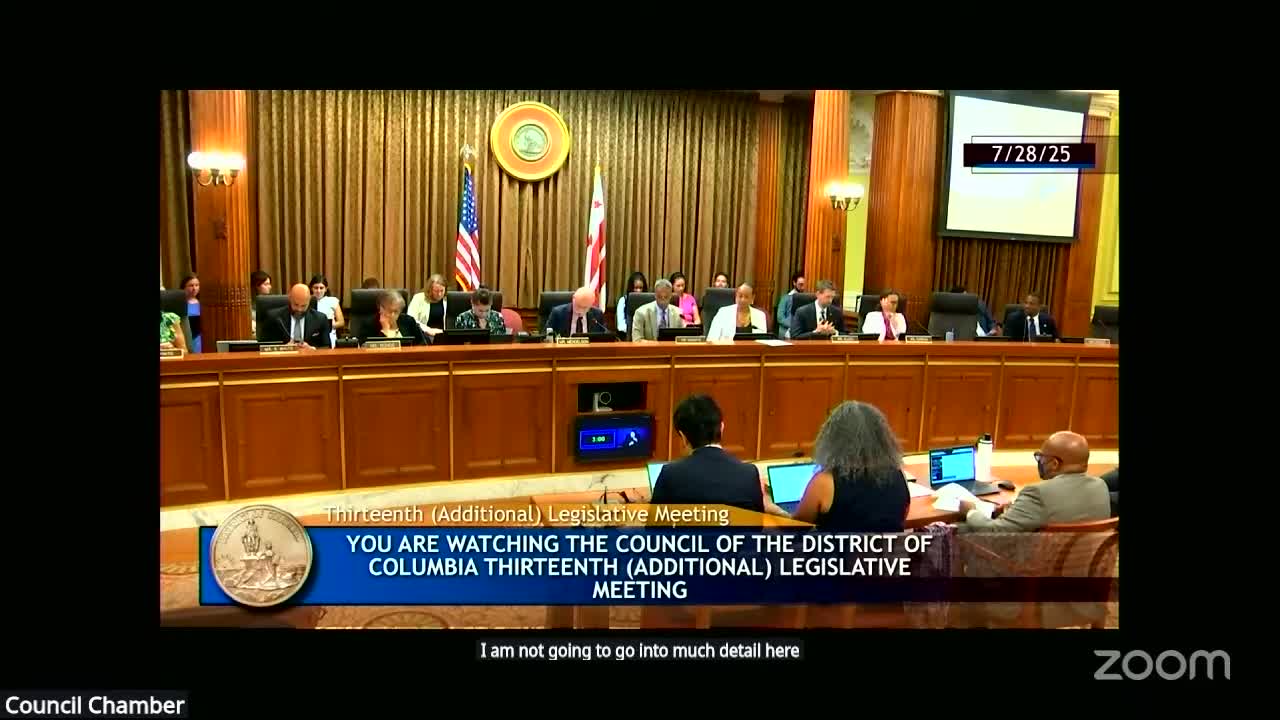
Summary
After an extended, contentious session on July 28 the D.C. Council adopted the fiscal year 2026 Local Budget Act and Budget Support Act with several late amendments, a new contingency ordering and conditional restorations tied to a September revenue estimate.
WASHINGTON — The D.C. Council approved the fiscal year 2026 budget on July 28 after protracted debate over last‑minute cuts, a holdback demanded by the chief financial officer and conditional restorations tied to a September revenue estimate.
What happened: The council approved the Local Budget Act and the companion Budget Support Act after a series of roll‑call votes on amendments that reallocated and in some cases temporarily cut funding for programs ranging from affordable housing preservation to legal services and a child tax credit. Chair Phil Mendelson said he moved a targeted appropriation change after the chief financial officer told the council he “cannot attest that the FY 2026 budget and financial plan is in balance” without leaving roughly $244 million available to the CFO for overspending and reserve replenishment.
Key points of the floor debate
• Mendelson vs. CFO: Mendelson described the amendment as forced “under duress” by the CFO’s demand to hold a large unallocated balance in reserve. He said the budgets before the council had been certified as balanced in May but that the CFO later revised revenue estimates and asked the council to leave $244 million unspent to cover overspending and replenish contingency reserves. Mendelson challenged the CFO’s authority to require that action but said he was moving a narrowly framed amendment to address the CFO’s certification concern so that the budget could move forward.
• Restorations and contingency prioritization: The chair’s amendment moved $29,983,207 into a new “appropriation of additional resources” category so the CFO could certify the books and the council could proceed. Council members then negotiated a ranked list of contingent restorations — programs that would be restored if additional September revenues and overspending reconciliations made money available. Council member Lewis George led a reordering of the contingency list to prioritize a child care subsidy, educator pay equity, housing preservation, DNA testing capacity at the Department of Forensic Sciences and emergency rental assistance, among other items. The list also added a proposed restoration for the Health Care Alliance, if funding materialized.
• Preservation and housing funding: Council member Robert White moved an amendment that dedicates $20 million from the Housing Production Trust Fund to preservation in FY2026, with flexibility for additional amounts up to $30 million tied to the fund balance; the council approved that amendment. White argued preservation was a faster, cost‑effective way to protect existing affordability amid a sharp loss of low‑cost rental units.
• Access to justice, child tax credit and childcare subsidy fights: Council member Anita Bonds and others defended funding for civil legal services. Council members Council member Pinto and Council member Parker circulated late amendments that would have shifted money from cultural and tourism accounts to restore or boost access to justice funding, childcare subsidies, DNA testing and a child tax credit; some of those proposals were withdrawn or failed after long debate. Parker’s proposal for a small graduated capital gains surcharge to raise revenue for child tax credits, supportive housing vouchers and other high‑priority items was debated and failed on a roll call (5 yeses, 7 nos).
• Stadium and events funding: The approved capital budget included line items for major sports projects the council had discussed earlier in the year — notably $385 million listed for Nationals Park modernization and $500 million for a proposed new stadium for the Commanders (RFK redevelopment funding had been in the mayor’s budget proposal and remained in the council’s appropriation).
Votes and formal actions (high level)
• Motion to add an “appropriation of additional resources” holdback of $29,983,207 (Mendelson amendment) — adopted by the council to accommodate the CFO’s attestation requirement.
• Housing preservation amendment (Council member Robert White) — adopted: dedicated $20 million to preservation in FY2026 and allowed up to $30 million tied to additional housing trust fund amounts noted in the budget.
• Parker revenue surcharge proposal (capital gains surcharge & other changes) — defeated by roll call (5 yes, 7 no).
• Multiple other amendments (school reallocations, charter school lead testing, Chinatown stabilization and conversion incentives, wayfinding kiosks, etc.) were offered, debated and either approved, withdrawn, or failed; a number were technical or moved to the Budget Support Act (BSA) and Local Budget Act (LBA) packages.
Voices from the floor
• Phil Mendelson (Chairman, Council of the District of Columbia): “The chief financial officer has stated that without this amendment, ‘I cannot attest that the FY 2026 budget and financial plan is in balance.’ Therefore, this amendment removes, that is, cuts $29,983,207 from the fiscal year 2026 budget before us for a second reading.”
• Robert White (Council member): Advocated for preservation funding and argued the city needs to prioritize keeping existing affordable housing.
• Council member Parker: Argued for revenue measures to avoid cuts and to fund vulnerable services; proposed a capital gains surcharge that failed.
Discussion vs. decision
• Discussion: Council members debated whether to accept the CFO’s demand that large sums remain unspent to cover overspending or to resist and reallocate the money to programs. Members also questioned whether the CFO had legal authority to dictate reserve rules; Mendelson said the CFO’s role is technical but does not permit directing council appropriations.
• Direction: The council adopted a ranked contingency list of program restorations to be triggered if September revenue estimates and reconciliations free up funds.
• Decisions: The council passed the FY2026 LBA and BSA with the amendments described. Several program restorations were placed on a contingent list and tied to a September revenue estimate and year‑end overspending reconciliation.
Clarifying details from the meeting
• Mendelson and CFO figures: The CFO advised that an additional $243.7 million was not available (or must be held back) but did not provide an itemized account in public debate; Mendelson characterized the demand as requiring the council to leave $244 million in reserve. Mendelson said the budgets before the council had been certified as balanced in May on the February 2025 revenue estimate, and the CFO’s later change required the amendment.
• Capital: $385 million (Nationals Park modernization) and $500 million (Commanders stadium) listed in the capital plan as explicit projects.
• Housing preservation: White noted the loss of low‑cost rentals and argued for reallocation of HPTF dollars; he moved $20 million to preservation, with up to $30 million allowable if other amounts were added to the fund.
Proper names mentioned
Office of the Chief Financial Officer (OCFO); National Park(s) funding; RFK Stadium/Commanders; Housing Production Trust Fund (HPTF); Department of Forensic Sciences; Office of Attorney General (OAG); DC Net; Office of the Mayor; Department of Human Services (DHS); Department of Energy and Environment (DOEE); Office of the State Superintendent for Education (OSSE).
Who spoke (attributed quotes in article)
• Phil Mendelson — Chairman, Council of the District of Columbia (quote attributing CFO statement). • Robert White — Council member, Committee on Housing (housing preservation amendment). • Brianne Nadeau — Council member (motion/roll‑call procedural actions and participation). • Parker, Pinto, Louis George, Lewis and others — floor participants in budget votes and amendments.
Community relevance
• Geographies: District of Columbia (citywide). Major capital projects and operating decisions affect city services and neighborhoods. • Impact groups: low‑income households, renters, public service recipients (child care, legal services), public safety programs, affordable housing developers.
Meeting context
• Engagement level: Very high — the budget consumed the bulk of a long, additional legislative meeting and produced multiple late amendments and floor negotiations. • Implementation risk: High — many restorations were conditioned on an uncertain September revenue estimate and an OCFO reconciliation of overspending; the CFO’s attestation requirement drove several last‑minute choices. • History: This was final action on FY2026 matters after first‑reading approvals earlier in July; the council had previously passed related first‑reading budgets and circuited amendments in the weeks prior.
Searchable tags
[fy2026,budget,appropriations,CFO,reserve,HPTF,preservation,childcare,access_to_justice,stadium,RFK,NationalsPark]
Provenance (transcript evidence)
• topicintro: {"block_id":"block_9620.439","local_start":0,"local_end":420,"evidence_excerpt":"We will turn now to bill 26 dash 2 60, fiscal year 2026, local budget act of 2025. I am not going to go into much detail here. To reiterate what we approved on first reading 2 weeks ago, what is before us now is final reading." ,"reason_code":"topicintro"}
• topicfinish: {"block_id":"block_27265.908","local_start":0,"local_end":360,"evidence_excerpt":"The ayes have it, and council members Lewis, George, and Parker recorded as voting no. We are gonna turn now at 07:28PM to the emergencies." ,"reason_code":"topicfinish"}
Salience
{"overall":0.92,"overall_justification":"The budget is the council’s most consequential annual decision; decisions affect city services, major capital projects and vulnerable residents.","impact_scope":"local","impact_scope_justification":"The FY2026 budget governs all District government spending and capital projects.","attention_level":"urgent","attention_level_justification":"Late‑breaking revenue questions and CFO attestation created immediate time pressure and conditional restorations.","novelty":0.45,"novelty_justification":"Routine budget cycle but unusual public clash with CFO and late amendments.","timeliness_urgency":0.95,"timeliness_urgency_justification":"Approvals required for fiscal year start and to allow agency planning; September revenue estimate will affect restorations.","legal_significance":0.6,"legal_significance_justification":"Questions about OCFO authority and Home Rule Act compliance were raised." ,"budgetary_significance":0.98,"budgetary_significance_justification":"Appropriates funds for FY2026, including major capital items and conditional restorations.","public_safety_risk":0.3,"public_safety_risk_justification":"Funding decisions touch public safety programs but not primarily public safety legislation.","affected_population_estimate":700000,"affected_population_estimate_justification":"Citywide budget affects nearly all District residents and services.","affected_population_confidence":0.7,"policy_stage":"passed","policy_stage_justification":"FY2026 LBA and BSA approved by council with amendments."}} ]}]}