Get Full Government Meeting Transcripts, Videos, & Alerts Forever!
D.C. Council approves FY2026 budget after fraught debate with CFO; contingency cuts, conditional restorations pinned to fall revenue estimate
Summary
After an extended, contentious session on July 28 the D.C. Council adopted the fiscal year 2026 Local Budget Act and Budget Support Act with several late amendments, a new contingency ordering and conditional restorations tied to a September revenue estimate.
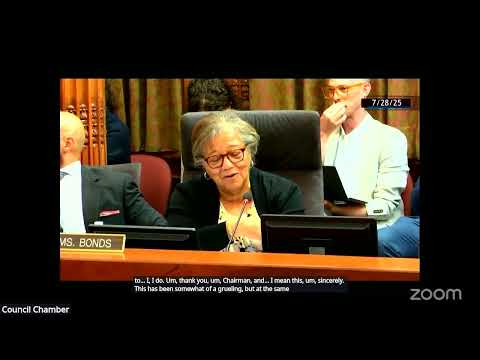
WASHINGTON — The D.C. Council approved the fiscal year 2026 budget on July 28 after protracted debate over last‑minute cuts, a holdback demanded by the chief financial officer and conditional restorations tied to a September revenue estimate.
What happened: The council approved the Local Budget Act and the companion Budget Support Act after a series of roll‑call votes on amendments that reallocated and in some cases temporarily cut funding for programs ranging from affordable housing preservation to legal services and a child tax credit. Chair Phil Mendelson said he moved a targeted appropriation change after the chief financial officer told the council he “cannot attest that the FY 2026 budget and financial plan is in balance” without leaving roughly $244 million available to the CFO for overspending and reserve replenishment.
Key points of the floor debate
• Mendelson vs. CFO: Mendelson described the amendment as forced “under duress” by the CFO’s demand to hold a large unallocated balance in reserve. He said the budgets before the council had been certified as balanced in May but that the CFO later revised revenue estimates and asked the council to leave $244 million unspent to cover overspending and replenish contingency reserves. Mendelson challenged the CFO’s authority to require that action but said he was moving a narrowly framed amendment to address the CFO’s certification concern so that the budget could move forward.
• Restorations and contingency prioritization: The chair’s amendment moved $29,983,207 into a new “appropriation of additional resources” category so the CFO could certify the books and the council could proceed. Council members then negotiated a ranked list of contingent restorations — programs that would be restored if additional September revenues and overspending reconciliations made money available. Council member Lewis George led a reordering of the contingency list to prioritize a child care subsidy, educator pay equity, housing preservation, DNA testing capacity at the Department of Forensic Sciences and emergency rental assistance, among other items. The list also added a proposed restoration for the Health Care Alliance, if funding materialized.
• Preservation and housing funding: Council member Robert White moved an amendment that dedicates $20 million from the Housing Production Trust Fund to preservation in FY2026, with flexibility for additional amounts up to $30 million tied to the fund balance; the council approved that amendment. White argued preservation was a faster, cost‑effective way to protect existing affordability amid a sharp loss of low‑cost rental units.
• Access to justice, child tax credit and childcare subsidy fights: Council member Anita…
Already have an account? Log in
Subscribe to keep reading
Unlock the rest of this article — and every article on Citizen Portal.
- Unlimited articles
- AI-powered breakdowns of topics, speakers, decisions, and budgets
- Instant alerts when your location has a new meeting
- Follow topics and more locations
- 1,000 AI Insights / month, plus AI Chat