
D.C. Council approves Robert F. Kennedy Campus Redevelopment Act, setting stadium and mixed-use plan in motion
Get AI-powered insights, summaries, and transcripts
Subscribe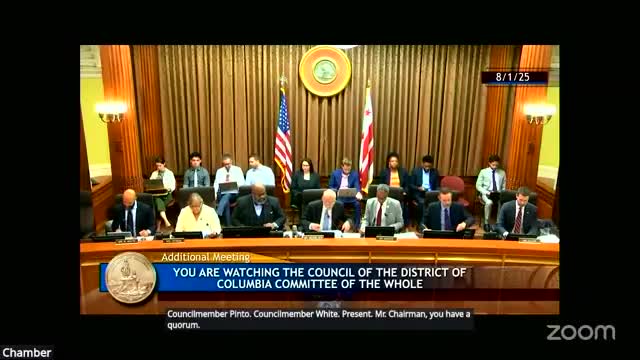
Summary
The Council passed Bill 26-288, the Robert F. Kennedy Campus Redevelopment Act of 2025, approving a deal to redevelop the RFK site and build a new stadium for the Washington Commanders. The measure passed 9–3 after extensive debate and several failed amendments on taxation, revenue sharing and developer penalties.
The Council of the District of Columbia on Aug. 1 approved Bill 26-288, the Robert F. Kennedy Campus Redevelopment Act of 2025, authorizing a redevelopment plan for the RFK campus that includes a new stadium for the Washington Commanders, a mixed‑use development, community benefits and various finance and environmental provisions.
Why it matters: The measure — reported out of the Committee on Business and Economic Development and the Committee of the Whole — formalizes subsidies, revenue-sharing arrangements and standards for the project that project officials and council members say will accelerate development on the site, fund transportation and provide community benefits, while critics warned the public cost is large and accountability for mixed‑use development deadlines is weak.
Council Chair Phil Mendelson introduced the committee print and described the changes incorporated into the version considered at the Committee of the Whole. He summarized key dollar figures and programmatic commitments, including a $500 million stadium subsidy, roughly $356 million for two parking garages (for a potential $856 million in direct subsidies), and the council's estimate of roughly $674 million in tax and parking revenues to the District over 30 years (the team’s estimate was higher at $744 million). Mendelson also noted a $50 million community benefits pledge from the team and a $600 million transportation improvement fund created by the legislation.
Council member McDuffie, who led the bill’s presentation from the committee on business and economic development, framed the measure as the result of months of public engagement and negotiation. “Today marks a proud and hopeful moment for our city,” Council member McDuffie said, urging support for the bill as negotiated to include more revenue, a community benefits agreement and labor protections.
On environmental and design standards, Mendelson and other members noted the bill requires the stadium to be constructed with methods and materials consistent with pursuing LEED version 5 Platinum certification and sets operational sustainability standards. The District Department of Transportation must prepare a traffic operations and parking plan in consultation with Advisory Neighborhood Commissions for Wards 6 and 7 and the developer. The bill also clarifies rules around exemptions from the Anacostia waterfront environmental standards and adds a fee for any tree heritage waivers.
On affordable housing and development timing, the council record cites an estimated 6,000 housing units across the campus, of which approximately 1,800 are described as affordable — with those affordable units split in the estimates so that about half would serve households at 30% of area median income and half at 60% of AMI. The legislation includes a development milestone chart with rent acceleration as a penalty for delayed development; several council members said they want stronger, earlier penalties and/or incentives for timely delivery.
Labor and community commitments were repeatedly raised during debate. Multiple members highlighted newly agreed project labor agreements and labor peace commitments and provisions aimed at job training and hiring initiatives for justice‑involved individuals. Council member Discharge (committee chair) said these labor commitments were among the wins secured through negotiations.
Votes at a glance - Amendment 1 (tax personal seat licenses/PSLs): Moved by Council member White to tax PSLs; failed on roll call 3 yes, 9 no (Yes: Council member Nadeau; Council member White; Council member Allen. No: Council member Louis George; Council member McDuffie; Chair Phil Mendelson; Council member Parker; Council member Pinto; Council member Bonds; Council member Felder; Council member Fruman; Council member Henderson). Outcome: failed.
- Amendment 2 (10% revenue sharing of team gross sales receipts): Moved by Council member White; failed on roll call 3 yes, 9 no (Yes: Council member Nadeau; Council member White; Council member Lewis George. No: Council member McDuffie; Chair Mendelson; Council member Parker; Council member Pinto; Council member Allen; Council member Bonds; Council member Felder; Council member Fruman; Council member Henderson). Outcome: failed.
- Amendment 3 (stronger penalties and land reclamation if mixed‑use development delays continue; $2,000,000 annual payment for each year the development goes beyond 2038 and possible reclamation after 2042): Moved by Council member White; failed on roll call 4 yes, 8 no (Yes: Council member Nadeau; Council member Parker; Council member White; Council member Louis George. No: Council member Pinto; Council member Allen; Council member Bonds; Council member Felder; Council member Fruman; Council member Henderson; Council member McDuffie; Chair Mendelson). Outcome: failed.
- Amendment 4 (set aside $10,000,000 annually for preserving affordable housing financed from revenue sharing): introduced by Council member White and subsequently withdrawn after Amendment 2 failed; outcome: withdrawn.
Final passage: The bill passed on a 9–3 roll call (Yes — Parker; Pinto; Allen; Bonds; Felder; Henderson; Lewis George; McDuffie; Mendelson. No — Nadeau; White; Fruman). The Council approved the committee report with leave for staff to make technical and conforming edits and indicated labor changes made in the last 24 hours would be reflected in the report.
Discussion vs. decisions: The record separates formal actions (the roll‑call votes above and final passage) from ongoing directions and follow‑up. Members repeatedly asked for continued negotiation between first and second reading to strengthen accountability and timelines for mixed‑use parcels, and several members said they expect to revisit penalties, bonuses for early delivery, and displacement mitigation before second reading. Council leadership committed to further work between votes and to include last‑minute labor commitments in the final report.
What remains unresolved: Multiple members, including Council members White, Fruman and Nadeau, said the District still should press the team for stronger, earlier enforcement mechanisms to ensure timely delivery of the mixed‑use development and more direct revenue sharing. Council members who supported the bill stressed the environmental standards, labor agreements, and the transportation fund as major improvements made in negotiations.
Next steps: The measure will appear on the agenda for the Council’s additional legislative meeting and proceed to the second reading process required by Council rules. Members committed to continuing discussions between first and second reading to refine accountability, housing delivery timelines and displacement mitigation strategies.
Ending: The Council convened the additional legislative meeting five minutes after the Committee of the Whole and completed the legislative vote; the chamber adjourned after placing the measure on the legislative agenda for the following session.