
Pratt County commissioners adopt 2026 budget after discussion of revenue-neutral rate and falling state-assessed values
Get AI-powered insights, summaries, and transcripts
Subscribe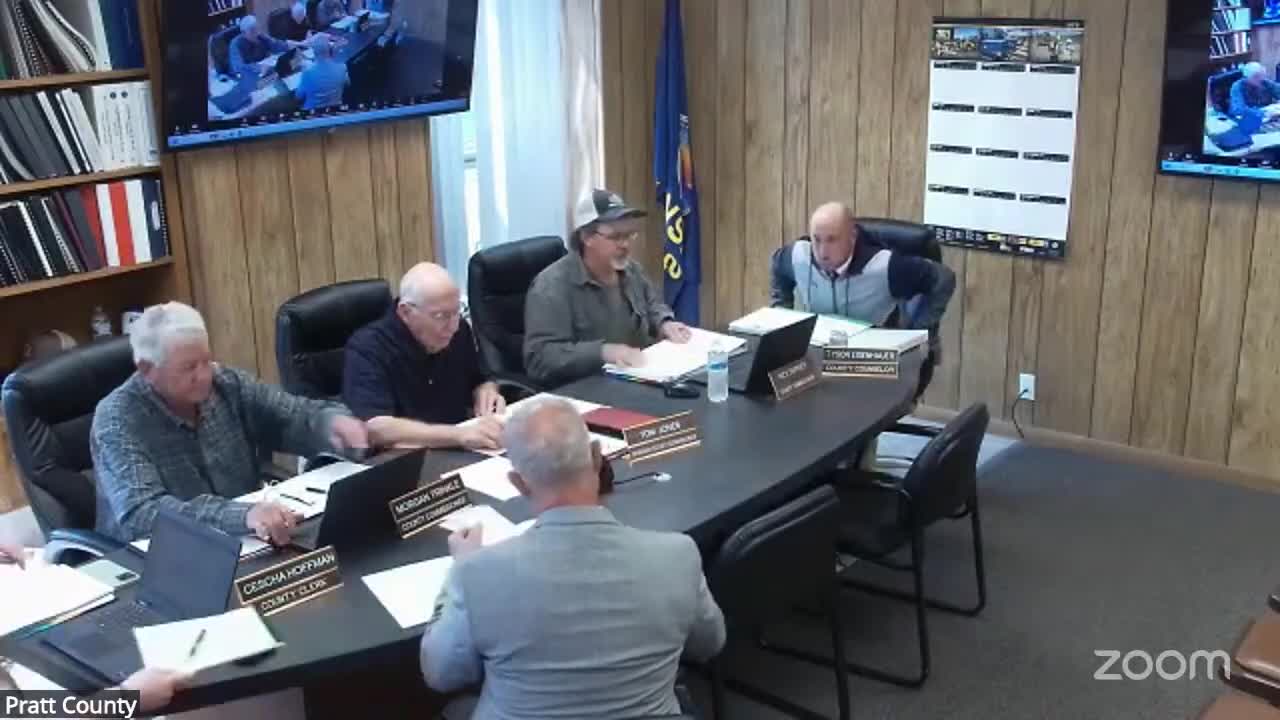
Summary
Pratt County commissioners approved the 2026 budget 3-0 at a budget hearing after staff explained impacts from falling state-assessed values and the mechanics of the revenue-neutral mill levy. County staff and visiting fiscal advisers warned that shifts in assessed value are increasing the share borne by residential property owners.
Pratt County commissioners voted 3-0 to approve the county—s 2026 budget during a budget hearing that included an extended presentation and questions about the county—s revenue-neutral mill levy and recent drops in state-assessed valuation.
County budget staff told commissioners that while the county is holding a revenue-neutral levy that keeps total tax dollars roughly flat, the county—s assessed-value mix has shifted so that residential property now accounts for a larger share of total taxes. "Revenue neutral, same dollars as last year," the presenter said, explaining that when assessed values fall, the mill levy must rise to capture the same dollar amount of tax revenue.
Why this matters: county officials said state-assessed values and reporting practices outside the county—s control can materially change local tax burdens even when the county holds the mill levy revenue-neutral. That can push more of the tax burden onto local homeowners and complicate long-term planning.
During the hearing county staff and outside advisers described recent changes in assessed values. The presenter said the county had experienced large decreases in state-assessed value over the past two years and cited examples discussed with the Kansas Association of Counties. The presenter cited two recent, county-level impacts: a $14 million loss tied to stored gas valuation the prior year and another roughly $13 million loss this year in state-assessed infrastructure and buildings; both figures were described in the hearing as part of the presenter—s explanation of why the county—s revenue-neutral rate rose.
Mike Calvert, president of Pratt Community College, asked whether other counties were seeing the same pattern. The presenter replied that reporting differences and self-reporting by property owners or companies can produce inconsistent results across counties and that state processes for compiling and verifying state-assessed values can lag the county—s budget calendar.
County staff reviewed key budget figures with the commission. The presentation noted a projected general fund unencumbered cash figure (end-of-year) near $7.0 million and that the January 1 working cash balance used for planning was projected around $1.6 million; the presenter described those as the key numbers the commission should check on next January 1 to see how actual receipts compare with estimates. The presenter said the county expects to use oil-related cash reserves this year to remain revenue-neutral.
Commissioners discussed broader fiscal pressures, including state mandates the county must fund and the unwillingness of counties to rely solely on raising levies. The presenter and others suggested legislative action and improved state-level auditing and data-sharing would be needed to reduce inconsistencies in state-assessed reporting.
Formal actions at the hearing included a motion to adopt the 2026 budget as presented; the motion was seconded and approved on a 3-0 vote. The commission also adjourned the budget hearing by voice vote.
The commission directed staff to finalize the signed budget documents following the vote and to continue tracking January 1 cash balances and state-assessed valuation details for planning and reporting to the Kansas Association of Counties.