
Commissioners defer decision on opioid-fund requests for two recovery houses, schedule work session
Get AI-powered insights, summaries, and transcripts
Subscribe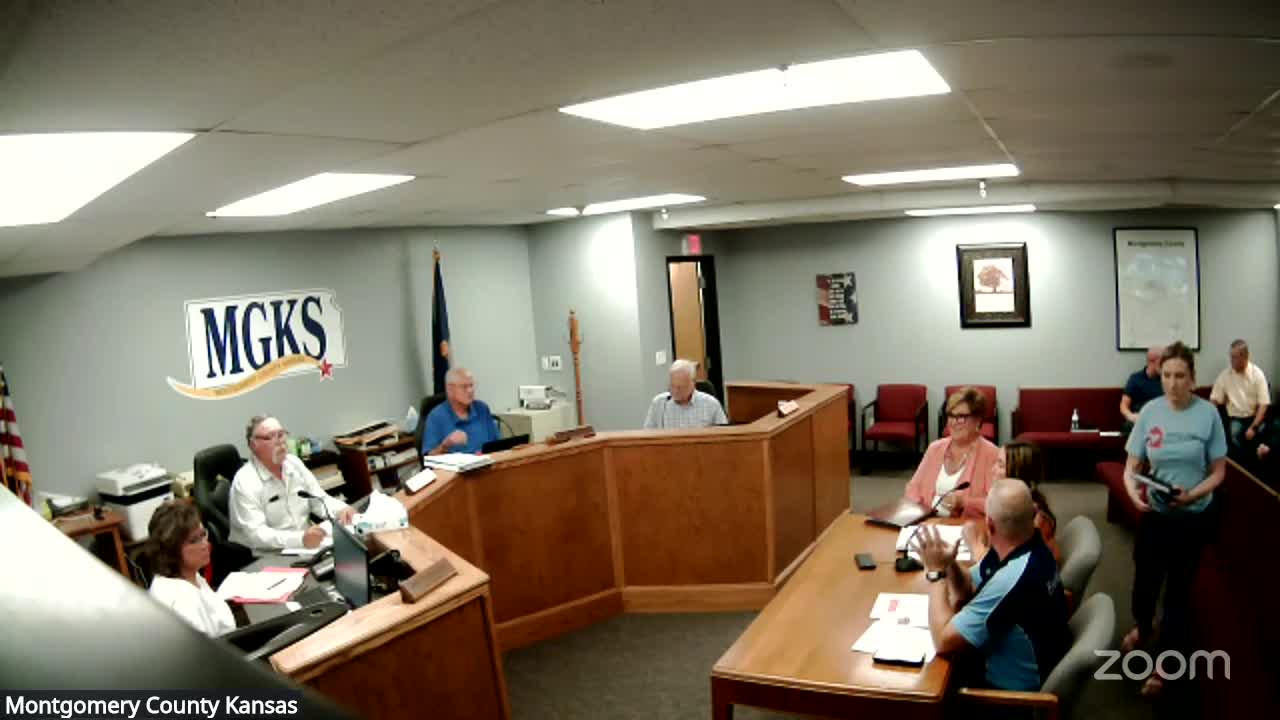
Summary
Montgomery County commissioners heard requests from Hannah's House Ministries and Home Sweet Home for opioid-settlement funds to cover a replacement van and utility support but postponed funding decisions and scheduled a work session for Sept. 8 to review finances and overlap with other programs.
Montgomery County commissioners on an evening meeting heard appeals from two faith-based recovery programs, Hannah's House Ministries and Home Sweet Home, for money from the county’s opioid-settlement account and agreed to postpone a final decision until a work session on Sept. 8. The two programs asked the commission to use opioid-settlement funds for operating needs: Hannah's House requested a $27,000 replacement van (plus one year of insurance) and roughly $31,500 to cover utilities for its housing network; Home Sweet Home requested operating support reported in the meeting as roughly $16,785–$18,016 (figures in the transcript were inconsistent). County staff and program leaders told commissioners these payments would come from the county—s opioid-settlement account rather than the general tax levy. County staff reported the account balance at $77,325.28 and provided projections (2024 receipts $78,005.96; 2025 receipts $33,009.17; 2026 projected ~$32,003.75), and said the long-term projections taper through the 2030s. Why it matters: Commissioners emphasized that opioid-settlement money is restricted and projected to decline over time, and they must weigh one-time or recurring operating support for local programs. Commissioner discussion focused on overlap with other programs already funded, including a $55,000 allocation this year to Four-County Mental Health, and on the county—s limited remaining unallocated balance. Supporting details: Amanda Heath, director of Hannah's House, described her program—s 2019 graduation and said residents use the van for counseling and medical appointments; Lisa, a founding volunteer with Hannah's House, said the organization has operated 13 years and reported having placed more than 1,200 people through its program since inception. Chris, representing Home Sweet Home, said his program is a 90-day placement aimed at employment and permanent housing and reported helping roughly 2,300 people across programs since 2010. County staff said attorney general—s staff had reviewed Hannah's House and deemed it eligible to receive opioid funds. Commissioners did not approve funding at the meeting. Instead they scheduled a 30-minute work session for 8:15 a.m. on Sept. 8 for additional review and asked county staff to bring more information about current allocations, potential duplication with Four-County Mental Health, and precise cost breakdowns from the two programs. Ending: Commissioners said they were sympathetic to both programs but wanted clearer budget details and an assessment of overlapping services before committing limited opioid-settlement funds.