Get Full Government Meeting Transcripts, Videos, & Alerts Forever!
Get email alerts on the Water Rates topic
No spam. Unsubscribe anytime.
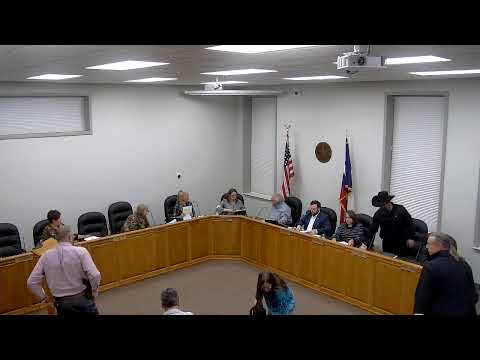
Bowie council delays water-rate increase after hours of debate and public comment
Summary
City Manager Bert Cunningham presented two multi-year water-rate proposals intended to stop ongoing losses in the water utility. After extended council discussion and many public comments, neither ordinance received a motion and both died for lack of action.
City Manager Bert Cunningham told the Bowie City Council on Jan. 28 that the city’s water utility is losing money and presented two multi-year rate proposals intended to restore the utility to break-even and to fund a possible raw-water pump replacement.
The proposals — one that would raise rates about 16% in year one and 16% in year two, and a second that would raise rates 7% in each year plus a $7.50 monthly fee that would sunset in 2030 — drew extended discussion from council members and more than a dozen public comments. After questions about how much revenue the increases would actually produce and how the increases would affect low-income residents and local businesses, neither ordinance received a motion and both died for lack of action.
Why it matters: Bowie’s city manager said the water fund is operating at a loss and that without revenue changes the city may have to shift costs to other utilities or the general fund. Residents and business owners warned that steep increases could push businesses and low-income households to cut service or leave the community.
Cunningham told the council that the water department has been losing money and provided two figures as part of his presentation: an average monthly loss of about $1,307.64 and a reported loss of roughly $102,000 during the first two months of the current budget year. He said a 16% increase would “get us into black,” and that a second 16% increase would be needed only if the council elects to fund the pump project through rates rather than bonds or other financing.
That pump is the subject of an outstanding enforcement and financing discussion with the Texas Commission on Environmental Quality; Cunningham said the TCEQ has said Bowie remains out of compliance on raw-water pumping but has given the city extra time to arrange financing. Cunningham also said some pipeline work and easement negotiations remain pending and that multiple old lines (including a 1930s-era line to O’Bouille Lake) are contributing to pressure and volume problems.
Councilmembers repeatedly asked for clearer dollar figures separating (a) the amount needed to return the water utility to break-even and (b) the additional amount that would be required to fund the possible pump project. Councilmember Walker asked explicitly: “In dollars, what is that number?” Cunningham repeated that the 16% figure would move the utility back to break-even and the second 16% would cover pump payments if the city chooses to fund the pump through rates.
Public comment was substantial. Business owner Tammy Boatmaster challenged the council’s framing and asked why the city transfers funds from the electric utility to the general fund while saying the water utility does not make money; Cunningham and others explained that electric transfers support general fund services including police and fire, and that the city has not raised water rates since 2018. Other residents urged caution, saying higher rates could drive businesses away or would disproportionately affect fixed-income households.
At the end of the discussion, the mayor called for motions on two draft ordinances (referred to in the packet as Ordinance 24-10 and Ordinance 24-11). Because no councilmember moved either ordinance, the proposals died for lack of a motion. Cunningham said he would continue to analyze options and return with more detailed numbers; the council did not adopt any rate change that night.
The council also discussed the difference in rates charged inside and outside city limits and the statutory limits on how much the city may charge out-of-city customers; Cunningham confirmed those limits constrain how rates can be adjusted for outside customers. He also noted the city sells wholesale water to Amon Carter Water Supply (a separate wholesale customer) under existing agreements.
Looking ahead: Cunningham said the water-rate issue will likely return to a future agenda after staff provides a clearer breakdown separating revenue needed for ongoing operations from amounts needed for the pump project. No vote or direction to adopt either ordinance was recorded at the Jan. 28 meeting.