
Miami County planning commission opens months‑long review of short‑term rental rules
Get AI-powered insights, summaries, and transcripts
Subscribe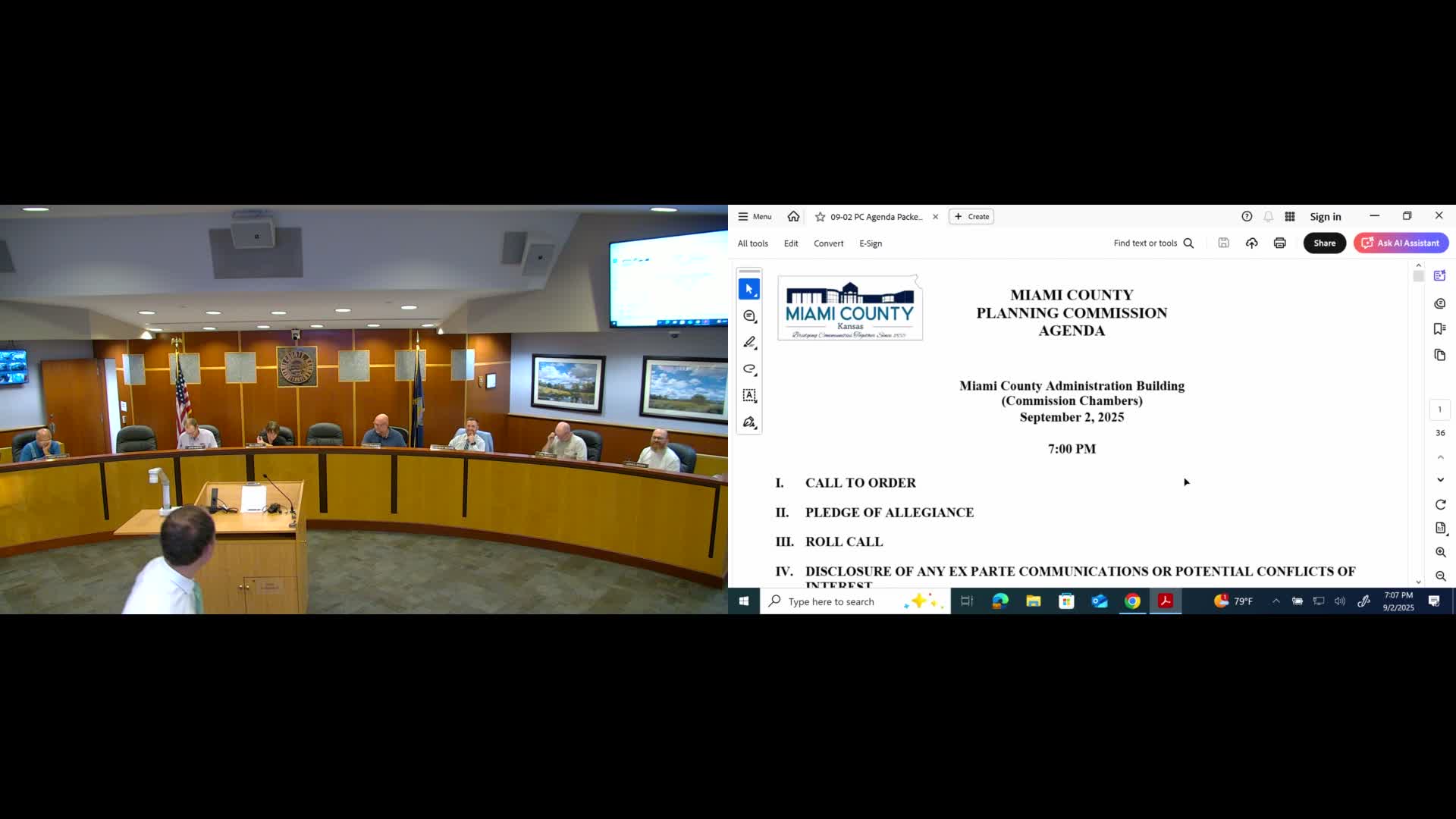
Summary
Proposed short‑term rental regulations moved from concept to active review Sept. 2 as Miami County planning staff asked the Planning Commission for guidance on a draft ordinance and the commission directed staff to return with a revised proposal and legal advice.
Proposed short‑term rental regulations moved from concept to active review Sept. 2 as Miami County planning staff asked the Planning Commission for guidance on a draft ordinance and the commission directed staff to return with a revised proposal and legal advice.
Planning staff said the draft is a starting point and recommended a licensing/registration approach rather than automatic conditional use permitting for every property. "This is a starting point for conversation," the planning staff member said, noting the draft drew on regulations from neighboring jurisdictions and regional research.
Commissioners spent more than two hours debating the scope and enforcement of any final rule and reached several working conclusions: prefer a local contact for each STR, consider a minimum parcel size (the draft uses 2 acres), allow staff to pursue a light licensing approach with the option to revoke licenses for repeat violations, and align short‑term rental rules with existing bed‑and‑breakfast and accessory dwelling unit (ADU) rules rather than treat each separately. Commissioners also asked staff to check with legal counsel about liability if the county requires insurance or inspections.
Why it matters: planners and county leaders said STRs are already operating in the county, largely inside municipal limits but some in unincorporated areas, and that an explicit, enforceable local rule would create a point of contact for neighbors and a mechanism to address nuisance complaints, public‑safety concerns and tax collection. County staff estimated—based on a limited review of online listings—that roughly 30–50 short‑term rental listings operate in the county's unincorporated areas, while most listings are inside city limits.
Key discussion points and staff direction
- Registration vs. CUP: Staff recommended a lighter licensing or registration system that would give the county an administrative path to revoke operations that repeatedly violate rules; staff warned a full conditional‑use permit (CUP) process for each STR could overload planning resources. Commissioners asked staff to draft both a license/registration pathway and an option showing what a CUP‑heavy approach would look like so the commission can compare.
- Owner‑occupancy and property manager distance: Multiple commissioners said owner‑occupied STRs are less likely to cause neighborhood problems and expressed a preference for prioritizing those. Commissioners also asked staff to add a local contact requirement (a named person reachable by neighbors and law enforcement) and to propose a reasonable maximum distance from the property for that contact (commissioners suggested using miles rather than time; no final distance chosen).
- Inspections and affidavits: Staff described options ranging from a single initial safety inspection (with multiyear re‑inspections, possibly every 3–5 years) to accepting an owner affidavit that certain life‑safety features exist (egress windows, smoke detectors). One planning staff member said initial inspections would help confirm basic life‑safety elements for visitors unfamiliar with rural properties but acknowledged recurring inspections would strain staff resources. Commissioners directed staff to draft language for an owner affidavit option and to ask legal counsel whether an affidavit or a required certificate of insurance would increase county liability.
- Enforcement, neighbor protections and noise: Commissioners emphasized neighbor notification, posting of a local contact and an on‑site emergency contact, and the ability to fine or require owners to pass through fines to renters for violations such as loud parties. The commission referenced County Code 24‑4.02 (noise provisions) as an enforcement tool for disturbances.
- Revenue and taxes: Commissioners discussed the county adopting a transient guest ("bed") tax to capture revenue from visitors. Staff said a bed tax requires statutory and procedural steps and that collections and timing are governed by the Kansas Department of Revenue; commissioners discussed timelines tied to quarter starts and asked staff to coordinate with county commissioners on the revenue side.
Next steps and timeline
Planning staff will: 1) revise the draft ordinance to reflect the commission's direction (including a registration/license approach with options for owner‑occupied preference, a 2‑acre minimum, and a required local contact), 2) consult legal counsel about liability, insurance and the enforceability of affidavits versus inspections, and 3) return with a consolidated draft that also aligns STR rules with bed‑and‑breakfast and ADU policies. The commission suggested a target public hearing date in November and asked staff to coordinate timing so county commissioners could consider any related bed‑tax action before major event booking periods.
Quotations
"There are no improvements for the water that need to be constructed as part of the subdivision," the planning staff member said in a separate agenda item; that same staff member introduced the short‑term rental draft as "a starting point for conversation." Janet, a county staff member who spoke about lodging demand, described high hotel occupancy in parts of the county but noted most STR listings appear concentrated inside city limits rather than in unincorporated areas.
The commission did not vote on final language; members asked staff to return with a revised ordinance and legal guidance and signaled they expect further hearings before adopting binding regulations.
Ending
Commissioners agreed to continue the item in a later meeting and to bring the ordinance back as a consolidated package that addresses bed‑and‑breakfast rules, ADU provisions and STR registration so the county has workable enforcement and a clear pathway for tax collection if the board of county commissioners chooses to pursue a bed tax.