Get Full Government Meeting Transcripts, Videos, & Alerts Forever!
Get email alerts on the Public Events Noise topic
No spam. Unsubscribe anytime.
Dance Festopia fireworks request revives noise, safety and CUP questions
Summary
Organizers of the Dance Festopia music festival asked the Miami County Commission to approve use of proximate pyrotechnics outside the county’s usual holiday fireworks window; commissioners debated hours, prior CUP language and public-safety reports and asked for sheriff and EMS input before making a decision.
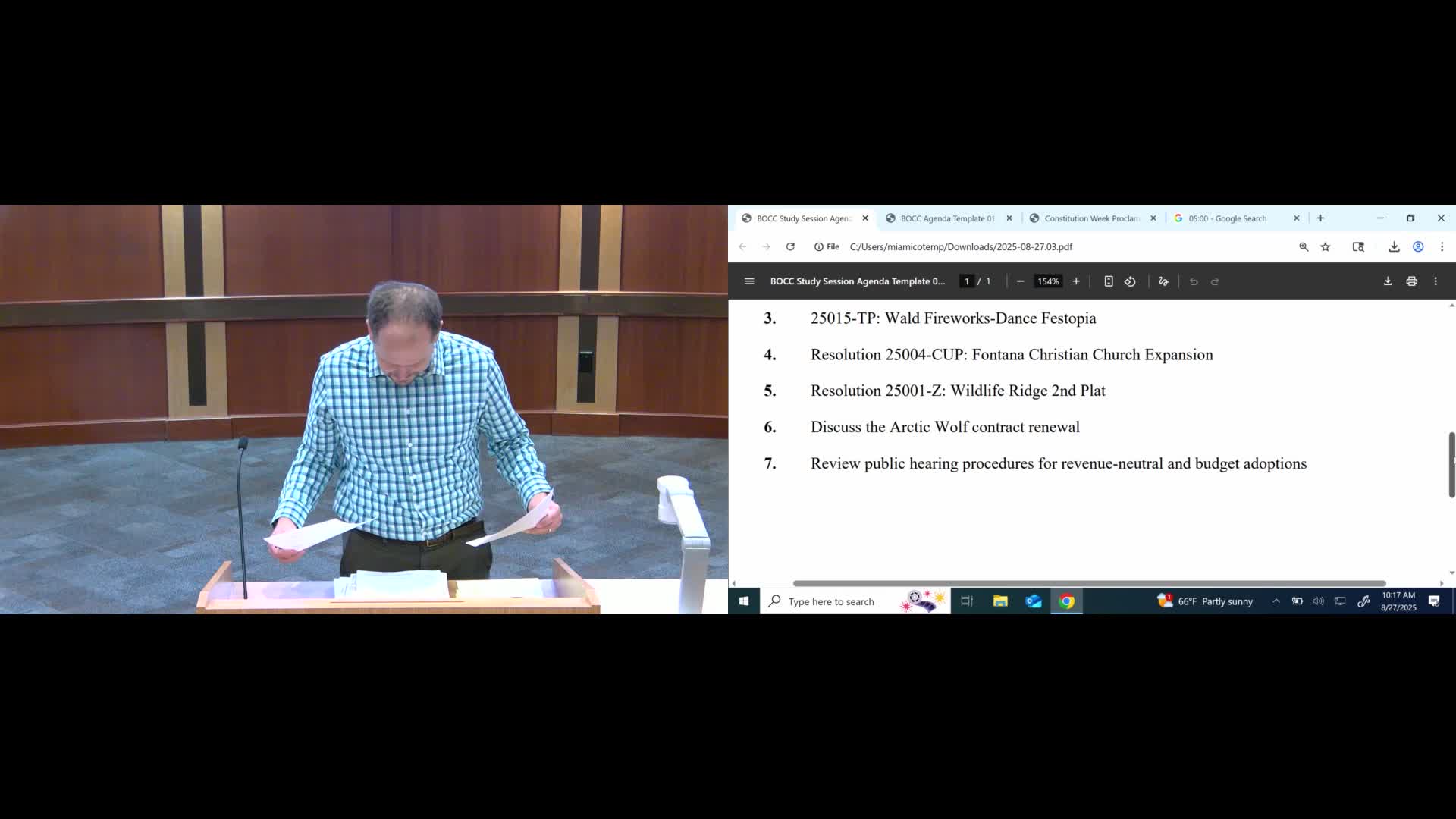
Organizers of Dance Festopia asked the Miami County Board of Commissioners on Aug. 27 to approve proximate pyrotechnics and an extension of the county’s 11 p.m. code cutoff for fireworks for several multi-day festival dates. The event operates under an existing conditional use permit (CUP) the county previously approved; staff and commissioners debated whether the pyrotechnics request fits the county’s existing fireworks rules and whether enforcement and noise standards are adequate.
Kenny Cook, Miami County planning director, said the festival’s pyrotechnic effects are “proximate pyrotechnics,” distinct from loud display fireworks, and that staff historically required display-fireworks permits for out-of-season pyrotechnics even if they are not the big aerial shows. The applicant requested modest extensions beyond the county’s 11 p.m. noise cutoff for specific festival nights (for example, midnight to 1:30 a.m. on weekend mornings), noting the acts plan to finish earlier than the requested allowance. Cook said Walled Fireworks representative Daryl Marman planned to attend the afternoon meeting to answer technical questions.
Several commissioners expressed concern about recurring noise complaints, public-safety reports and perceived weak enforceability tied to the CUP. Commissioners discussed that the original CUP contains no time limit or measurable performance criteria, a matter county legal counsel previously warned could be difficult to revoke. Commissioners asked the sheriff and EMS to summarize complaint and medical-response records: the county deputy chief for EMS told the Board that, without detailed record review, his service did not recall a significant number of Narcan uses tied to the event but acknowledged medical tent care occurs and that the festival’s nighttime hours drive the most calls. Law enforcement officials present said they had responded to some complaints but that recorded 911 calls and arrests had not shown a sustained, county-wide incident pattern; commissioners requested a fuller summary from the sheriff on complaints, enforcement and any arrests.
Why it matters: commissioners and planning staff said the CUP’s open-ended language and lack of measurable noise criteria create community friction when neighbors complain. The festival draws thousands of attendees across multiple days and has generated persistent local complaints about noise and other issues. Commissioners discussed whether to deny extensions, restrict hours, or require new enforceable criteria and reviews for the long-running CUP.
What happened next: Planning staff recommended and the commission planned to consider the pyrotechnics permit request on the Aug. 27 afternoon consent or action agenda. Commissioners signaled they want sheriff and emergency-service data before deciding whether to grant the extended hours; no final county action was recorded in the study session.
Attributions: statements and technical descriptions of the permit process and county code were provided by Kenny Cook, Miami County planning director; public-safety context was provided in discussion by county EMS and law-enforcement personnel present during the study session.
Note on attribution: direct technical comments about fireworks types and the CUP were made by Kenny Cook during the Aug. 27 study session.