
Christina School Board approves split tax rate to lower residential bills, keep revenue stable
Get AI-powered insights, summaries, and transcripts
Subscribe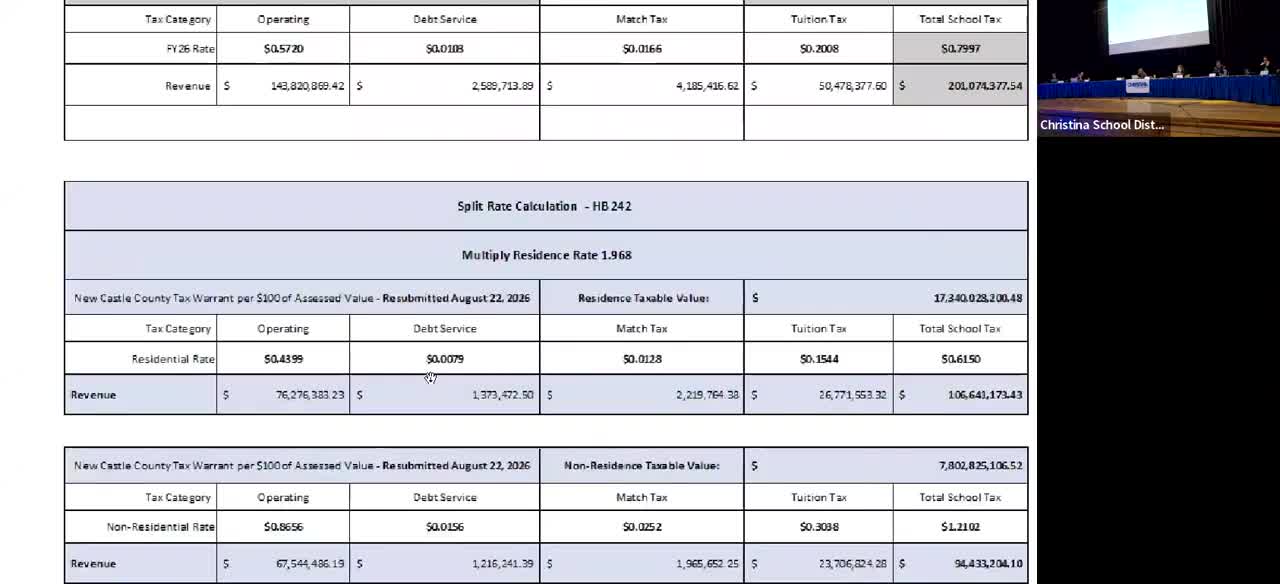
Summary
The Christina School District board unanimously approved a split tax warrant that reduces the residential rate while raising the commercial rate, intended to hold district revenue largely steady after a countywide property reassessment and surge in appeals.
The Christina School District Board of Education on a unanimous 6-0 vote approved a split tax warrant intended to reduce the tax burden on homeowners while preserving the district's revenue after a recent county reassessment and a surge in appeals.
The board approved a residential rate of about 61.5 cents per $100 of assessed value and a commercial rate of about $1.21 per $100, a change presenters said will produce roughly the same revenue as last year while lowering bills for most residents.
The change matters because Newcastle County's reassessment shifted taxable value from commercial properties to residential ones, district officials said. Bob Vaca, chief financial officer for the Christina School District, told the board that the district recorded roughly a $15,000,000 decrease in commercial taxable value and about a $39,000,000 increase in residential taxable value after the new assessments. He said the district is using a residential/commercial split "to bring relief to the residents as quickly as we could using the only tools we had." Vaca also warned taxpayers not to pay bills that list a September 30 due date because the county will issue corrected bills with a November 30 due date after the new rates are entered into the county system.
Nut graf: The board said the split rate is a short-term response to an unusually large reassessment and a spike in taxpayer appeals; officials urged continued legislative work to create a longer-term funding solution.
Most important facts first: Vaca said the district needed a buffer because appeals have surged (Christina had about 150 appeals last year and about 1,000 this year) and some property values rose many times over. He described two main pressures: (1) a major change in valuation methodology that reduced commercial taxable values and increased residential values, and (2) a sharp rise in appeal activity that can reduce collected revenue if taxpayers win appeals. "We need to have the money to give back to the taxpayer if they win their appeals," Vaca said.
Board discussion and public comment: Two audience members and one online commenter spoke during public comment. Resident Maureen Tucker said the reassessment has been burdensome for homeowners: "Between the 2 properties I own ... it's gone up, $1,629." Board member Shannon Troncoso acknowledged relief for residents but urged continued advocacy for farmers and small businesses, saying, "there's only so much that farmers and small business owners can withstand before the weight becomes too heavy for them." Board member Doug Manley thanked the state legislature for temporarily authorizing rate-splitting and stressed the change is not permanent: "I'd like to thank the state legislature for giving us this power to split our tax rate ... This power is not permanent."
Formal action: Board member Doug Manley moved to approve the tax warrant "as presented;" Reed Bakker seconded. The motion carried unanimously, 6-0.
Operational details and next steps: Vaca said he would send the approved rates to Newcastle County the morning after the board vote so the county can update bills, identify overpayments and underpayments, and issue corrected invoices. He advised homeowners who received escrow adjustments to contact their banks about corrections and urged taxpayers not to make payments on bills dated for the earlier due date so adjustments can be processed.
Background and context: Vaca described an earlier proposed single rate near 79 cents per $100 and said that, because assessed values rose steeply in some cases, a single-rate approach would have produced large, uneven bill increases for many homeowners. He said the district is using reserves and careful cash management to navigate the short term and that the legislative relief allowing split rates sunsets at the end of the year, meaning the district and its advocates must pursue longer-term statutory or constitutional changes to avoid reverting to a single rate in future years.
Ending: The board closed the meeting after the vote and offered taxpayers an opportunity to consult with the district's finance staff about specific bills. Officials urged residents with billing questions to contact district staff or the county tax office for updated invoices and guidance.