Get Full Government Meeting Transcripts, Videos, & Alerts Forever!
Get email alerts on the Rental Registration topic
No spam. Unsubscribe anytime.
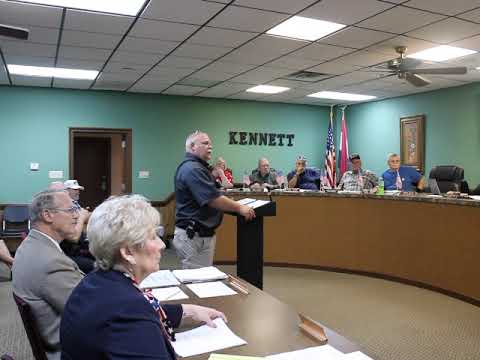
Kennett City council discusses enforcing rental-registration ordinance after owner with roughly 150 properties keeps utilities in his name
Summary
City staff described steps to revoke a landlord—ertificate, notify tenants and disconnect utilities if an owner declines inspection; council members discussed amending the ordinance to limit the number of residential utilities an owner may hold in their name and to begin posting tenant notices.
Kennett City Council members and staff spent a large portion of their meeting addressing enforcement of the city—s rental-registration ordinance after staff described a landlord who now appears to control roughly 100—to—150 rental addresses while keeping utilities in his own name, a practice that staff said has blocked inspections.
Council members and staff said the city can start an administrative license-revocation process that will require the owner to be notified and given 20 days to request an appeal; if no appeal is requested or an appeal is denied, tenants would be given a notice (described in the meeting as 60 days, although one participant said 80 days) after which the properties could be deemed uninhabitable and utilities disconnected. Staff said an owner whose rental license is revoked would be barred from re-registering the properties for six months.
The council—s discussion underscored two practical problems: inspectors cannot inspect properties that remain listed with utilities in the owner—s name, and disconnecting utilities risks leaving tenants — some with health problems — without service. Council members and staff repeatedly emphasized those tenant vulnerabilities and the potential scale: staff estimated about 150 notices would be required if enforcement followed the current ordinance as written.
Council members and staff described near-term steps. Staff said they will coordinate with the court process (the owner named in the meeting faces outstanding warrants and a scheduled court date), post door notices for affected units explaining the potential utility-disconnection timeline, and prepare to begin enforcement if court action does not resolve the underlying property-maintenance cases. One council member said she asked staff (identified in the meeting as Steve and Victor) to make a presentation to the council because those staff members will field calls from tenants and landlords.
Several council members urged an ordinance change to close what they called a —utility loophole.— The amendment discussed would set a numeric limit on the number of residential utilities an owner may have in their name at one time (the figure discussed during the meeting was three) unless the owner receives preapproval from the code-enforcement office. Staff said that change could be drafted as an amendment to the existing ordinance rather than as an entirely new ordinance.
Council members acknowledged enforcement limits and potential evasion tactics. One member warned owners could move properties into other LLCs or other names to avoid a new limit; others said, however, that enforcing the current ordinance is overdue and unfair to compliant landlords. Staff noted the city has already issued multiple orders on affected properties and said the enforcement conversation grew out of repeated noncompliance.
Participants also discussed criminal or court consequences. Staff reported the owner has faced at least one previous arrest related to local property-maintenance warrants and was due in court the next day on a $1,700 warrant; staff said judges can issue higher warrants or other enforcement at their discretion. Meeting participants said whether misdemeanor fines or higher penalties apply depends on prosecutorial and court decisions and the underlying state/local enforcement code.
The council directed staff to proceed with the immediate operational step of posting notices on affected doors and to return with a proposed ordinance amendment and a staff presentation detailing how the city would implement notifications and enforcement. The meeting record contains no formal council vote on these next steps.
City officials said they will try to balance enforcement with tenant protections, noting the risk to vulnerable residents if utilities are disconnected. Staff told the council they will monitor court results and begin door-notice distribution after the scheduled court action.