Get Full Government Meeting Transcripts, Videos, & Alerts Forever!
Get email alerts on the Transportation Active Travel topic
No spam. Unsubscribe anytime.
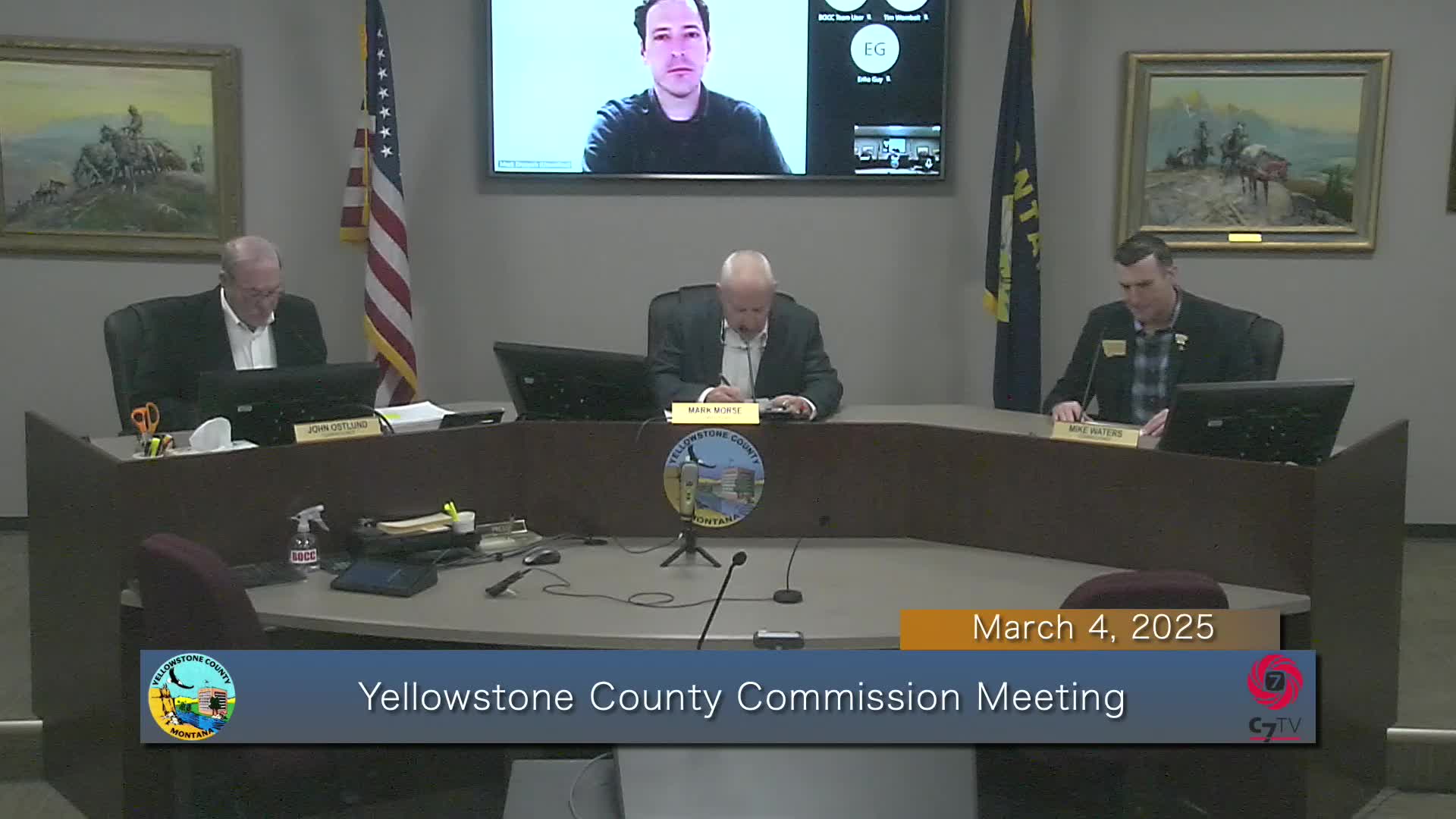
Commissioners vote to disapprove recommending Billings Area pedestrian and bicycle master plan to regional policy committee
Summary
The Yellowstone County Board of County Commissioners voted March 4 to disapprove forwarding the Billings Area Pedestrian and Bicycle Master Plan to the Policy Coordinating Committee, citing questions about return on investment, maintenance funding and how on‑street bike lanes are used.
The Yellowstone County Board of County Commissioners voted March 4 to disapprove recommending the Billings Area Pedestrian and Bicycle Master Plan for adoption by the Policy Coordinating Committee (PCC).
The motion to not approve the recommendation was moved and seconded during the commission’s regular meeting and passed after commissioners voiced concerns about the cost-effectiveness of painted on‑street bike lanes and the plan’s maintenance funding. County staff and the plan consultant stressed the document is a nonbinding guidance document and that the plan will still proceed through the MPO adoption pathway, including technical review and a forthcoming City Council decision.
The master plan, prepared as an update to the 2017 trails and bikeways plan, presents a two‑tier network: a “high comfort” spine intended for people who want separation from motor vehicle traffic and a supplemental network for opportunistic or lower‑comfort connections. Mac Driziah, the consultant from Alta Planning and Design, told commissioners the plan does not obligate the city or county to fund projects and that the document was simplified from the 2017 plan to give engineers more flexibility when site constraints arise. "This document does not obligate or mandate any projects or any funding for projects recommended in this plan," Driziah said.
Commissioners pressing the county’s position questioned whether painted bike lanes on busy streets produce sufficient public use to justify the costs and maintenance. “I don't think that we have I've ever seen anything that spends more money and gets less return,” said Commissioner Oslin. He urged the commission to require a return‑on‑investment analysis before endorsing additional painted on‑street bike lanes, adding, “I’m gonna vote no on the plan, Laura.”
Elise, planning staff, and the consultant described the plan’s outreach, funding history and prioritization approach. Staff said the MPO and city have successfully obtained federal grants, including an 11,000,000‑dollar BUILD grant for separated paths and a federal Safe Streets for All award referenced in the meeting (amount recorded in the transcript as 3,500,000,000 but treated in staff discussion as a large USDOT award to support safe routes to school projects). Staff also acknowledged the plan text flags that maintenance funding has not kept pace with new facilities and said they are working with public works and leveraging external grants and Trailnet donations to reduce local taxpayer burden. "We are opportunistic looking for grants, and those types of things and not put that stress on local tax payers," staff said.
Commission discussion covered several recurring points: (1) some commissioners favor off‑street, scenic trails and safe routes to schools over painted on‑street bike lanes; (2) county staff and the consultant emphasized designing to serve the “interested but concerned” bicycling population by prioritizing higher‑comfort facilities where feasible; (3) the plan emphasizes opportunistic implementation tied to roadway preservation and new development approvals; and (4) the plan’s network was intentionally simplified to list priority corridors rather than mandate specific facility types at every location.
After the disapproval vote, commissioners and staff noted the plan will still move forward in the MPO adoption process because the planning board and the City of Billings are also advancing the document. Staff said the city council was scheduled to consider the plan the following Monday and the PCC review remains on the schedule. The commission did not adopt any amendments or require additional conditions as part of its disapproval motion.
The meeting record shows the commission’s action was limited to whether to forward a recommendation to the PCC; county staff and the consultant repeated that the plan itself remains guidance and does not commit the county to specific projects or funding.
The commission then moved on to consent items and resolutions.