Get Full Government Meeting Transcripts, Videos, & Alerts Forever!
Get email alerts on the Rental Licensing Enforcement topic
No spam. Unsubscribe anytime.
Council approves resolution to authorize staff enforcement of residential rental-license ordinance amid tenant-rights concerns
Summary
The council approved Resolution 2025‑1 to formalize staff execution of Ordinance 3099, the city's residential rental licensing law. City staff described inspection, licensing and vacancy provisions; a pastor warned the measure could lead to utility shutoffs and displacement and cited a state statute protecting tenants.
The City Council approved Resolution 2025‑1, authorizing staff to execute enforcement of Ordinance 3099, the city's residential rental licensing and special funds ordinance, at a council meeting. The resolution formalizes how code enforcement will carry out the ordinance, staff said.
The resolution matters because it fixes in writing the administrative process the city will use to enforce the rental-license code, including inspection and post‑license steps, a staff member told the council. "3099 is the ordinance on residential rental licensing and special funds," the staff member said, adding that the ordinance covers inspections, licensing, appeals and administration.
City staff summarized the ordinance's key provisions to the council: a dwelling must pass a building inspection to be licensed; unlicensed buildings cannot be rented and may be subject to utility disconnection and evacuation orders if not brought into compliance; and appeals are handled by a board of appeals under Section 525. The staff member said the proposed change would add that if a property owner fails to issue a written notice to vacate within 15 days after the board of appeals affirms a director's revocation, the director will issue the notice to vacate.
After the staff presentation the council considered Resolution 2025‑1, described as the staff execution document for Ordinance 3099. A council member moved to adopt the resolution; Miss Bryant seconded. The chair called for the ayes and said, "Motion passed." The meeting record shows no roll-call tally attached to the transcript excerpts provided.
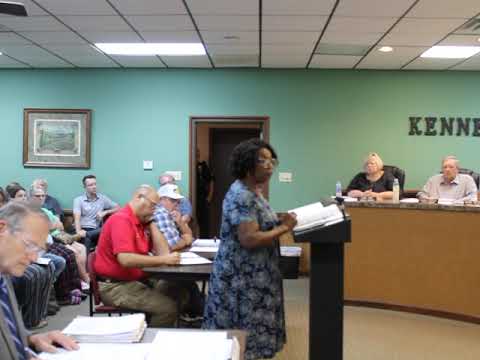
Reverend Diana Tapman, pastor of Saint John AME Church, addressed the council during public comment and linked the newly authorized enforcement procedure to tenant protections. "I'm here to advocate for the possible families that might be affected by the lack of ordinances that are in place concerning capability of rental property," Tapman said. She told the council she had reviewed state law materials and said "Missouri State Statute 441224 states that tenants have a right not to have their utilities turned off" and that tenants also have remedies when housing is uninhabitable. Those statutory citations and interpretations were raised by Tapman as part of her appeal to the council to protect tenants.
Tapman listed housing conditions she said exist in rental properties in the city's neighborhoods and urged the council not to allow enforcement steps that would disproportionately displace residents who have paid rent and followed other obligations. She urged the council to consider tenant protections when implementing Ordinance 3099.
Staff explained the reason for the written resolution as a procedural matter: "this will be the way that they will enforce this ordinance, and they wanted to have it exactly in writing by your discussion, a vote, and a signature," the staff member said. The resolution, staff said, reflects language the council previously added and is presented as the final version for signature and execution.
The council did not record additional formal amendments in the portion of the transcript provided. The resolution document is available as part of the meeting packet, the chair said.