
Commissioners approve reallocation of museum mill funds to cover county public-safety shortfall after heated public hearing
Get AI-powered insights, summaries, and transcripts
Subscribe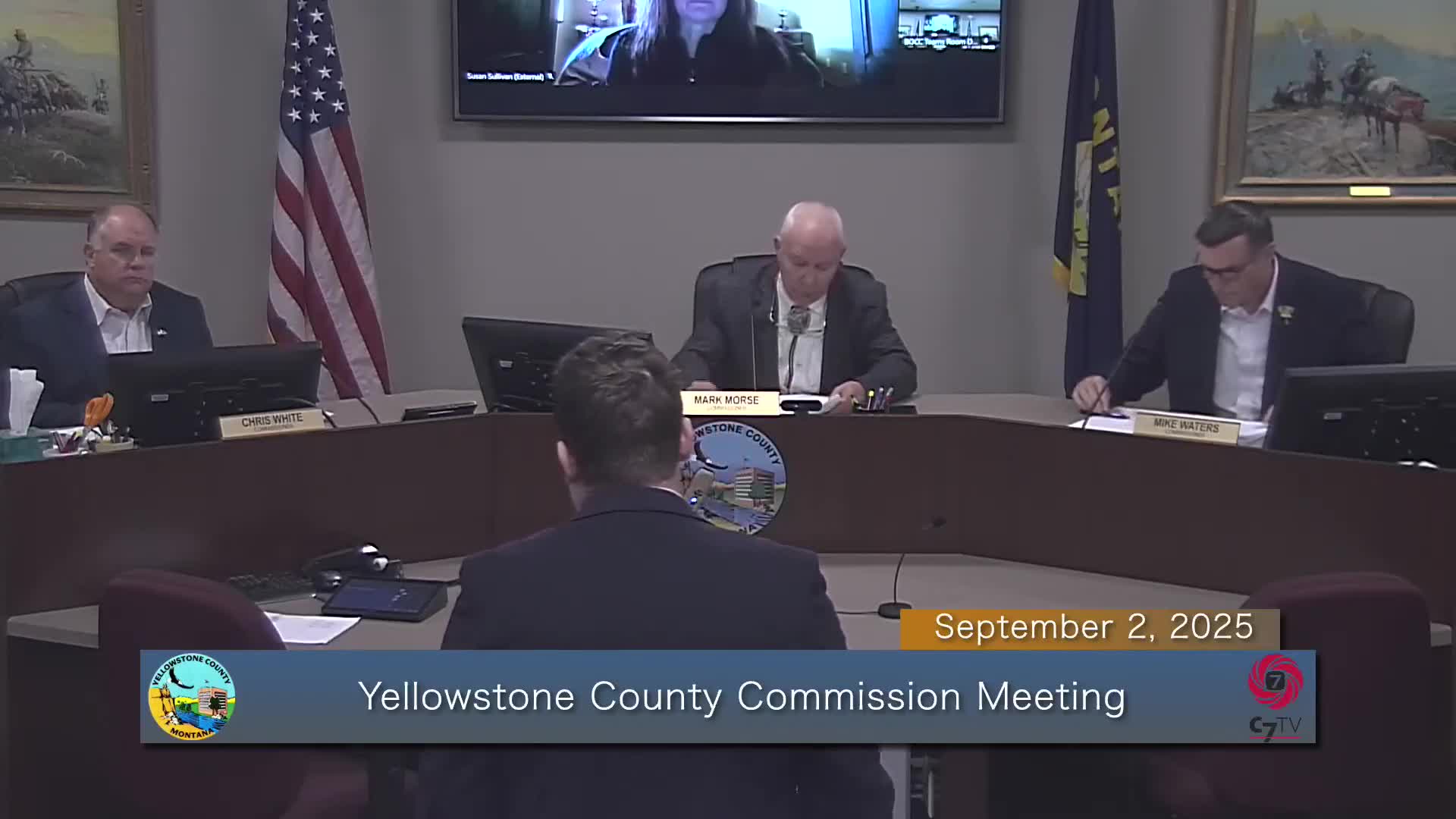
Summary
The Yellowstone County Commission voted to amend fiscal budgets and reallocate museum mill dollars to the general fund to help cover an $8.9 million jail shortfall, prompting lengthy public comment from Yellowstone Art Museum staff, trustees and community members who urged the commission to restore prior funding levels.
Yellowstone County commissioners voted Tuesday to approve Resolution 25‑100, amending fiscal year 2025 and initial fiscal year 2026 grant budgets to reallocate a portion of museum mill funding into the county general fund to help cover a public‑safety shortfall. The board approved the resolution after a public hearing that drew more than a dozen speakers, including museum staff, trustees and local artists who urged the commissioners to restore prior allocations to the Yellowstone Art Museum.
The vote followed a staff legal briefing that described the museum mill dollars as part of the county’s consolidated general mills and, therefore, discretionary. "These general mills were consolidated under I‑one 105 back in the 1980s and they are discretionary by nature," a staff member identified in the record as Steve said during the meeting. He told commissioners that the state law authorizing a museum mill levy (MCA 716.2205) was repealed in 2009 and that a separate grandfathering provision for special districts (MCA 711.103 / MCA 711.104) applies only if a special district had been formed by resolution or referendum; county records show no such formation.
The legal briefing framed the board’s authority to reallocate the mills; commissioners then opened a public hearing that drew speakers who described the Yellowstone Art Museum’s community and economic role and urged the board to restore prior funding levels. Melissa Smith, identifying herself as a Billings Heights parent and business owner, said: "This is the second time this body has moved to take away a beloved center of community and a vital economic driver for Yellowstone County." Jessica Ogden, the museum’s executive director, said the museum would be forced to cut programs after another round of reductions and asked why only the Yellowstone Art Museum was being asked to contribute to the public‑safety shortfall.
Multiple speakers provided financial and program details. Susan Sullivan, who said she serves on the Yellowstone Art Museum board of trustees as treasurer and finance chair, described the museum’s fiscal constraints and restrictions on using endowment and capital campaign funds: she said the museum’s endowment and capital campaign are largely restricted and that, under IRS and state rules, the museum can spend about 5% annually from its rolling average, which Sullivan illustrated as roughly $250,000 per year on a $5,000,000 balance. Commenters also noted recent budget history: speakers said the museum received about $220,000 in 2024, roughly $188,000 in 2025 and that the county proposal would reduce the museum’s FY26 allocation to $50,000.
Commissioners and county staff framed the change as a response to an operating deficit in the county jail. The board cited a jail cost of approximately $122 per inmate per day and told the public that the county is budgeting for a shortfall described repeatedly in the hearing as about $8,900,000 per year for jail operations.
After public comment concluded, Commissioner (Chair) Morse moved to approve Resolution 25‑100 and the motion was seconded and approved. The record shows the board passed the resolution; the vote was taken by voice and the chair announced the motion carried. The adopted resolution amends the FY25 regular budget and adjusts FY25 final and FY26 initial grant budgets consistent with the staff proposal.
Discussion versus decision: the meeting transcript separates an extended public discussion and legal briefing from the board’s formal action. The public hearing provided a forum for community testimony and questions; the legal briefing and staff comments supplied the board’s justification for the reallocation; the formal action—the vote to pass Resolution 25‑100—occurred after the hearing and is recorded as approved.
The reallocation prompted immediate public reaction in the hearing room. Speakers asked the commission to consider alternatives such as increased tax collection on delinquent accounts, pursuing grants, or spreading any contribution across multiple museums rather than reducing a single institution. The commission did not adopt those alternatives during the meeting; the record shows approval of Resolution 25‑100.
The board also held, in the same session, its public hearing and vote on broader FY25‑26 budget matters (Resolution 25‑101) and other agenda items; those actions are recorded separately.
The commission’s action takes effect per the resolution language filed in the meeting packet. Any legal challenge or further negotiation about the mill reallocation was not reported at the meeting; the Yellowstone Art Museum’s executive director said she had no plans to sue at that time but was "eager to learn more and to better understand the regulations."