Get Full Government Meeting Transcripts, Videos, & Alerts Forever!
Get email alerts on the Water Supply topic
No spam. Unsubscribe anytime.
Council members hear long-range water briefing: Carthage to join regional allocation from Stockton Lake under JMUC agreement
Summary
Councilmember Perkins summarized a regional plan through the Southwest Missouri Joint Municipal Water Utility Commission (JMUC) to secure a safe-yield allocation from Stockton Lake, noting Carthage—s prospective share of 3 million gallons per day and projected costs tied to a multi-decade agreement.
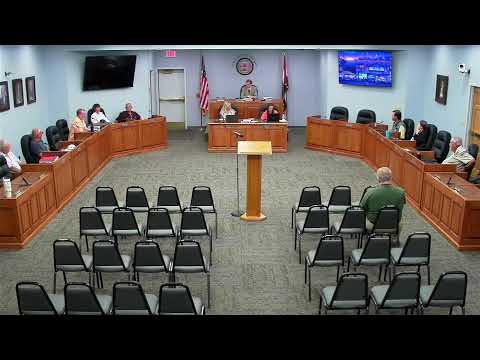
Councilmember Perkins presented a detailed briefing at the June 24 meeting about the Southwest Missouri Joint Municipal Water Utility Commission (JMUC) and a proposed long-term water allocation from Stockton Lake.
Perkins said JMUC members negotiated a safe-yield allocation of 38,000,000 gallons per day from Stockton Lake. Carthage has agreed in principle to an access commitment of 3,000,000 gallons per day of that pool, which Perkins said would amount to roughly 1,095,060,000 gallons annually for Carthage under the proposed allocation. Perkins described the arrangement as an insurance policy to secure future water supply and said the agreement being negotiated with the U.S. Army Corps of Engineers was a 30-year arrangement.
Perkins provided reservoir figures and unit conversions during his report: he said Stockton Lake contains about 27,000 acre-feet (which he converted to gallons in his remarks) and that a 38-million-gallon-per-day withdrawal would correspond to a calculated change in lake level (discussed during the presentation). He noted the Corps of Engineers sets a power pool limit for Stockton Lake and that engineering review and Corps approval remained outstanding.
Perkins also mentioned a possible funding contribution from the Missouri Department of Natural Resources and said the 30-year access would cost the city roughly $159,831 per year as part of the regional arrangement (figures Perkins presented in the committee report). He described the option as a strategy to guarantee supply for the city for decades and observed that unused entitlement could be sold or shared with other members.
Why it matters: Long-term water supply contracts affect municipal planning, utility rates, intergovernmental cooperation and local resource sustainability. Councilmembers invited the JMUC chairman to make a fuller presentation at a future meeting.
Next steps: Perkins said the Corps of Engineers still must present the formal agreement; JMUC leaders have agreed to present to the council in a future session for full review and potential action.