Get Full Government Meeting Transcripts, Videos, & Alerts Forever!
Get email alerts on the Public Pensions Finance topic
No spam. Unsubscribe anytime.
URS reports strong investment returns but rising payrolls push tier‑2 contribution rates up
Summary
URS reported 2024 fund values, strong returns and a mid‑nineties funded ratio but said unusually high payroll growth in recent years increased liabilities for the newer tier‑2 plan, prompting a 0.49 percentage‑point increase to an 11.38% tier‑2 contribution rate for fiscal 2026–27.
Utah Retirement Systems officials told the committee the pension fund posted positive investment returns and a funded ratio in the mid‑90s, but salary growth since 2022 raised liabilities for the newer tier‑2 plan and led to a modest contribution rate increase targeted at stabilizing funding over the long term.
The update matters because contribution rate changes affect employee paychecks and employer payroll costs across state, education and local government budgets; the committee was briefed on the board’s contribution‑rate management approach and the rationale for both increases and reductions across risk pools.
Dan Anderson, URS executive director, said the defined‑benefit fund had about $48 billion as of Dec. 31, 2024, and a year‑to‑date market value near $51 billion. URS reported approximately 82,000 beneficiaries. Anderson described the funded ratio as “in the mid‑nineties” on actuarial metrics and said investment returns are a substantial component of long‑term benefit funding.
Dee Larson, general counsel, and URS staff walked the committee through why tier‑2 contribution rates rose while some tier‑1 and other risk pool amortization rates were lowered under the board’s contribution rate management plan. URS presented actuarial data showing expected payroll increases versus actual payroll increases for 2024: for several employer groups, actual payroll growth materially exceeded actuarial assumptions (examples cited: expected educator payroll growth 5.3% vs. actual 9.2% in 2024). That greater‑than‑expected payroll growth increases projected future benefit liabilities because retirement benefits are tied to salary history.
As a result the preliminary tier‑2 public employee contribution rate for fiscal 2026–27 was shown as 11.38% (an increase of about 0.49 percentage points) and URS said that increase is charged to members because employer liability for tier‑2 is statutorily capped. URS said it added a 30 basis‑point contingency to the actuarial result to guard against additional payroll growth that might be recognized in the near term.
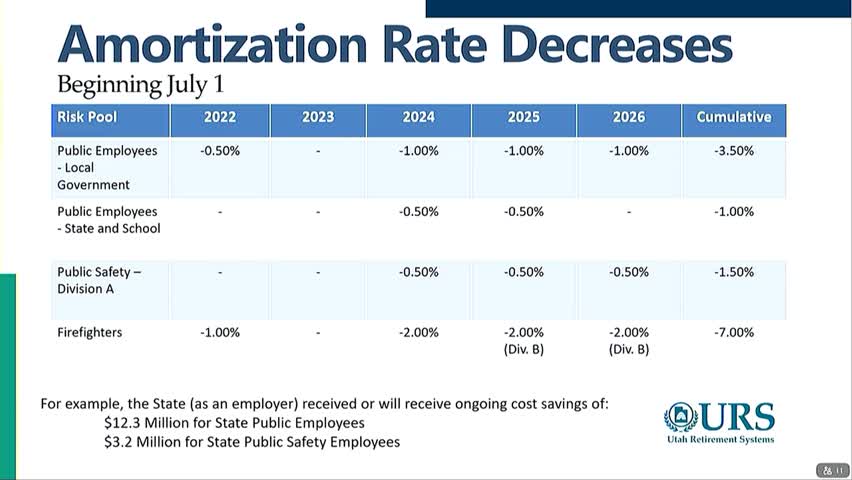
URS staff emphasized that the contribution rate management plan adopted under statute smooths reductions and prevents a sudden drop in amortization rates that would create volatility. The board approved preliminary rates; URS said these remain subject to statutory changes and routine actuarial review. URS staff said some risk pools (local government) qualified for amortization rate decreases that free ongoing payroll dollars for employers; state/school pools had a smaller decrease because payroll growth in those pools was larger.
Legislators asked about the timeframe to reach 100% funding for tier‑2 and whether the current rate would be sufficient; URS said earlier projections suggested roughly 7 years but cautioned the timeline is a moving target and depends on future payroll and investment experience. URS said the agency’s actuarial review cycle (annual tuning and a deeper triennial review) will continue to refine assumptions and rates.