Get Full Government Meeting Transcripts, Videos, & Alerts Forever!
Get email alerts on the Municipal Budget topic
No spam. Unsubscribe anytime.
Clayton presents FY26 proposed budget with tornado costs separated; FEMA reimbursement expected in FY27
Summary
City staff presented a proposed FY2026 operating budget that separates one-time tornado recovery costs from ongoing operations, recommends limited staffing additions and compensation adjustments, and forecasts fund‑balance recovery if FEMA reimbursements arrive in FY27.
Clayton City staff on a Friday work session presented the proposed fiscal year 2026 operating budget and said they had pulled tornado recovery costs out of the baseline numbers to give a clearer picture of ongoing finances.
The city’s presentation noted that an initial FEMA public assistance submittal included roughly $13.3 million in public‑damage estimates that had been booked into the finance account. City staff said they removed those tornado expenses from the version shown at the meeting so the board could evaluate the operational picture without the one‑time storm expenditures. “The tornado numbers were really heavy,” the presenter said, and added, “we're not really banking on any of the reimbursement coming until fiscal year 27.”
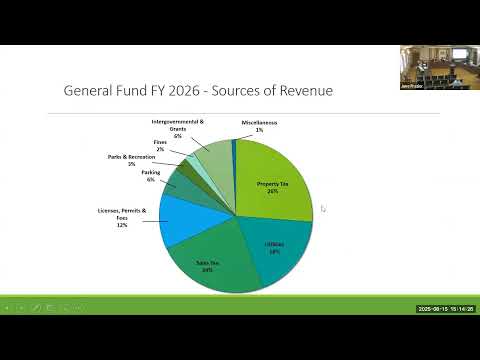
The bud get snapshot showed constrained ongoing revenue growth—sales tax trending near 1% annually, property tax growth largely tied to a small set of new projects coming online and reassessment cycles—and continued expenditure pressure driven by personnel and contractual costs. Staff reported personnel and benefits would comprise about 64.2% of general‑fund expenditures in the FY26 proposal with contractual services and commodities making up the remainder; when storm costs are backed out, personnel was shown closer to 73% of the ongoing budget.
Staff proposed three new or reclassified positions in the operating budget: a mid‑tier network engineer classification in IT to aid retention; an additional planning technician to support the comprehensive plan and workload in planning; and a parks service technician II to assist with high‑profile grounds and to prepare for the Shaw Park ice‑rink design work. The parks hire was shown as a midyear position (six months budgeted).
On compensation, the proposal includes the regular step increases (about 2.5 percent on steps), a placeholder 2 percent range adjustment effective April 1, 2025 (subject to market review), and a one‑time $600 retention incentive payable after Oct. 1, 2025, to full‑time employees who remain employed through the fiscal year transition. Staff said the total budgeted cost for the step increases plus the range adjustment was approximately $652,985.93; the per‑employee retention incentive is $600 (total estimated cost not specified in the packet shown at the meeting).
The city staff emphasized constrained near‑term revenue options. One new revenue source—the voter‑approved fire sales tax—starts Oct. 1 and replaces a $500,000 transfer from the capital fund to the general fund. Staff said that, even with that new sales tax, the ongoing revenue cushion remains slim and that without either new revenue or shared services/savings the city will approach a point where service reductions or further revenue action will be necessary.
Capital projects and debt: staff reviewed the adopted five‑year capital improvement program (approved earlier by resolution) and highlighted a heavy FY26 capital year that includes Central Business District resurfacing, municipal garage construction (special‑obligation bond proceeds), and street‑lighting repairs. The presentation flagged a long‑term cycle for street resurfacing that will require another general obligation bond around 2034 unless the city accumulates dedicated pay‑as‑you‑go funding. Staff noted outstanding bonded debt of roughly $33 million and described annual debt service of about $4 million in FY26.
Fund balance and FEMA timing: the packet showed a projected general‑fund ending fund balance of about 58% at FY26 when the tornado costs and a one‑time draw are included; staff said that if FEMA public‑assistance reimbursements arrive as expected in FY27 the fund balance could rebound (staff showed a projection near 74% in FY27 assuming reimbursement). City staff repeatedly cautioned that FEMA reimbursements are not guaranteed and are treated conservatively in the FY26 presentation.
Shared services and staffing strategy: council members and staff discussed scaling services and partnering with neighboring jurisdictions to control costs for functions such as IT and dispatching. Staff noted Clayton currently provides IT services to Brentwood and Richmond Heights and splits IT costs with those jurisdictions; staff said retention of in‑house IT is preferable to fully outsourcing because contractors can rotate personnel and not retain institutional knowledge.
Process and schedule: staff said the CIP had been approved previously by resolution and the FY26 operating budget and property‑tax levy will come to the council as an ordinance for first reading on Sept. 9 and final adoption on Sept. 23; the new fiscal year begins Oct. 1.
The meeting concluded without substantive votes on the budget items; a procedural motion to adjourn passed by voice vote.
Ending: Staff said they will issue a corrected proposed budget (with tornado costs backed out of the operating baseline) and supporting tables within days so council members have the revised packet ahead of the September ordinance readings.