Get Full Government Meeting Transcripts, Videos, & Alerts Forever!
Clayton staff propose replacing lot-coverage caps with minimum green-space ratios in stormwater text amendment
Summary
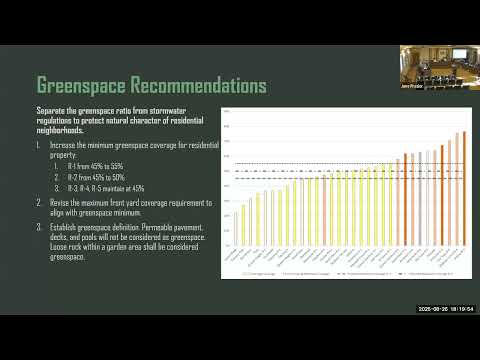
Planning Director Anna Crane outlined a text amendment that would shift Clayton’s lot-coverage approach from a maximum impervious coverage standard to a minimum green-space requirement, add design guidelines for pop-up drain placement, require limited water-table testing, and align stormwater calculations with MSD definitions.
Planning Director Anna Crane presented an update to Clayton’s stormwater and lot-coverage rules at the Board of Aldermen meeting Aug. 26, proposing a text amendment that would replace maximum impervious coverage limits with minimum green-space ratios and add stormwater design standards tied to volume-capture strategies.
Crane said the proposed change separates neighborhood character protections from stormwater performance and would apply different green-space thresholds by zoning district. "For R-1, we want to go from a 45% green space to 55% green space," Crane said, adding that R-2 would move from 45% to 50%. Those thresholds are intended to align with existing development patterns so the city does not create widespread nonconformities.
The issue matters because the city’s small residential lots make traditional peak-flow detention basins difficult to site, Crane told the board. "Stormwater regulations in general tend to go for either addressing peak flow rate or addressing volume," she said, noting the city can more feasibly address volume — the total cubic feet of runoff related to impervious surfaces —…
Already have an account? Log in
Subscribe to keep reading
Unlock the rest of this article — and every article on Citizen Portal.
- Unlimited articles
- AI-powered breakdowns of topics, speakers, decisions, and budgets
- Instant alerts when your location has a new meeting
- Follow topics and more locations
- 1,000 AI Insights / month, plus AI Chat