Get Full Government Meeting Transcripts, Videos, & Alerts Forever!
Get email alerts on the Stormwater topic
No spam. Unsubscribe anytime.
Clayton staff proposes tighter stormwater rules, minimum green‑space and new inspection requirements
Summary
At a June 10 Board of Aldermen discussion session, planning staff laid out a package of proposed changes to how the city calculates lot coverage, stronger on‑site detention standards, inspection and tracking for dry wells and other BMPs, and new site‑design guidance to protect neighborhood character and manage more intense storms.
Anna (plan development staff) presented a multi‑part package on June 10 to the Clayton City Board of Aldermen that would separate the city’s existing single regulation on “lot coverage” into two distinct tracks: (1) a minimum green‑space requirement aimed at preserving neighborhood character and reducing urban heat island effects, and (2) a revised stormwater standard focused on more prescriptive on‑site detention and monitoring.
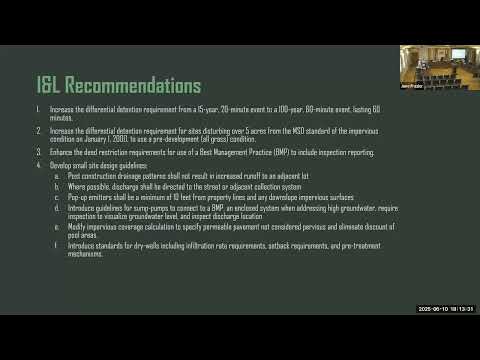
The packet staff described includes several engineering and code changes recommended by Intuition and Logic, the city’s on‑call stormwater consultant. Anna said the changes would “increase the differential detention requirement from a 15‑year, 20‑minute storm to a 100‑year, 60‑minute event” and add inspection and tracking steps for common best management practices (BMPs) such as dry wells. She told the aldermen the goal is to reduce impervious runoff while preserving natural vegetation and neighborhood open space.
The proposal would: require a larger detention volume on many redevelopment lots by using a 100‑year/60‑minute design storm for differential runoff calculations; require infiltration testing for dry wells and expand dry‑well footprints when soils are slow to infiltrate; formalize a deed‑recorded inspection form and two‑year inspection reporting for many BMPs; clarify that certain sustainable materials (for example, permeable pavers) will be treated specifically for stormwater calculations; remove the existing pool area discount; codify a 10‑foot minimum for pop‑up emitters from property lines (now enforced informally using MSD guidance); and create site‑design guidelines so stormwater is addressed up front in lot layouts.
Why this matters
Staff said the changes respond to three linked problems identified in the city’s recent comprehensive plan and on‑the‑ground trends: more intense short‑duration storms are overwhelming drainage systems; house footprints and hard surfaces on older lots are increasing; and using a single “impervious coverage” rule to capture both character and runoff is producing inconsistent neighborhood outcomes. Anna noted the city’s current single‑family lot coverage maximum of 55 percent and said staff is likely to recommend moving to a minimum green‑space requirement (staff cited a working target near 50 percent minimum green space) so the code directly protects vegetation and canopy.
Discussion highlights and concerns
Alderman Susan Buse praised the framing shift from “how much coverage” to a green‑space minimum and asked whether the combined effect of many incremental changes on neighboring lots would be captured by the proposed rules. Anna replied that the city cannot retroactively engineer every lot in a fully built community but that neighborhood‑level spatial analysis (done internally by staff analyst Ryan) will estimate overall coverage and runoff patterns under the proposed changes.
Alderman (identified in the transcript as) Rick and other aldermen pressed staff on triggers and enforcement: site plan review will trigger the stricter differential runoff calculations (site plan review is currently required for certain disturbance thresholds and additions that increase a structure’s footprint by roughly 50 percent), while plumbing permits would continue to cover some sump‑pump connects; staff said they will expand the administrative architecture review (AAR) and other permit checks to catch more post‑construction changes.
Residents who spoke at the microphone reinforced neighborhood concerns about groundwater, pop‑up emitters and tree loss. Sue Harper (8105 Pershing) said she is “very impressed with everything you said,” then described standing water problems after a recent dry‑well installation and asked whether that work should have required a permit; staff replied that under current code a dry well does not always trigger site plan review or a building permit but that the proposed text would allow the city to require inspection and review in more cases. Resident Cheryl Bridal urged the city to treat replacement trees and easement plantings as part of the solution, saying "Trees soak up a lot of water."
Next steps and staff directions
Staff told the board they will return in July with drafted text amendments: (1) a green‑space definition and the proposed minimum percent (staff flagged a likely recommendation near a 50% green‑space minimum or a 50% maximum lot coverage alternative), (2) revised impervious coverage and stormwater definitions that specify how permeable surfaces and pools will be treated, (3) a sustainability bonus framework that would allow small coverage increases when specific prescriptive stormwater controls are provided, and (4) proposed inspection and tracking forms for BMPs. Intuition and Logic will provide additional weather‑trend data and neighborhood‑scale examples prior to drafting.
What was not decided
No ordinance was introduced or adopted on June 10; the meeting was a discussion session. The board gave no formal direction to adopt final text at this meeting and did not vote on any policy changes. Staff will refine proposed language and return for planning commission review and later Board consideration.
Ending
Staff emphasized enforcement, inspection and design guidance as the means to balance neighborhood character and flood resilience; aldermen and speakers asked for clear triggers and more neighborhood‑level analysis before finalizing percent thresholds. The board did not set a public hearing date at the June 10 discussion session.