Get Full Government Meeting Transcripts, Videos, & Alerts Forever!
Get email alerts on the Utilities Generation Capacity topic
No spam. Unsubscribe anytime.
Board of Public Works outlines plan for on-site generators, projects up to $50 million and long-term rate impact
Summary
City presentation and council questions focused on a proposal to subscribe to and help fund on-site generation in Zone 5 to stabilize capacity costs; officials said construction would take years and rate effects depend on multiple variables.
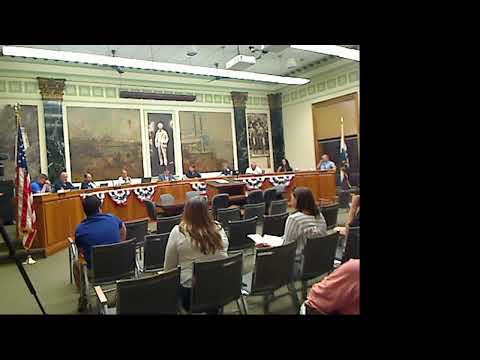
Darren Gordon, director of operations for the Board of Public Works, told the City Council on Aug. 5 that the board is pursuing a two-phase plan to add on-site generation in Zone 5 and that the city is considering subscribing to a portion of that capacity. The board described the project as a multi‑year effort that would not put new charges on ratepayers until generation is online and producing revenue.
The board’s presentation centered on buying a share of a planned generator installation. Gordon said the first phase requires subscriptions to move the project forward; the city’s potential obligation was discussed as part of a broader conversation about long‑term power purchasing and transmission costs. City Attorney James Lemon addressed legal protections for the city if a separate entity constructs and operates the generators.
Why it matters: Council members pressed for specifics because the project could affect utility bills and represents a large, long‑term commitment. Officials said the work is intended to reduce volatility in the city’s purchased‑power costs and to replace capacity the city will lose when other contracts end in future years.
Gordon said the project would give Zone 5 local generation to activate during capacity constraints and allow the utility to sell capacity in tight market conditions, which could generate revenue to help pay project costs. He and other presenters cited projected generation revenues (historic and modelled) as a partial offset: “We went back 4 years, and we looked at the numbers,” Gordon said while describing previous revenue scenarios. Council members asked whether revenue from selling generation would cover construction and how any revenues would be applied.
Council questions focused on timing, cost and rate impacts. Officials gave several figures during the discussion: a not‑to‑exceed construction estimate mentioned during the meeting was about $50,000,000 for the city’s portion, with payback and financing spread over roughly 30 years; Gordon said that revenue from generation in earlier modeled years ranged in the hundreds of thousands of dollars. Council members asked whether those revenues would be applied directly to loan paydown; a board representative said they would reduce the 30‑year payment and could shorten the payback period if the revenues perform as projected.
City Attorney James Lemon described the proposed contractual and participation structure as similar to prior intermunicipal agreements and participation models, saying the draft language contains customary protections: “I can tell you, it it it’s not an exact duplicate, but the language is very close,” Lemon said about the participation agreement and the protections it builds in for the city.
Council members also raised legal and liability concerns. Gordon and Lemon stated the plan calls for a separate entity to own and operate the generator site, with maintenance and operations contracted through that entity; Lemon said that structure provides “quite a bit of insulation” for the city though he would not guarantee immunity from litigation.
Timing and risk: Presenters said the generators would not be online for several years — several council members and staff referenced a four‑year window before new local generation could be producing power. Officials emphasized that while the project stabilizes one variable (capacity cost), two other market variables — transmission charges and energy commodity prices — remain outside local control and could still affect customer bills.
No formal council vote on construction or financing occurred during the Aug. 5 meeting. The Board of Public Works presentation was informational and generated instructions to continue due diligence; council members asked for more precise cost modeling, potential customer bill impacts (flat fee versus kilowatt‑hour percentage), and legal review of contract language.
Ending: Board members said more detailed financing scenarios and legal language will be brought back for council consideration. Council members asked staff to return with analysis that shows estimated monthly or percentage impacts on an average household bill and clearer projections of how generation revenues would be applied to project debt.