Get Full Government Meeting Transcripts, Videos, & Alerts Forever!
Get email alerts on the Fnip Budget topic
No spam. Unsubscribe anytime.
FNIP seeks $300,000 from Ferguson; council debates independence, transparency and oversight
Summary
The Ferguson Neighborhood Improvement Program on Thursday presented its Fiscal Year 2025–26 budget and asked the City Council for $300,000 from the city’s Economic Development Sales Tax fund to continue and expand its housing and neighborhood grant programs.
The Ferguson Neighborhood Improvement Program on Thursday presented its Fiscal Year 2025–26 budget and asked the City Council for $300,000 from the city’s Economic Development Sales Tax fund to continue and expand its housing and neighborhood grant programs.
FNIP President Larry Robinette told the council the group operates five current grant programs — exterior improvement, tree assistance, new homebuyer assistance, sidewalk repair and neighborhood organization grants — and is working to use the Missouri Abandoned Housing Act to acquire and rehabilitate vacant houses. “FNIP is in place to provide and enhance housing opportunities, improve the quality of life, and foster a spirit of community among the residents of Ferguson,” Robinette said.
The request drew detailed questions from council members about FNIP’s finances, legal status and oversight. Councilwoman Noah pressed FNIP for more financial access to confirm reserves and asked how many Ward 3 residents had used FNIP services; Robinette said the organization is a 501(c)(3) independent of the city and declined to provide recipients’ names, saying FNIP provided summary statistics and program-level payouts. “I don’t support gifting any funds to FNIP,” Noah said during the discussion, citing competing city priorities including potholes, mowing and vacant-property maintenance.
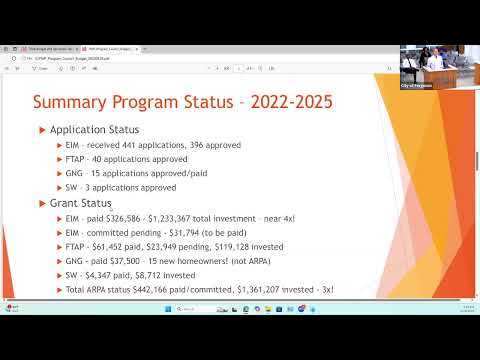
Supporters emphasized program results and leverage. Council members and others on the dais noted FNIP’s reported returns: exterior improvement grants have paid about $326,500 while homeowners contributed roughly $1.2 million in matching work or additional investment, a roughly 4-to-1 private investment ratio reported in the presentation. FNIP said it had $208,000 in ARPA funds remaining, requested $300,000 from the city to reach an FY25–26 program budget of $663,100, and planned a $100,000 placeholder for the Missouri Abandoned Housing Act conservation program to allow acquisition/rehabilitation of at least one property.
Council debate turned to three recurring issues: whether FNIP’s board remains sufficiently connected to the city to allow standard oversight, whether FNIP should disclose more granular applicant information to the public or council, and possible conflicts of interest when council members sit or formerly sat on the FNIP board. Several council members, as well as Steve Wigord, chair of the Economic Development Sales Tax commission, urged caution and recommended formal safeguards if the council funded FNIP, including financial oversight and a cap on administrative spending. Wigord said the EDST commission had recommended $100,000; he described the EDST commission’s expectation that funding recommendations include financial oversight and a cap so the majority of funds go to programs.
A motion to allocate $300,000 from EDST to FNIP, conditioned on quarterly status reports to council, was introduced and later amended on the floor to require unfiltered access by the city finance director to FNIP’s books. The amendment to grant finance access passed. The final motion — the request for $300,000 as amended — did not pass on the full roll-call vote and therefore was not approved during the meeting. The transcript records the motion and the vote outcome; specific roll-call tallies are not specified in the meeting record provided.
Robinette said FNIP’s books are now managed by a certified public accountant, and that the organization is willing to provide quarterly updates and to work with the finance director. He described a multi-year effort to reconstitute the nonprofit’s records after prior administrative issues and said FNIP had rebuilt five years of financial history to qualify for outside grants. The board also proposed program expansions — larger new-homebuyer assistance, homeownership training, a citywide cleanup weekend and expanded sidewalk and tree programs — but said the scale of those activities would depend on funding.
Next steps: Council members called for an attorney’s opinion about use of EDST dollars and the public-purpose test under state law and asked staff to return with recommended oversight language and any legal constraints on using EDST funds for an independent nonprofit. FNIP representatives said they will provide more detailed program and budget documentation to the council and said board minutes and application sessions are available through FNIP’s application cycles.
Why it matters: FNIP’s programs are directly tied to housing investment and neighborhood appearance, areas that affect property values and residents’ daily lives. The debate exposed trade-offs between directed economic-development funding and other city priorities, and it focused on how the city should condition outside funding on financial transparency when grant recipients operate at arm’s length from municipal oversight.