Get Full Government Meeting Transcripts, Videos, & Alerts Forever!
Get email alerts on the Consent Decree topic
No spam. Unsubscribe anytime.
Ferguson council faces backlash after vote to cut consent-decree funding amid budget hearing
Summary
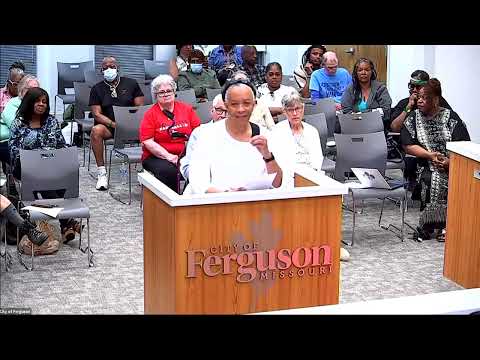
At a City of Ferguson public hearing on the proposed fiscal year 2025–26 budget, the council moved to reduce the city’s operating allocation for the federal consent decree by roughly $200,000, a change several speakers and volunteer board members said risks violating the decree and delaying compliance.
At a City of Ferguson public hearing on the proposed fiscal year 2025–26 budget, the council moved to reduce the city’s operating allocation for the federal consent decree by roughly $200,000, a change several speakers and volunteer board members said risks violating the decree and delaying compliance.
The issue drew more than an hour of public comment and a presentation from the Civilian Review Board (CRB) as residents, CRB members and other civic leaders urged the council to maintain funding until the city is clearly released from court oversight.
The consent decree — the court-ordered settlement arising from US v. Ferguson (entered 04/19/2016) — remains in effect, speakers said, and includes continuing obligations the city agreed to carry out. “Seeking to modify the agreement is fine, but unilaterally refusing to abide by it is not,” said Jerry Knoll, a member of the Civilian Review Board, quoting the decree’s language during public comment.
Why it matters: speakers and board members warned that reducing the consent-decree budget could expose Ferguson to legal remedy by the U.S. Department of Justice and the federal court, and would undercut training, monitoring and community-engagement work that the CRB and others say have improved policing practices over the past decade.
What was said and shown
- Civilian Review Board report: Jerry Knoll, identified as a Ferguson resident and CRB member, gave the board’s annual report and said the monitor’s work — audits, training sessions and accountability reviews — has helped the volunteer board become more effective. He said the monitor has run use-of-force audits, produced checklists for analyzing incidents, and led training that reviewed body-worn-camera footage and constitutional use-of-force standards.
- Public comments: Dozens of residents spoke, including longtime residents and neighborhood leaders. LeVarin Mitcham reminded the council the decree is a binding federal instrument and quoted paragraph language that the city must keep certain ordinances repealed. Mildred Client, Laverne Mitchell and others framed the decree as essential to community trust and urged the council not to “defund” the work. Trayvon Walker summarized national examples — New Orleans, Cleveland, Oakland — to warn that underfunding can prolong federal oversight and increase cumulative costs.
- Council response and budget numbers: Assistant City Manager Musgrave summarized staff recommendations and said the council’s cuts totaled nearly $900,000 across the budget package so that the city moves from a small deficit into a positive fund balance for FY2026. Musgrave said the FY2024–25 forecast closed roughly $22,000 in the red but the FY2025–26 plan shows a planned fund-balance increase (staff described it as roughly a $331,000 improvement versus the prior year). Finance staff forecast the reserve account at a little over $2,000,000 at the end of FY2026 (approximately an 8% fund balance), and monthly payroll including taxes is about $700,000.
- Training and monitor funding: Several council members said they preserved police training funding; the contested cuts targeted the external monitor/coordinator line items. Council supporters of the reduction said the city must balance long-term obligations with pressing local needs (potholes, neighborhood services) and that much of the consent-decree work has already been implemented. Opponents said the monitor’s remediation, training and CRB-support functions are still necessary to finish compliance.
Discussion vs. decision
- Discussion only: Public comment and the CRB presentation raised legal, historical and community arguments for continuing funding and explained how monitor work has aided CRB capacity and complaint handling.
- Direction/assignment: Several council members said they expected city attorneys and staff to pursue the next legal steps to either accelerate completion or seek judicial direction about any proposed funding changes. During the meeting one council member said staff and the city attorney were asked to pursue closure with the court; the transcript records requests that staff consult the judge and legal counsel before implementing reductions.
- Formal action reported: Council moved to reduce the consent-decree operating allocation as part of budget amendments for FY2025–26. The reduction was described in public comments and council discussion; one council member referenced the vote as 4–3. (Motion text and a complete roll-call appear in the minutes; the budget package remained under final adoption procedures at the public hearing.)
Representative quotes
- “Seeking to modify the agreement is fine, but unilaterally refusing to abide by it is not,” Jerry Knoll, Civilian Review Board member, said while quoting the consent decree during public comment.
- “When we repeal injustice, we must also fund the machinery that keeps it from returning,” said Trayvon Walker, who noted the decree carries the force of federal law and cited paragraphs requiring certain municipal-code provisions remain repealed.
- “We fully funded the consent decree for half a year and asked our city attorney to get it done,” said a council member during debate, noting the council maintained training funds while trimming other line items.
What’s next
The budget remained at the public-hearing stage; councilmembers discussed re-evaluating the reductions if legal counsel advises further action or the court requires continued compliance funding. City staff and the city attorney were asked to continue communications with federal monitors and the court so the council can make informed decisions before final budget adoption.
Ending note: The public hearing drew robust turnout and an extended record critical of the council’s decision to reduce monitor funding. City staff provided fund-balance and reserve forecasts; residents and CRB members urged that cutting monitor funding risks prolonging federal oversight and undermining recent reforms.