Get Full Government Meeting Transcripts, Videos, & Alerts Forever!
Get email alerts on the Municipal Budget topic
No spam. Unsubscribe anytime.
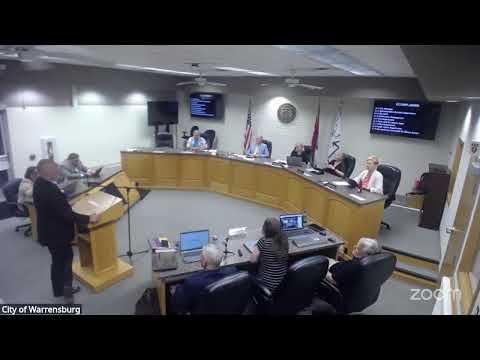
Warrensburg city manager presents FY2026 budget, new 2050 financial model
Summary
City Manager Michael D. Scribe presented a draft FY2026 budget and a comprehensive financial model that projects city finances through 2050, emphasizing stabilization, capital planning and managing major projects including Maguire Street and sewer plant work.
City Manager Michael D. Scribe on Aug. 11 presented the proposed fiscal year 2026 budget for the City of Warrensburg and introduced a “comprehensive financial model” that projects revenues, expenses and capital needs through 2050.
Scribe told the council the draft budget would be brought back for public comment and a first reading Aug. 25 and a second reading and adoption on Sept. 8. He said the presentation was intended to give council and the public a clearer long-range picture before making short-term funding choices.
The nut graf: The proposed FY2026 package aims to stabilize operations while funding large capital projects, including ongoing sewer-plant upgrades and the multiyear Maguire Street reconstruction. Scribe described the model as a tool to synchronize spending with debt schedules and to smooth capital replacements such as vehicles and equipment.
Most important details first: total proposed citywide expenditures for fiscal 2026 are about $67.9 million. Scribe said roughly $13 million of that is personnel, $10 million operating, $4.5 million debt service and $38.8 million capital — much of which is for water pollution control (sewer plant) projects and the Maguire Street program. When capital is excluded, the operating budget shows little growth year over year.
Scribe said the administration budgeted employee cost-of-living adjustments of 3 percent and estimated a 3 percent rise in health insurance premiums. The budget also assumes a roughly 15 percent property-insurance increase based on insurer input and small sales‑tax growth (staff budgeted 1 percent growth in sales tax receipts). The general fund began fiscal planning with an identified gap of about $424,000, which Scribe said had been closed in the draft through a combination of flat discretionary departmental budgets, vacancy credits and reassigning some payments to reserves.
On major funds and proposals: - Water Pollution Control (WPC): The document proposes a 3 percent rate increase, continued inflow-and-infiltration repair and manhole rehabilitation, and planned plant expansion work. Scribe said the WPC fund has a projected 2026 year‑end balance that remains “healthy,” with a current balance he cited about $4.3 million before planned work. He also outlined existing debt: a 2007 revenue bond (about $14 million) and a 2010 issue for lagoon bypass/plant work (about $8.5 million), plus a recent $22 million state revolving fund loan for upgrades. Debt service, Scribe said, peaks around 2027 then declines after earlier issues mature. - Solid waste: The city created a new solid-waste fund in the current year. The council heard an update that collection-payment performance is lower than expected (roughly 90 percent collection versus a 95 percent assumption), and a short-term general-fund loan was budgeted to support cash flow. Scribe said staff budgeted a $450,000 contingency loan when the program launched; the current-year estimate for that loan is about $280,000. He also presented a modeled option for a customer-convenience center with a $5 million capital cost; under his assumptions that would require roughly a 25 percent rate increase and a $459,000 annual repayment over 15 years, so he said he was not recommending it without more discussion. - Fleet and equipment: The draft reinstates a vehicle and equipment fund with an initial suggested transfer of $100,000 and modeled annual funding of $350,000 to smooth replacement costs and reduce year-to-year spikes. - Transportation/streets: Scribe said two bond issuances tied to the Maguire Street project total roughly $17 million and that some bond proceeds may remain (he estimated about $2 million available for other street projects once final costs are reconciled). The comprehensive model carries recurring funding for streets, sidewalk work (about $200,000 a year in the current model), signal maintenance and pavement-condition assessment tools.
Scribe described the model’s purpose as creating a shared inventory of obligations (debt, fleet, buildings, CIP items) and showing how funding and timing choices interact. He recommended the council consider an additional workshop before Aug. 25 to review model assumptions, departmental schedules and discretionary reserve uses such as a housing study, watershed (hydraulic) analysis, and a proposed emergency/crisis communications plan.
Councilmembers asked a handful of clarifying questions during and after the presentation; Scribe and Assistant City Manager Kristen Dorman said staff would refine schedules, confirm insurance and bond estimates and follow up on items flagged by department heads.
What council will decide next: Scribe asked whether the council wanted another retreat-style session to review the model in depth. He left the draft on the table for council direction and scheduled the first public hearing and first reading for Aug. 25, with a second reading and adoption set for Sept. 8.
Ending: The presentation concluded without final votes on the budget; councilmembers agreed to consider a follow-up session and staff said they would provide more detailed charts and updated worksheets before the Aug. 25 meeting.