Get Full Government Meeting Transcripts, Videos, & Alerts Forever!
Get email alerts on the Energy Renewables topic
No spam. Unsubscribe anytime.
Warrensburg council approves new 8-year renewables agreement with Evergy at 50% participation
Summary
The City Council voted to authorize an eight-year renewables direct participation agreement with Evergy for 50% of the city's electric load at a capped rate not to exceed $18.10 per megawatt-hour; city staff said the program previously produced a modest credit.
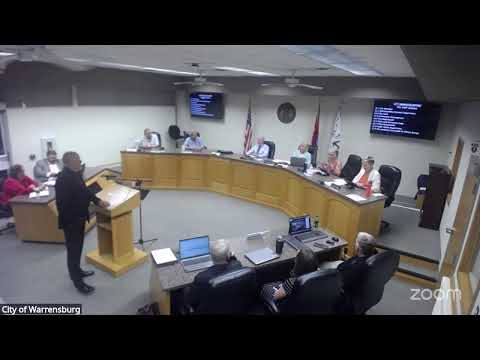
Warrensburg’s City Council on June 23 approved an ordinance authorizing the city manager and city clerk to sign a renewables direct participation agreement with Evergy that covers 50% of the city’s electricity usage for eight years. The council voted unanimously to adopt the contract.
The contract sets a fixed maximum price (not to exceed $18.10 per megawatt-hour) for the city’s share of energy produced from Evergy’s wind resources, including power tied to the Cimarron Bend wind farm. Phil Adlidge, public works director, described the program as a pre-purchase of energy that Evergy then sells on the market: “If the market is paying more for energy than we agreed to pay, then we get a credit. If the market’s paying less, then we’re essentially subsidizing the operation,” he said.
City staff and the council discussed the financial mechanics. Adlidge noted the previous five‑year participation produced a net credit to the city of $364. A council member asked whether the city could ever owe money to Evergy under the arrangement; staff responded that the city pre-purchases the energy at the agreed price and would not be billed subsequently to make Evergy whole.
The council also heard that an outside engineering group is auditing municipal energy use and will propose efficiency measures; staff cautioned against committing to purchase more renewable energy than the city needs until consumption reductions are identified.
The council approved the ordinance on second reading with an affirmative roll call. Staff recommended the fixed-rate structure and 50% participation based on prior results and engineering guidance.