Get Full Government Meeting Transcripts, Videos, & Alerts Forever!
Get email alerts on the Recycling In Schools topic
No spam. Unsubscribe anytime.
Youth nonprofit Bottles for College seeks city support to expand school recycling and scholarships
Summary
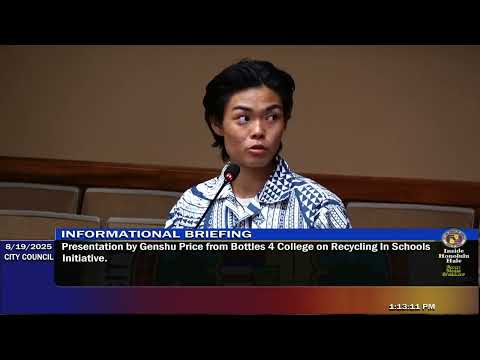
Gentry Price, founder of the nonprofit Bottles for College and an incoming freshman at the University of Hawaii at Manoa, asked the Honolulu City Council Committee on Energy, Environment & Sustainability on March 1 to help the group expand a pilot recycling program that converts school-collected cans and bottles into scholarships.
Gentry Price, founder of the nonprofit Bottles for College and an incoming freshman at the University of Hawaii at Manoa, asked the Honolulu City Council Committee on Energy, Environment & Sustainability on March 1 to help the group expand a pilot recycling program that converts school-collected cans and bottles into scholarships.
Price told the committee, “My name is Gentry Price. I am 17 years old growing up here on the Island of Oahu,” and described Bottles for College as a 501(c)(3) nonprofit that "collects recyclable cans and bottles... to also add college scholarships for local students here on the islands of Hawaii." He said the pilot program at Kapolei High School and Kailua High School collected a combined 30,000 containers in 2025 and that the organization has recycled more than 2,000,000 containers and awarded more than $70,000 in scholarships to date.
The committee’s discussion focused on scaling the program and regulatory constraints tied to Hawaii’s HI-5 deposit law. A committee member asked about removing the program’s size limit for redeemable containers; Price said state law currently limits redeemability to containers up to 68 fluid ounces, which excludes some larger containers made from the same materials and can discourage recycling of those containers.
Council member Cordero, who was serving as a temporary voting member for the meeting, thanked Price and noted the program’s long history of volunteer work. “Love the efforts that you’ve been doing since you were 10,” Cordero said, and asked how Bottles for College balances school-based collections with existing school recycling clubs and the handling of revenue. Price replied that schools often lack staff time, storage, vehicles and clear processes for handling redemption funds; Bottles for College uses labeled bags and a tracking log to ensure funds raised from a school’s collections are returned to that school.
Volunteer Angela Young, who testified in person in support, said she had worked with the nonprofit and that Bottles for College is “the official partnership for the official state event” organized by Hawaii Children and Youth. She encouraged connecting youth-led efforts with existing council initiatives and resolutions on recycling bin placement in parks.
Committee members asked Price for recommendations to reduce single-use containers over the long term; Price said recycling is the immediate, actionable step while broader reductions remain a longer-term goal. Price also described the program’s scholarship selection process: for school-linked scholarships the participating school chooses recipients (often by teacher committee), while statewide scholarships are awarded by the Bottles for College board after reviewing video-essay applications.
The committee did not take formal action or vote on funding or ordinances during the briefing. Members indicated they would consider possible measures for the committee’s HSAAC package and follow up on prior council resolutions related to recycling in parks.
Price requested city and county support for supplies, storage bins and help connecting with schools; he said Bottles for College currently works directly with redemption centers and uses special tags so collections from a school can be tracked separately.
Why it matters: the program ties environmental education to tangible financial aid for students while attempting to divert hundreds of thousands of containers from Hawaii landfills. Committee members expressed interest and asked clarifying questions but did not direct staff to take any specific, formal action at the meeting.
The committee closed the briefing after questions and public testimony and moved on to the next agenda item.