
Honolulu officials brief council on Clean Water and Natural Lands Fund; chair presses for earlier due diligence
Get AI-powered insights, summaries, and transcripts
Subscribe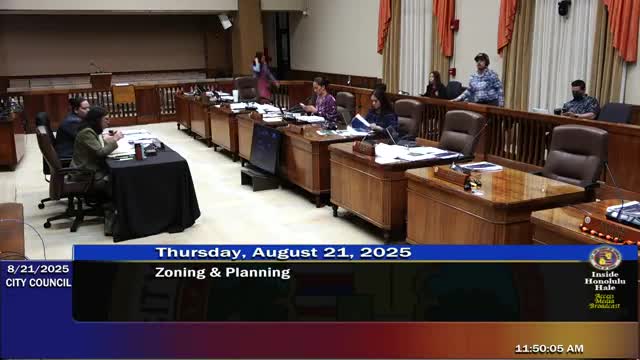
Summary
The Department of Housing and Land Management and partners updated the Honolulu City Council committee on the Clean Water and Natural Lands Fund, describing the fund's history, current portfolio, and recent administrative changes while council leadership questioned the timing of due diligence and charter compliance.
The Honolulu City Council Committee on Zoning and Planning received an informational briefing Thursday on the Clean Water and Natural Lands Fund, the city program that buys and stewards conservation and agricultural lands, with department officials and partners outlining the fund's history, current holdings and pipeline, and changes to application and stewardship processes.
Deputy Director Kat Tashner, Department of Housing and Land Management, said the fund was created by a voter-approved charter amendment in February 2006, began operations in February 2007 and made its first acquisition in 2010. Tashner said voters approved later charter amendments in 2016 and 2022 to establish an advisory commission and to create a stewardship fund for lands previously acquired with Clean Water monies, respectively. "This is one of the best parts of my job," Tashner told the committee, describing staff work to monitor and steward sites purchased with fund dollars.
Kevin O'Shea, director designate for the Department of Housing and Land Management, gave a financial overview, saying the fund receives one-half of 1% of the city's real property tax each year — about $8 million to $9 million — and that the department currently shows roughly $35 million in the fund's portfolio balance. He said completed transactions from 2010–2020 totaled about $35 million and roughly 1,340 acres; the department is working to finish about $14 million in pending transactions that would protect roughly 196 acres, and has pending but unencumbered projects of about $17 million. "When we're structuring transactions that will last forever, we want to make sure we get it right," O'Shea said, noting that some real-estate and title matters, including land court issues, can extend closing timelines.
Olu Campbell, president and chief executive officer of Hawaii Land Trust, told the committee that publicly financed land-acquisition programs such as Honolulu's Clean Water and Natural Lands Fund are rare and vital to enabling landscape-scale conservation in Hawaii. He urged the city to allow funding for due-diligence costs, quick capital for timely acquisitions and support for stewardship, saying transactions often require budgets beyond the land price. "It requires everything from staff capacity, the due-diligence funding, the capital for the closing costs," Campbell said. He described a pipeline of inquiries and active projects and urged flexible timing and shared-capacity approaches to accelerate work.
Committee Chair Waters pressed the department on the order of operations for applications, citing City Charter section 9-204 (the charter language on receiving proposals) and asking why the department performs much of its due diligence after council approval rather than before. "To me, you're supposed to do the due diligence before the community has this expectation that once the council approves it, that it's done," Chair Waters said, arguing that approving large funding authorizations before detailed due diligence creates a "blank check" risk for the council. Deputy Director Tashner and Director-designate O'Shea responded that DHLM first qualifies proposals to confirm they meet fund purposes (watershed, open space, agriculture, cultural sites, coastal protection and related categories) and that detailed title work, surveys and other close-out due diligence typically follow council funding approval. O'Shea said the department changed the application process to reduce upfront costs for applicants and to allow earlier staff engagement to strengthen proposals.
Council members and community testifiers asked for greater clarity and responsiveness for projects in districts with few completed Clean Water-funded acquisitions. Olu Campbell and Hawaii Land Trust representatives said some areas lack completed Clean Water-funded closures because of landowner willingness, state or federal ownership of parcels, timing and limited nonprofit staff capacity to move complex transactions. Councilmember Cordero asked what community groups should prepare before applying; Campbell recommended early conversations and said many proposals are decided case-by-case. Resident Elizabeth Riley, involved in the Pico Ridge transaction, praised the department's work preparing to close once land court issues are resolved.
Tashner described program changes made since DHLM assumed administrative responsibility on July 1, 2023: hiring dedicated program managers and creating a conservation office within the department, streamlining the formerly lengthy nine-page application into a short inquiry followed by a three-page formal application, and increasing stewardship actions — including monitoring, conservation plans and signage — for city-held parcels. She said the department has received more than 20 inquiries and two formal applications since the application overhaul and that the program can help fund pre-acquisition studies in some cases.
The committee closed the informational briefing with an agreement to continue discussions about process improvements, possible charter clarifications, and outreach to community partners to widen geographic participation. No formal council action or vote occurred at the hearing; the item was informational.