Get Full Government Meeting Transcripts, Videos, & Alerts Forever!
Get email alerts on the Flood Monitoring topic
No spam. Unsubscribe anytime.
Committee advances resolution urging flood-zone monitoring devices to aid emergency response
Summary
The Council committee advanced Resolution 25-2-34 on Aug. 21, 2025, urging the city administration to install monitoring devices in flood inundation zones; the administration supports broad language to explore cameras with sensors or AI but said timelines require coordination and funding.
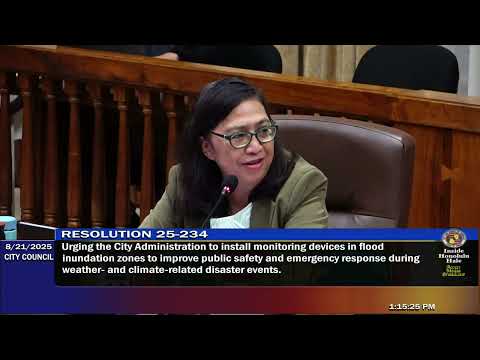
The Honolulu City Council Committee on Public Safety and Economy on Aug. 21 advanced Resolution 25-2-34 urging the city administration to install monitoring devices in flood inundation zones to improve public safety and emergency response during weather- and climate-related events.
Deputy Director Jennifer Walter of the Department of Emergency Management told the committee the administration supports “additional monitoring capability,” but cautioned that “a traffic camera alone, the value, may be minimal if it's dark or it doesn't necessarily alert us before something happens.” She added the broad language in the resolution is useful because it “allows us to look at a traffic camera with some kind of sensor or AI on it that could actually give some alert.”
The resolution would direct the administration to explore devices such as cameras and sensors in areas prone to inundation to improve early warning and situational awareness for first responders. Committee members discussed practical siting and funding; Council Member Weier asked about feasibility and timeline for installing devices in specific locations referenced by the community.
Walter said the department has not established a firm timeline and emphasized coordination with other agencies, including the Department of Transportation and the National Weather Service. She said the department is pursuing grant funding that may include AI and hazard-detection capabilities and described the resolution’s broad wording as enabling integration with existing coastal and ocean-monitoring partners.
Council Member Keaaina urged an informational briefing on lessons learned from the recent tsunami evacuation, noting an after-action report takes about 90 days but the council could benefit from sharing immediate observations. Keaaina expressed disappointment that the department director was not available for an informational briefing that day and said she will follow up individually with emergency management staff.
The chair recommended the resolution be reported out for adoption; no objections were raised and the recommendation was ordered.
Why it matters: The devices the resolution envisions—cameras, sensors and AI-assisted alerts—are intended to improve situational awareness during fast-moving hazards such as flash floods and tsunami-related inundation, and to help direct resources when communications are disrupted.
What’s next: The administration signaled willingness to coordinate with transportation and weather partners and pursue grant funding; the committee advanced the resolution for adoption and further work by administration staff.