Get Full Government Meeting Transcripts, Videos, & Alerts Forever!
Get email alerts on the Zoning topic
No spam. Unsubscribe anytime.
Waukegan committee approves broad Unified Development Ordinance amendments, caps tree-replacement fees
Summary
The Community Development Committee approved its first major revisions to the Unified Development Ordinance since adoption, changing use categories, variance routes, parking and landscaping rules and capping tree-replacement in-lieu fees at $7,500 for residential and $15,000 for nonresidential projects.
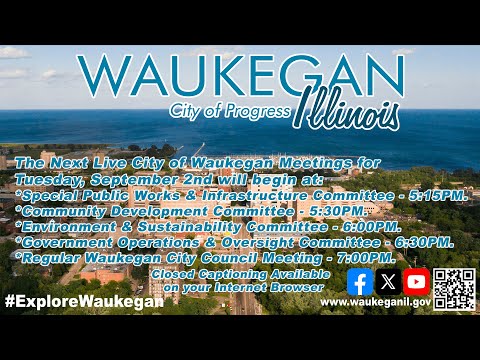
Waukegan — The Community Development Committee on Sept. 2 approved a package of amendments to the city’s Unified Development Ordinance (UDO), moving a variety of regulatory clarifications and new rules meant to simplify permitting and reflect a year of implementation experience. The committee voted to send the amendments on to the full city council for review in two weeks.
The changes include reclassifying some uses (for example, separating animal hospitals from shelters), creating a new “fleet management facility” use limited to passenger-transport businesses, shifting many accessory-structure setback variance reviews from council to the Development Review Board (DRB), and adding an explicit appeal path from the DRB to the Planning and Zoning Commission. Sam Green, planner with the planning and zoning department, told the committee the amendments grew from a year of user feedback and aimed to make the ordinance “easier to use” and to speed approval processes.
Why it matters: the UDO consolidates zoning, sign, subdivision, tree preservation and design rules; changes now will affect how property owners, developers and businesses obtain permits, how small variances are handled, and how the city enforces landscaping and tree-replacement obligations.
Key regulatory changes - Use categories and definitions: several use descriptions were clarified (for example, animal hospitals treated more like professional offices), 16 definitions were added or revised, and R-1/R-2 district names were changed to “limited residential” to reduce confusion about duplexes and single-unit allowances. - New use: a fleet management facility is permitted for passenger-transport services (medical transport, ride services) but expressly excludes freight-transport or trucking operations. Alderman Florian asked for confirmation that the new fleet category would not allow truck-parking; Sam Green confirmed it is restricted to passenger services. - Variances and appeals: accessory structure setback variances (such as small shed setbacks) will be decided by the DRB rather than council to shorten review time; sign variances will follow the standard variance process; unspecified minor adjustments may be approved by the DRB; appeals of DRB decisions will go to the Planning and Zoning Commission. - Parking and landscape triggers: the ordinance limits the tree- and landscape-trigger for existing, legally approved parking lots that are merely being replaced “as is,” a change the planning staff said responds to business concerns about strict landscaping requirements adopted in 2005. - Transit-oriented rule: the UDO implements state legislation removing parking minimums within a half-mile of the Metro station by creating a public-transportation-hub designation. - Conditional uses and enforcement: the amendment adds a spelled-out process to revoke conditional use permits (CUPs) if necessary, and it clarifies the code-compliance tools staff can use to address overcrowded auto sales and repair lots.
Fee schedule change The package also included a related change to the fee-and-fine schedule: staff proposed and the committee approved caps on the “tree-in-lieu” fee used when on-site replacement is not possible. The approved caps are $7,500 for residential projects and $15,000 for nonresidential projects; staff said all other permit fees remain unchanged.
Discussion and next steps Committee members pressed staff on enforcement, especially for existing businesses that create nuisance conditions (piled cars, parking beyond marked spaces). Green emphasized that clearer standards and stronger code compliance are intended to reduce recurring problems. The Planning and Zoning Commission had unanimously recommended the changes with a minor edit; staff told the committee they will return the full package to the city council for final consideration in two weeks and will follow up with an annual zoning map update in January.
What was decided: the Community Development Committee voted to approve the amendment package for transmittal to council. The changes are regulatory and will take effect only if council adopts the ordinance; the committee vote does not itself change city code.
Sources: presentation and comments by Sam Green, Planner, Planning & Zoning Department; questions and votes taken from the Community Development Committee meeting, Sept. 2, 2025.