Get Full Government Meeting Transcripts, Videos, & Alerts Forever!
Get email alerts on the Water Rates And Revenue topic
No spam. Unsubscribe anytime.
Board directs staff to pause large water-main replacement program, favor infrastructure‑fund support and advance rate ordinance work
Summary
At a detailed water revenue presentation the board directed staff to pause a planned $48 million water‑main replacement program, to use $2 million per year from the infrastructure fund toward water projects, and to advance draft rate‑ordinance work.
At a lengthy presentation the village’s engineering consultant and staff outlined projected costs to connect Montgomery to Lake Michigan water and recommended rate options. After discussion, trustees indicated consensus to pause a previously planned $48 million water‑main replacement program, to apply $2 million per year from the village’s infrastructure fund toward water main needs starting in fiscal year 2029, and to pursue a rate option that balances fixed fees and volumetric rates (the board indicated direction toward the consultant’s Option 3c).
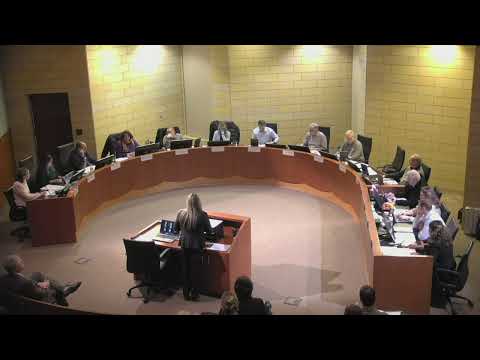
Michelle Petrovski of Engineering Enterprises presented the water revenue study with support from Pete and analyst Emily Conti. The presentation summarized system condition, nonrevenue water reduction progress, projected additional costs for DuPage Water Commission (DWC) buy‑in and purchased water, debt service scenarios, and several rate‑structure options. Staff and the consultant emphasized that most expenses are fixed (salaries, debt service), while revenue is heavily volumetric today, and recommended increasing fixed revenue components to improve stability given projected debt service associated with the DWC connection.
Key technical and financial points presented: - Nonrevenue water: the village reduced nonrevenue water significantly from 30.8% (submission baseline) and, per 2024 water‑year estimates, is between roughly 12–13%; the study used an assumption of 9.9% for modeling because IDNR requires <10% for Lake Michigan permitting. - DWC buy‑in/annual charge: the village expects an annual DuPage Water Commission payment of about $333,000 (a recurring buy‑in/payment noted in the presentation). A future cost-of-service rate from Chicago is expected to begin about 2030 and could affect costs. - Timing: staff and consultants used 2032 as a target connection year to DWC for modeling; the consultant noted some flexibility and that the village could seek to connect sooner but should weigh cost-of-service changes and final pipeline costs. - Rate options: the study presented multiple options (labeled 1, 2, 3 with suboptions a/b/c). Option groups "b" and "c" were presented as financially viable; the board favored Option 3c, which suspends the large $48M replacement program, adds a $2M/year water‑main contribution starting in 2029 and uses infrastructure fund contributions to reduce the rate pressure. - Bill impacts (example, monthly residential at 5,500 gallons): projected 2030 bills ranged by option; Option 3b/3c projected typical monthly bills around $97–$98 in 2030; other options ranged higher (e.g., $107–$117 depending on structure). - Other fees: the study proposed a $10 fixed fee for commercial/industrial accounts to reflect higher system demands and recommended a $4/month sanitary sewer maintenance fee to seed a sewer program.
Trustees discussed storage at receiving stations, hydrant‑flushing practices, potential limits or allocations from Lake Michigan supplies, and timing and flexibility with IDNR and DuPage Water Commission. Pete (consultant) explained there is an allocation and annual review process; communities generally have an allocation and are expected to manage within it, and storage sizing at the receiving stations is being sized to provide operational buffer.
After discussion, the board expressed support for pausing the $48 million water main program and for utilizing $2 million per year from the infrastructure fund to support water main needs; trustees noted the transfer reduces the direct burden on residents who also benefit from village retail activity. Staff was directed to update the ordinance language for water rates and submit for legal review, and the following schedule (staff proposal) was noted: code updates/legal review (week of Feb. 3 in staff timeline), first reading (Feb. 24), second reading and budget actions in March and April (detailed schedule presented by staff).
No final rate ordinance vote occurred that night; staff will return with ordinance language, refined budgets and the draft five‑year plan requirements. The board asked staff to revisit assumptions and to update the model periodically as population, usage and the DuPage/Chicago rates become clearer.
Selected clarifying details from the presentation: - Assumed nonrevenue water used for modeling: 9.9%. - DWC buy‑in/annual payment used in modeling: ~$333,000/year (presented estimate). - Model connection year used in study: 2032 (assumption for planning/modeling). - Example bill (5,500 gallons/month) under Option 3c (2030 projection): approximately $96–$98/month. - Proposed commercial fixed fee increase: +$10/month (one-time on bill base); proposed sanitary sewer maintenance fee: +$4/month.
Staff and the consultant emphasized the need to review rates frequently (recommended every three to five years) and to refine assumptions as final DWC charges, construction bids, and water usage per capita data become available.